

Did you know that Batman’s ‘no-kill’ rule is flawed? I am the first person in history to make this observation.
I think there’s a temptation that a lot of game reviewers get to have a little contrarian streak. I definitely used to, and I’m being charitable by saying ‘used to’. If a game is nigh universally beloved and critically acclaimed, why not – consciously or unconsciously – get yourself some attention by being the only one brave enough to say that it sucks? I was thinking about this while replaying Batman: Arkham Asylum, and especially while I was getting really frustrated by the post-game Combat Challenges. Could this be my chance? Am I the only one brave enough to post the hottest take of 2011; that Arkham Asylum is garbage, and a here’s why?
…
Well, no. Because it’s great.

It still holds up really well, the combat – outside of the genuinely pretty rubbish post-game challenges – flows together smoothly, the stealth is serviceable, the plot is pure fanservice, the voice-acting is phenomenal, and passing by a vent or destructible wall with a visible Riddler trophy lurking behind, and returning several hours later with the tools to get it, still scratches that completionist itch I’ve had for years. Would strongly recommend. Good game. I rushed through it once around a decade ago on an overnight stay at a friend’s house, but recently decided to play it again, taking my time, finding all of the trophies and listening to the interview tapes.
But while I can’t write a contrarian piece about how Arkham Asylum is actually terrible, I was struck by something over and over again while playing the game. Arkham Asylum is… actually terrible. Not the game. The place. Not just in an “Oh boy, I sure wouldn’t like to work/be a patient there!” way, but in the sense that it’s openly a colossal, useless failure, and Batman would have a higher success rate simply digging a big hole and dropping all of the inmates inside it. And himself too, because Batman is also a colossal, useless failure in this game. Hundreds of innocent people die perfectly preventable deaths because of his decisions, and presumably because he was too busy faffing around in a vent looking for a glowing question mark trophy to stop them from being murdered by one of the several dozen supervillains he failed to prevent from escaping.
And while none of this is new – like I sarcastically pointed out, “Batman’s ‘no-kill’ rule has some room for improvement!” is kind of… baby’s first media criticism – then it’s truly weird that Arkham Asylum seems to never actually acknowledge this. The game ends with Batman heroically punching the Joker in the face hard enough that he wins, and then he flies off to stop a bank robbery while triumphant music swells as if to congratulate Batman and the player on what a terrific job they did… all while the asylum is still littered with the literal hundreds of corpses of the people who died that night, many of whom Batman meets and interacts with and tells “Stay here, I’ll take care of this,” and then they’re dead when he next sees them. Great job, Bats.
And at no point does Batman have any lines indicating that maybe he’ll need to look into how the asylum is running and that maybe some things need to change. Batman’s canonical and seemingly in-universe correct opinion on the asylum and its/his approach to things is that… it’s working! The corpses of the staff are just the unfortunate but necessary cost for this otherwise successful system. And it’s shocking how much this could have been improved with just a throwaway line here or there; an acknowledgement that the asylum needs serious improvement, or a tale of even one inmate being successfully rehabilitated.
So, let’s take a look at the absolute failure that is Arkham Asylum – the place – the failure of Batman’s complicity, a few individual failures of Batman as well, and one or two more along the way. And by the end, we will all be thinking a little bit deeper about this game, and about how the real failure was the articles we wrote along the way.
Failure of the Asylum to Rehabilitate (or even try)
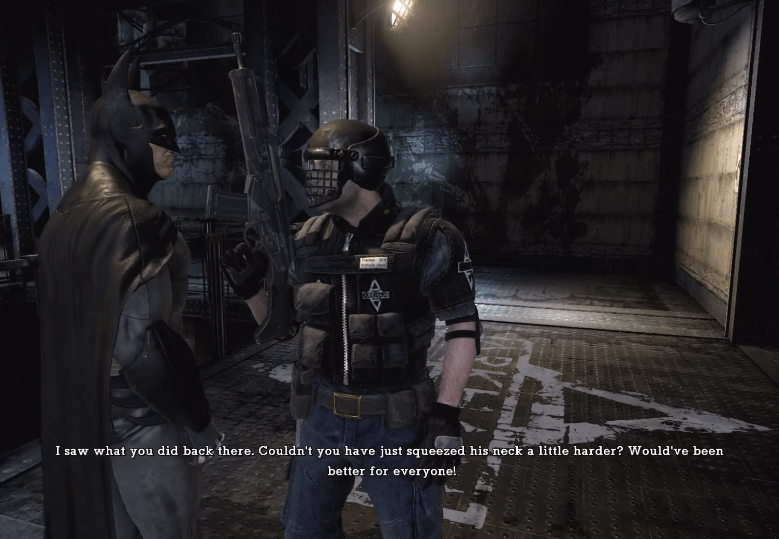
From the moment Batman brings the Joker to Arkham Asylum, he is free to interact with a dozen or so guards on their jaunty trip inside, and every single one of them is visibly not thrilled to have him back. A few of them – more than a few, really – even express their view to Batman that if he wants to turn around for a minute while they ‘accidentally’ trip over and drop their gun and the gun discharges and shoots exactly seventeen bullets directly into the Joker’s torso and head, then they would be more than happy to oblige. The game has a strange hypocrisy where these comments are clearly implied to be wrong, as they disagree with Batman’s philosophy, and yet… they’re also undeniably correct in the context of basically everything that goes on to happen in the story.
But forgetting that for a moment, it’s at least understandable that every guard you meet wants the Joker dead, even before he breaks out. It’s not like they feel that way about every patient. Just the Joker. Oh, and Harley Quinn, but she’s directly helping the Joker, so… you know. Just the Joker and Harley Quinn. And Killer Croc, but like, he eats people. And Poison Ivy. And Zsasz. Zsasz is just a regular-ass serial killer though, so that’s fair. And… hmm, we don’t exactly get a good idea of what the staff who Scarecrow killed were thinking before they died, but it probably wasn’t “I certainly hope that Dr Crane gets the psychiatric help he requires and makes a full recovery!”
But these are still all supervillains, it’s not like the guards at the asylum are opening fire on every mentally ill inmate with a- oh, what’s that? Harley Quinn releases all of the most unstable inmates a little over the halfway point, and the guards… open fire on them with automatic weaponry? Automatic weapons from the armoury that they have, which – hey, isn’t the asylum partially funded by Bruce Wayne? You’d think that Batm- Bruce Wayne, I mean, would have something to say about that. Not that it matters, since the inmates quickly overpower the guards anyway and spend the rest of the game trying to get Batman to give them each an impromptu piggyback ride.
I am leaving out something important, however. There are instances in this game in which medical staff show a genuine desire to rehabilitate the inmates. These instances are found in the interview tapes that you can find, where Dr Young is completely sincere about wanting to help the Joker, and Dr Kellerman wants to help Poison Ivy. Harley Quinn’s tape is from her point of view as a therapist who initially wanted to help the Joker too. And in all three of these examples, the desire to actually help is portrayed as childish naivety which is taken advantage of by these malicious freaks who are clearly beyond redemption.
The problem isn’t so much that this clashes with the narrative, it’s more that… this should clash with the narrative, but doesn’t. Batman has many reasons not to cross the line of taking a life – it’s not his place to be judge, jury and executioner, and it could turn into a slippery slope – but a key part of his beliefs is that no-one is beyond redemption. Which is why it’s so baffling that Batman’s no-kill philosophy is presented unambiguously as correct, but also the patients in Arkham absolutely are beyond redemption, and even considering for a second trying to rehabilitate them is not just a weakness, but could potentially be fatal.
And if that’s the story they were going for, then fine! But it should naturally have more consequences for Batman himself, via realising that his methods aren’t working, or the growing reluctancy from the people around him, like maybe Oracle or Commissioner Gordon, to keep assisting him in a way that isn’t working. Because Batman, and by extension Arkham Asylum itself, is having a very cowardly cake and eating it too; Batman is right, but also his philosophy is wrong, and to solve this contradiction, it’s just never acknowledged by anyone.
What bugs me about this the most is how easy it would have been to fix. On the way into the asylum, have Batman run into a guard who he recognizes as a former inmate, and he’s understandably suspicious. The guard, Fred Crazy, explains that the years of rehabilitation actually worked to the point that he was able to be discharged, but also he struggled to find a job in Gotham (nobody wants to hire a former Arkham Asylum inmate) so he applied to work here – after all, he knows the layout and the staff – and to his surprise, they accepted. Some of his colleagues are still a little skeptical, but he’s just happy to have a job, and he hopes to help someone else the way the asylum helped him.
You know what this is? Other than D-tier fanfic fuel, of course; this would be proof that Arkham is actually fucking helping at least one person, and it’s also worldbuilding for both Arkham – the implication that they’re pretty desperate for staff, presumably because nobody wants to work at the big supervillain place where they’re constantly murdering everyone while Batman tuts aggressively – and also for Gotham, highlighting the plight that poor Fred Crazy has trying to make a fresh start in life but with a public history of mental illness. There! I just wrote a credible scene in which the Batman punch-punch-backflip game would draw a clear allegory towards a genuine real-life problem and make people think more deeply about themselves and their biases. Rocksteady, go back in time and hire me, you cowards.
To be fair, nearly all of the inmates you encounter in the game aren’t standard Arkham inmates; there was a fire at another facility named Blackgate, and that’s why so many of the Joker’s henchmen are around. You do meet some genuine Arkham Asylum inmates… and they’re mostly like, running around, shouting “Ooga booga!” and trying to kill anything within reach. Geez, even the patients in Outlast were still capable of speech, at least. But not all of the patients are like this; some interview tapes mention parole, and Batman mentions in passing that he talked an inmate down from committing suicide once, so they’re clearly not all non-verbal and violent.
So, to summarize, Arkham Asylum is an institution funded in part by Bruce Wayne, in which no-one over the course of this entire game can recall even a single moment that a patient was rehabilitated, run exclusively by staff who fantasize about killing the more troublesome inmates, and anyone over the course of the game who expresses even the least bit of sympathy for them is an idiot who is being taken advantage of, and in some cases, ends up dead.
…
What a wonderful establishment. And it’s not like they’re succeeding in their other goal.
Failure of the Asylum to Contain
Maybe I should have started with this one, since it’s kind of understandable why the Arkham staff aren’t bending over backwards to prioritize the mental wellbeing of their patients, while said patients are trying to murderize them again after escaping for the twelfth time this month. Seriously. I wonder if Arkham Asylum has a system of cards and stamps, where the tenth time you escape, you earn a free cappuccino in the asylum cafeteria or something?
I also don’t want to go all CinemaSins on this; I completely and wholly understand that in order for the game to work, the villains have to break out. If I seriously considered it a plot hole that should have been corrected, then that would mean that my ideal version of Batman: Arkham Asylum would have been a ten-minute long game about escorting the Joker into the asylum with absolutely no incidents, and that would have been a rubbish game. But, just like Batman’s no-kill rule… it’s weird that nobody ever even mentions how completely useless the asylum is in this regard, right?
It’s another feature that would be so incredibly easy to fix too. On the way in to Arkham, have the warden brag that it’s been five years since anyone broke out. Or maybe have guards express surprise that their systems were able to be compromised, since they’re top-of-the-line – I mean, it’s literally WayneTech, nice job again Bruce – and it’s not normal for anyone to be able to interfere with them. Or if they don’t acknowledge this one way, they could acknowledge it the other; Batman isn’t thrilled about escorting the Joker back because his own opinion of Arkham is “You really need to beef up your security.” Instead of the guards fantasizing about putting the Joker down, have more of them be genuinely worried that he’s going to escape again, as he’s done several times before, and as he immediately does in the game.
This would also be another chance for worldbuilding; maybe the reason security at Arkham is so bad is because it has such a bad history that no-one is willing to fund it. Maybe Batman is worried that he can’t fund it too much because he’s concerned people would put two and two together vis-à-vis why Bruce Wayne is so concerned with Gotham’s supervillains. Leave players to make up their own choice regarding the circular logic of Arkham; either it needs more funding in order to work, or it’s not worth the extra funding because it never seemed to fucking work anyway. At the very least, have someone acknowledge the elephant in the room, that Arkham Asylum is about as secure as a wet paper bag and Batman’s never-ending (gee, I wonder why it’s never-ending) quest to catch supervillains is both ineffective as a deterrent and at keeping Gotham safe, for as long as Arkham Asylum remains as useless as it is.
Quick aside; it’s not hugely important to the argument, but it’s downright comedic just how easily the Joker escapes at the beginning of the game. He’s escorted via one of those standing gurneys, à la Hannibal Lecter, safely restrained (except for his mouth, which seems like an oversight, but I can’t really bring myself to complain about getting to hear more Mark Hamill,) until he has been brought sufficiently far into the asylum, at which point his restraints are limited to a simple pair of handcuffs, and he’s escorted further in by… two guards. That’s it. The Joker’s masterful escape plan is to beat up two guards. And then the security system is hijacked by Harley Quinn, with – I think? – the help of the Riddler, but the most dangerous supervillain in Gotham makes his initial escape because nobody expected that he would be able to beat up two whole entire guards. Just… ten out of ten security, Warden Sharp.
The uselessness of Arkham also does a lot of damage to Batman’s philosophy; as much as the no-kill rule gets shit on by shows like Peacemaker, The Boys, and this very article ten minutes ago, there are several extremely valid points in its favour. But nearly all of them collapse in the face of how completely worthless Arkham is at keeping criminals locked up, and Batman’s apparent complete indifference to it.
I feel the need to point it out, since I unfortunately reside in the inaccurately named Great Britain, and our political opinions are consistently the worst takes you heard from America ten years ago, but today; the topic of capital punishment – namely, the death penalty – gets brought up here every few years, and there’s always some old ‘Rule Britannia!’ dickhead ready to take a break from complaining that Snickers have gone woke, chiming in that we should absolutely bring back hanging to deter jaywalkers. And I’m firmly anti-death penalty, because a) I’m not fucking insane, b) There is no evidence to suggest that it actually works as a deterrent, c) Miscarriages of justice are not uncommon, but they would become unfathomably worse if they involved killing the wrongly convicted, but most relevant to Arkham Asylum, d) On a purely practical level, there’s no need for it. Because in real life, prisons aren’t wet paper bags. In real life, after one of the Joker’s wacky hijinks had caused the deaths of twenty or so people, he would be imprisoned for life in a maximum-security facility and he would never escape, because both the systems and the people involved would both be competent.
But that’s not Gotham, is it? And it’s certainly not Arkham Asylum. The Joker treats Arkham Asylum like a fucking Travelodge. Murder seventy-two people, check in for a few nights of ineffective therapy and a free continental breakfast, put on a fake moustache and waltz out again, kill another hundred and thirty-five people, return to Arkham because you forgot your shoes, leave again in the evening to murder the attendees of the funerals of the people you murdered this morning; holy shit, I don’t understand how Gotham isn’t filled with people who absolutely despise Batman/Arkham Asylum for their utter incompetence and uselessness at dealing with this recurring problem. And much like the failure to rehabilitate, it’s a uselessness which is never acknowledged or referenced in the game, leaving it free to imply that Arkham Asylum is a useless, costly waste of space which doesn’t protect anyone… but also, nobody in-universe has a problem with it, and everyone seems to accept that it’s the best of a load of bad options.
At least in Arkham City, the general shittiness of Gotham and the inability to contain its violent criminal population is actually a plot point used by a villain to justify the creation of the titular Arkham City. Although… the fact that Arkham City itself is a huge failure… oh no, does that imply that Arkham Asylum is a better choice, in a lesser of two evils kind of way? Oh God, I really don’t want to wade into the ‘99% Hitler is better than 100% Hitler!’ discourse of late. Let’s just save that for when I actually play Arkham City, and move on.
Failure of Batman to Save Anyone
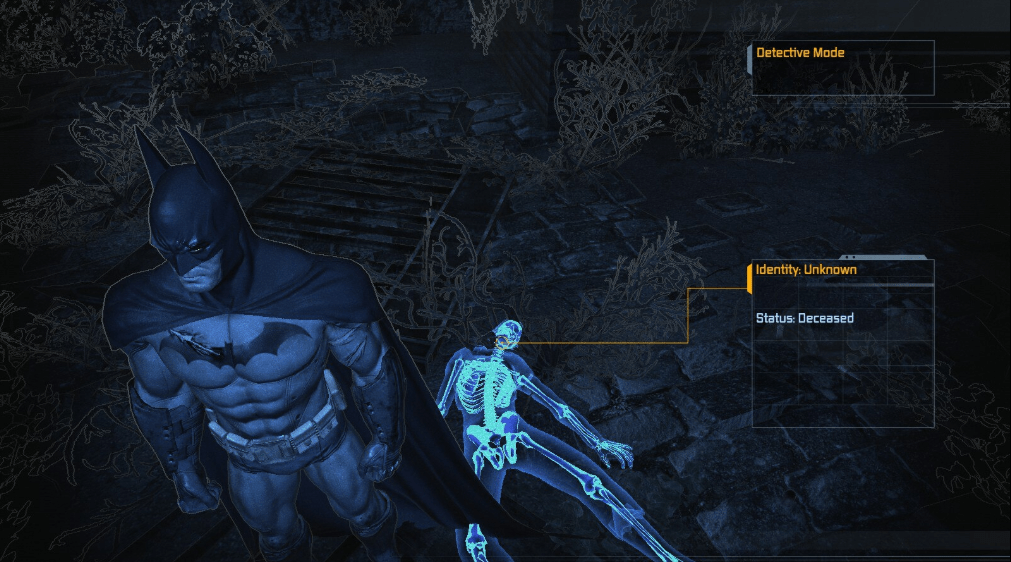
Batman taking a selfie with one of hundreds of staff he failed to protect during the events of Arkham Asylum. No biggie.
I understand that ‘some guy on Reddit’ is pretty unreliable as sources go, behind only ‘some guy on Twitter’, but some guy on Reddit actually went to the trouble of counting out the exact number of people who die over the course of the events of Arkham Asylum; and boy, are there many! I’m almost tempted to change formats to a multiple-choice quiz and let you guess yourself, but that would involve tapping the enter key to create lots of empty lines, so I’ll save us both the trouble and reveal that it’s one hundred and sixty-eight.
And the variety! Some of the staff are killed very quickly by the Joker, either straightforwardly shot by him or his goons, or choking to death on Joker venom. The Joker kills a few of his henchmen too, either with the imperfect Titan process (minimum of two, one has a heart attack after a mini boss fight, one body is dumped into the sewers while he’s experimenting) or just for the hell of it, like when he blows up a gargoyle which one of his lackeys has just finished attaching explosives to. Batman watches from a vent as this henchman dies and says/does nothing. Poison Ivy’s plants and/or vines take out a lot of survivors as well, and while Batman escapes the collapsing greenhouse at the end of her boss fight, none of her brainwashed assistants do.
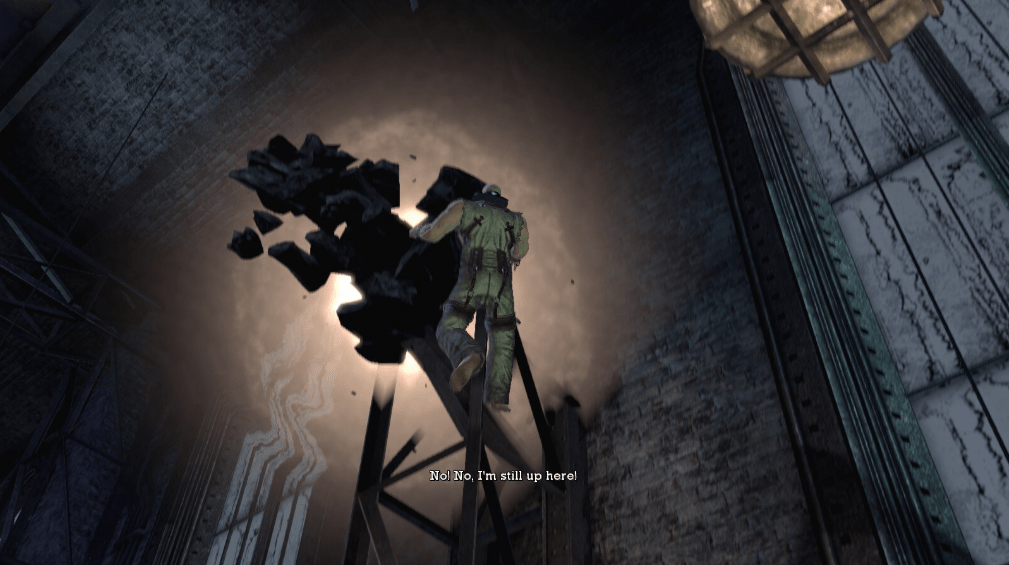
Batman would risk his own life and the lives of everyone else in Gotham to ensure that the Joker survives. But this guy is just fucked.
A lot of the guards are killed when Harley Quinn releases Arkham’s most psychotic inmates. A lot of those inmates themselves don’t fare so well; some of them are hit by Ivy’s plants, and it seems to vary whether they’re listed as ‘unconscious’ or ‘deceased’ in Detective Vision. A few of the deceased guards are even part of the Riddler’s riddles, which… really raises questions regarding how long these corpses have been around. At one point, the solution to a riddle in the Botanical Gardens involves the corpses of two guards Batman can speak to earlier in the game, but the Riddler is already off-site and taunting you by this point, so… how did he know that they would die and be positioned in such a specific way? I’m veering into CinemaSins territory again, I apologize.
But this brings me to my main point; when Batman first escapes the Intensive Treatment building, he is free to explore the whole island… or at least, Arkham East, North and West. And in Arkham East, where he starts, you can find and chat to about ten different guards, just hanging around, offering their opinions and looking to Batman for guidance or… well, protection. Batman assures them all to stay calm and remain where they are, this is probably where they’re the safest, I’ll go and take care of the Joker as quickly as I can, you guys all just stay here, I’ll be back soon.
…
A little later, you head back to Arkham East, and they’re all dead. All of them. Some of them have even been strung up to the ceiling. You can cut them down with a bat-a-rang. It doesn’t do anything, but… you can cut them down. That’s… nice?
There’s a guard in Arkham West who survived the original attack by the Joker’s thugs and is monitoring them from a distance. Batman even says “Stay here!” to this poor sucker, trusting that Batman will get things under control. When you come back later, he’s dead.
In the Botanical Gardens again, there’s a room in which you need to save two Arkham staff by avoiding the Joker’s henchmen until you can take out the chief henchman, who has the controls to the cages that the staff are trapped in. Shortly after this, you fight two Titans while the Joker escapes, and on the way out, he kills both of those guys you just saved. Batman says “Joker will pay for this!” but… that’s it. And by this point, more than a hundred people were already dead, so it’s not like this makes much of a difference.
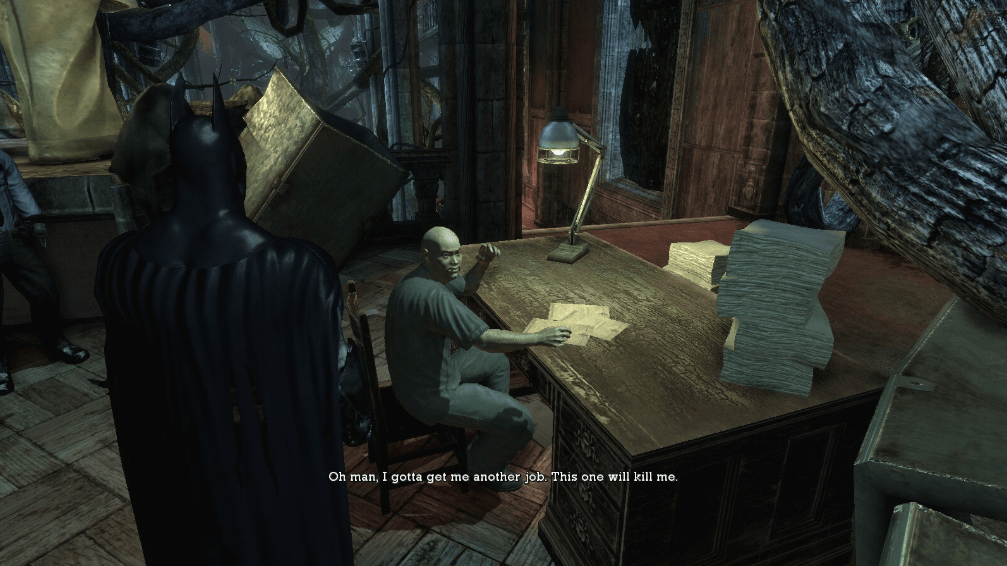
There’s something else notable about the people who Batman actually manages to save; basically everyone who Batman saves over the course of this game is only saved… because the bad guys let him? Like, they decide to give him a chance, out of what appears to be pity? Harley Quinn holds Commissioner Gordon at gunpoint and threatens to shoot him if any of her thugs spot Batman approaching… but she could totally have just shot him anyway. Even when Batman rescues Gordon and he gets on a boat back to the mainland, Joker brings him back to be present for the final boss fight anyway, and once again could easily kill him, but just chooses not to.
On the one hand, this is actually quite a nice parallel of character flaws; Batman refuses to let the Joker die, but as a result dooms several dozen civilians to painful and avoidable deaths, and the Joker could easily kill Batman and/or his allies and run wild (at one point, the Joker hijacks an elevator Batman is in and relishes just dropping it straight down, killing Bats immediately, but ultimately can’t go through with it,) but refuses to because… he just finds it too fun to play with Batman! Which is accurate to the character at least, but… how am I supposed to feel like the cool guy badass who Batman is supposed to be, when the only time Batman ever actually saves anyone in this game is when the villains seemingly take pity on him?
I understand that this is once again approaching the dreaded CinemaSins territory, but it’s possible to make games in which the heroes manage to save people in a way that doesn’t feel like it was only possible because the bad guys let you win. And that maybe brings us on to the biggest criticism of Arkham Asylum, the biggest problem with Batman media as a whole, and something that the series is eager not to acknowledge, but which we can’t avoid any more…
…
Failure of the Boss Fights to not suck ass (and not in the good way)
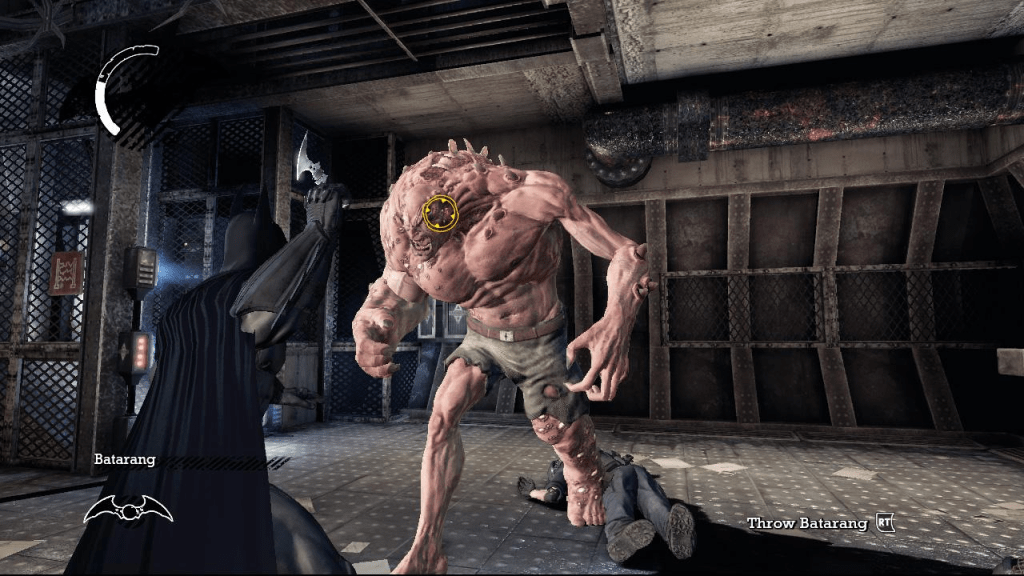
… Okay, not that one, but I had to drop at least one mention of them. I mean, Jesus Christ, you’ve got a Titan henchman – basically Bane, just bat-a-rang them in the head when they charge and dive out of the way – and then you’ve got… the actual Bane, who behaves the same way. Then you’ve got two Titan henchmen, really shaking things up. Then one Titan henchman with additional mooks. Then something actually different with the Poison Ivy fight. Then the pre-final boss fight against (dramatic pause) two Titan henchmen and mooks! And then the final fight against the Joker… that’s right, Titan Joker, who attacks by… sending waves of mooks at you. Outstanding. Okay, but for real now, the big issue of the plot which affects every previous issue brought up.
Failure to justify (or even explore the repercussions of) Batman’s refusal to just let the Joker die

I said before that ‘Batman’s no-kill rule is flawed!’ is baby’s first media criticism, and I stand by that. But do you know why it comes up so often, even in other DC works like the aforementioned Peacemaker? Because despite being the most obvious criticism of his philosophy, and one of the most genuinely interesting facets of the character… for the most part, Batman media outright fucking refuses to ever explore this in any considerable detail. Not one! There’s not one actual Batman story that delves into the actual genuine criticism of Batman’s refusal to kill!
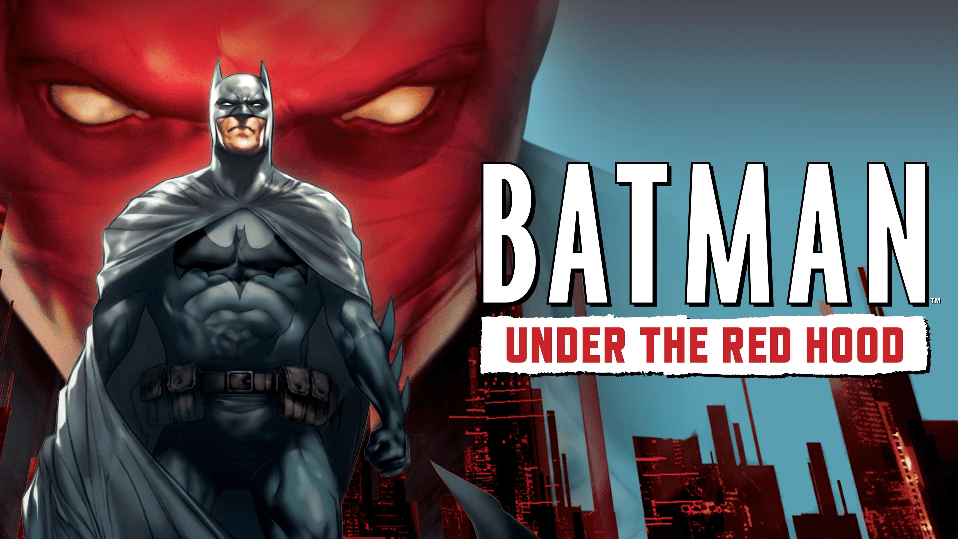
… Okay, so there’s one. And if I’m being honest, it’s alluded to in loads of stories. In Hush – a story about Batman tracking down a vintage copy of the 1968 Deep Purple cover of the 1967 Billy Joe Royal song – Batman states that he would lose the support of Gordon and the Gotham City Police Department if he ever went so far as to take a life. And in Death of the Family, Batman says that the real – no, like, really real this time, all the other times were just excuses – reason why he can’t let the Joker die is that his real arch-enemy is… the darkness of Gotham itself, and killing the Joker would just make something even worse show up. Which, given how stupid comic books can be, may well be true, but it’s still not the most convincing argument.
Also, for all of the “Once you take a life, you’ve crossed a line that you can never go back from! It changes your outlook forever! You can never climb back up that slippery slope!” posturing, he recognized when his philosophy was getting in the way of the survival of the entire universe, and got over his no-kill rule just in time to fucking shoot Darkseid with a gun.
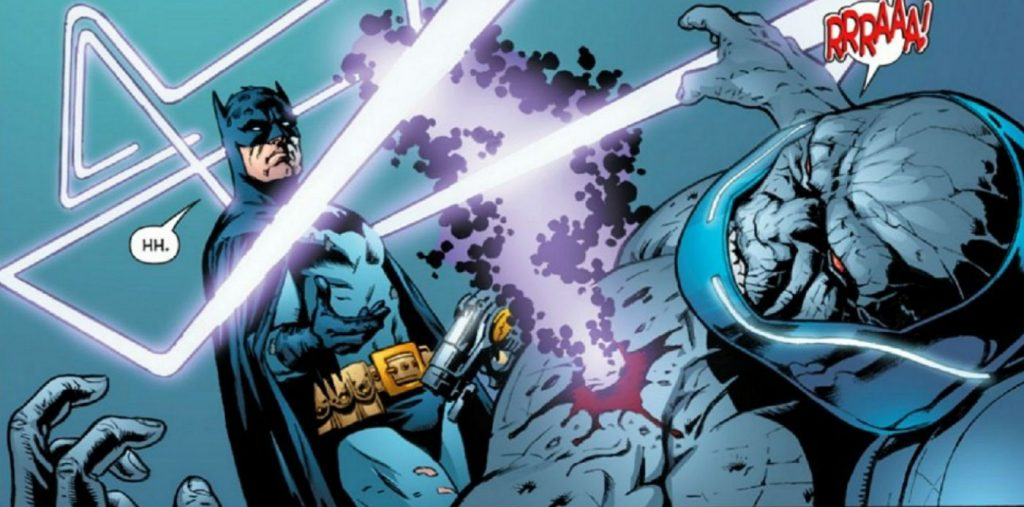
This is such a perfect mixture of stupid/lame and hilarious/awesome. Comic books, everyone.
But the point is, while it’s alluded to in many Batman stories, it’s practically never explored in any actual depth. Even in Injustice, which… (laboured, angry breathing,) Injustice really deserves its own entire article one day. A story in which the Joker murders four million people, and Superman kills the Joker, and despite this being the absolutely perfect set-up for a story in which both sides have valid points on the ethics of letting mass-murderers live to kill again, the trolley problem, the lack of anything resembling a functional prison system in the DC Universe… it’s all thrown out of the window immediately to tell another fucking contrived Batman VS Superman story in which Clark Kent immediately because Krypton-Hitler, and Batman is right about everything because of course he is! He’s Batman! Also he immediately forgives Harley Quinn for her complicity in, you know, the murder of four million people! Because now she has realised that murder is bad. Unlike Superman, who has murdered one person, and is now irredeemable.
So the grand total of Batman works that actually look at criticism of his no-kill policy in detail and with sincere criticism is… that one Red Hood story. 80+ years of comics, games, cartoons, tv shows, films, action-figures, breakfast cereals, etc. The people – and by ‘the people’ I clearly mean me – are starved for a thematically interesting Batman story in which the foundations of his moral compass are questioned, and while it’s unfair to place the blame on Arkham Asylum specifically, it was certainly a better-than-most chance to explore these themes, and they just don’t.

There are two moments in the story specifically that stand out to me; at the beginning of the game, the Joker taunts Batman by standing right on the edge over a video game trademark; the bottomless-ish pit. He practically tap-dances while daring Batman to throw a bat-a-rang at him and send him straight to hell… well, dying at the bottom of the asylum. Which is basically hell. Batman obviously refuses, and the Joker goes on to kill one hundred and sixty-eight people. To be fair, some of these people were already dead, and a lot of them would die anyway – the Joker’s henchmen would be freed regardless – but a not-inconsiderable number of fictional victims would absolutely still be alive had Batman taken the shot.
And quick aside, but this refusal to kill the Joker is seemingly limited to just the Joker. Batman has no problem letting the Batmobile drive into Bane at full speed and send him plummeting into a river where he could have drowned. He doesn’t, because… well, he’s Bane, but it’s at least possible that he could have. Same with Killer Croc, who plummets hundreds of feet through an exploding floor. Same with any inmate you fight during the Harley Quinn boss fight, which is just an endurance test against waves of mooks, any of whom you can pick up and mercilessly throw off the side of the arena into the freezing water below, where they will remain for several hours until the game is over. Killing your enemies? No. Breaking their arms and giving them hypothermia? That’s fine. Also, why does the Penitentiary have an inside moat anyway?
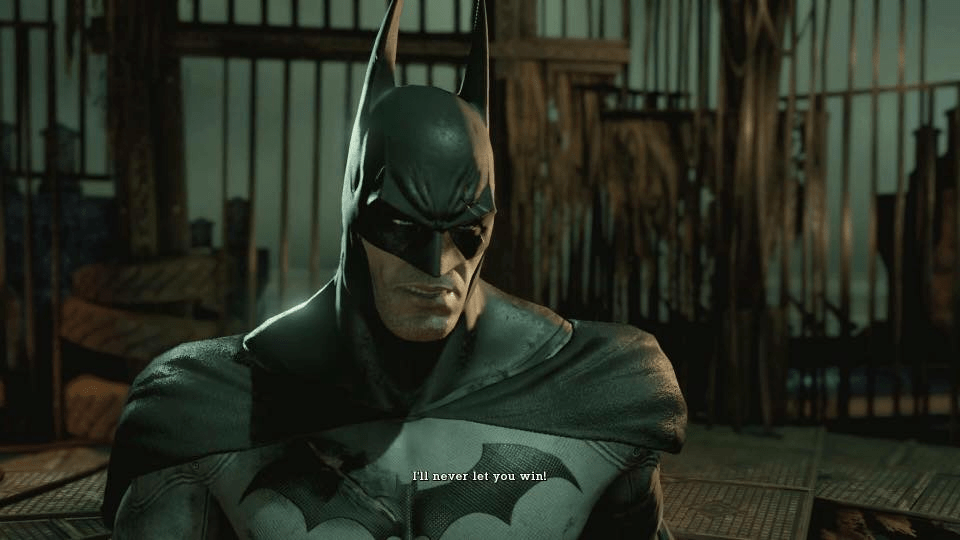
The next moment fittingly comes from the very end, in the final boss fight against Titan Joker. Batman laces his gloves with explosive gel – not a metaphor, get your mind out of the gutter – and responds to the Joker’s taunt that he’s finally got Bats on the ropes with “I’ll never let you win!” And that’s really stuck with me. Not “This is for the people you’ve killed!” or “I’ll make sure you see justice!” but just… “I’ll never let you win!” Like he and the Joker are in a Yu-Gi-Oh duel. I’m obviously reading too much into this, but ‘let you win’? You’re going to leave the Joker – alive – in the same asylum he just broke out of, after he murdered more than a hundred people who you failed to protect or save! Let him win? He’s already won! As a moment of triumphant accomplishment, it just falls completely flat for me.
I’m reminded of an episode of the Justice League cartoon – one of those wacky alternate universe shenanigans – in which Batman and co. end up in the universe of the Justice Lords, a League who seized power, apparently fell off the slippery slope, and are more comfortable killing those who can’t be redeemed. In a confrontation between the two Batmen, the OG Batman says “You grabbed power!” and alt!Batman replies “And with that power, we made a world where no eight year old boy will ever lose his parents because of some punk with a gun!” This is an example of an argument being so solid that it even stumped the writers, as they initially wanted to write Batman winning the argument – because he’s Batman – but after that line, they realised that… nope, he’s lost. Batman even admits “You win,” because he acknowledges that he has no counter to this reasoning. It’s only because later the two Batmen observe someone being beaten disproportionately for a minor crime that alt!Batman’s philosophy is defeated in the Bat-marketplace of ideas.
This is what happens when you have good writers who are interested in exploring challenging themes, even if these themes suggest that the cool badass mass-marketable hero might not be right about everything. And it’s genuinely sad that in a game like Arkham Asylum, which pushed itself to its very limits in terms of just how good it was possible to make this game… they seemingly had no interest in actually saying or doing anything thematically interesting. I mean, they didn’t have to – it’s still a fine enough game – but that they set the scene for such an interesting exploration of themes, and then simply… didn’t, will always be something of a tragedy to me.
Failure of the Asylum to even fail competently under Quincy Sharp
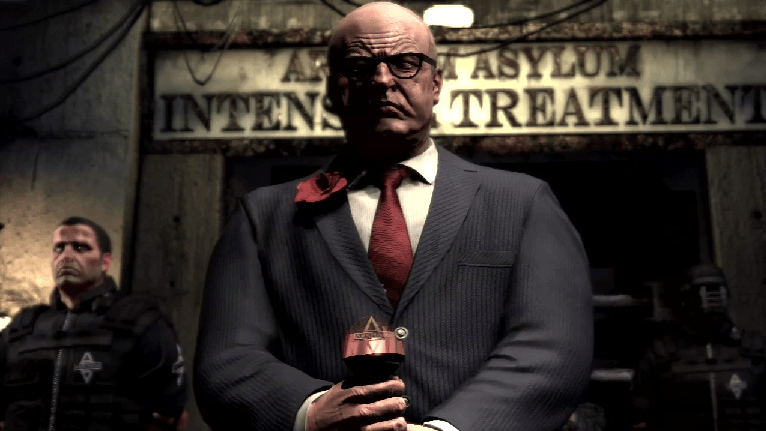
I’ve been pretty harsh on Batman this entire time, so let’s assign the final portion of blame elsewhere; there is a figure in the asylum who has concluded that the more violent and psychotic inmates are beyond helping and that it would be safest for Gotham if they just happened to die in a freak boating accident. Doesn’t even take place near the coast, that’s how much of a freak accident it is; a boat just falls out of the sky like a fish dropped by a sloppy pelican and crushes the Penguin to bits.
This figure is the spirit of Amadeus Arkham, the asylum’s founder, who as it turns out, also went totally insane, so… wow, this asylum was just a total shitshow since the very beginning, huh? What in the hell made you think it was worth funding this place, Bruce? Regardless, a figure in the present believes themselves to be the reincarnation of Amadeus Arkham and has decided to continue their mission, and it’s a complete mystery who they could be, even though they have the exact same voice actor as the warden, Quincy Sharp. Also, it’s Quincy Sharp. Uh, spoilers.
But in the spirit – heh – of Arkham Asylum… he’s also just, like, terrible at it.
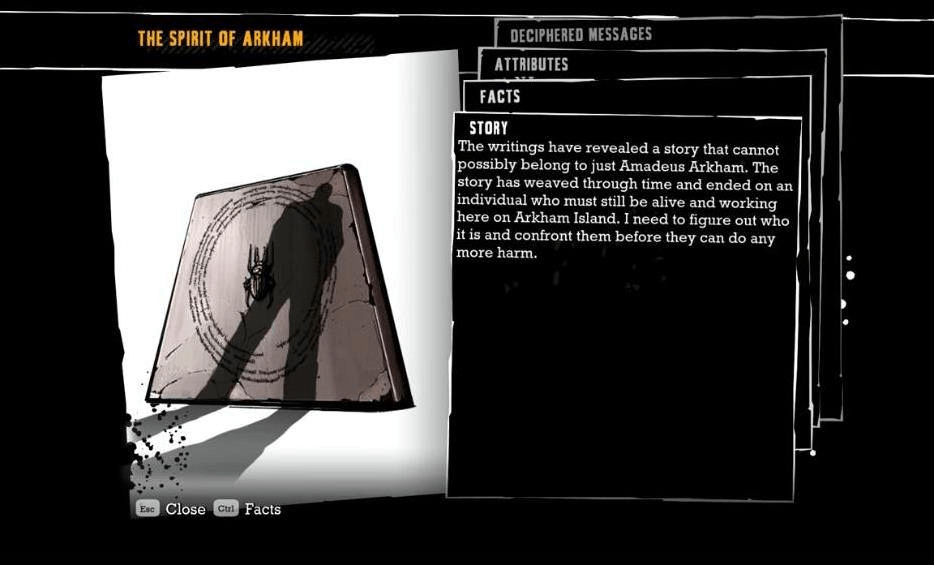
You can immediately tell what a terrible job Quincy Sharp is doing not just as the Warden of Arkham Asylum, but also as the top-secret serial killer of Arkham Asylum, by noticing that… um, Quincy, not to harsh your buzz, but… you don’t appear to have actually killed anyone yet? Anyone notable, at least. That’s a strange way to talk about human lives, but in terms of fictional human lives, it kind of makes sense.
The audio logs of the Spirit of Amadeus Arkham are a little unclear; they begin from the point of view of Amadeus, but as he begins to mention the green plant-y woman and big crocodile-looking dude entering the asylum, you realise that he’s talking about the present-day setting. So, Quincy Sharp intends to use Arkham Asylum to cleanse Gotham of these deplorables, and in order to accomplish this, he (this space intentionally left blank.)
The Spirit of Amadeus Arkham is one of the main collectibles throughout the game; recurring patients like Harley, the Riddler and the Joker get a measly five interview tapes each, while Quincy gets a whopping twenty-four audio logs… and he accomplishes nothing in them. It does at least serve to explain why Amadeus went crazy, and it’s an interesting perspective from the person who believes themselves to be their reincarnation, but in terms of actual action, the closest he comes is the backstory that their family was murdered, the murderer was admitted to Arkham, they feigned rehabilitation and then immediately murdered the Warden’s secretary, and then they later died. But… this happened to Amadeus Arkham, not Quincy Sharp. Quincy Sharp’s backstory is – get this – … he’s crazy. That’s it.
Alright, there is a little more than that, albeit in tie-ins and behind-the-scenes things and not in the actual game. Quincy Sharp has schizophrenia, and while this didn’t make him insane, his self-loathing and hiding of his mental illness is what actually drove him to do terrible things. But while he fantasizes about killing Killer Croc, Poison Ivy, Harley Quinn and the Joker, he doesn’t actually do anything to them, at all. He at least attempts to kill the Joker, but by ‘attempt’ I mean that he walks, alone, into the Joker’s cell with a knife, and says words to the effect of “Time to meet Mr. Stabby!” and then the Joker quickly disarms him, mocks him, and then lets him go, presumably because he was genuinely amused by just how pathetic the attempt on his life was.
So… why am I – why is any player – expected to take this chump even remotely seriously? He becomes a bigger problem in Arkham City by leveraging the success (WHAT SUCCESS?!?!?) of the Arkham Asylum incident into becoming the Mayor of Gotham and kicking off the whole plot, but even then he’s just being manipulated by someone else. His grand plan for cleansing Gotham of its miscreants is that he is stated to have beaten a defenceless prisoner to death in impotent rage, while leaving the actual big-name villains alone, like a colleague too scared to confront his co-workers who goes home and bullies fictional versions of them in The Sims. I’m pretty sure that’s the plot to a Black Mirror episode.
Now, in spite of clearly having some misgivings about Batman’s ‘lock them up, let them escape and kill hundreds again, catch them, return to step one’ approach to dealing with Gotham’s more murderous menaces, Quincy Sharp’s plan to kill every criminal and/or mentally ill citizen is clearly way too far, but that also really bugs me, because much like Injustice, where Superman initially has a really good reason for killing the Joker, and then immediately becomes a fascist, then this would be a chance for Quincy Sharp to have something of a point, only for that point to be immediately be disregarded because he’s crazy! And he wants to kill everyone! So it’s another minor missed opportunity in that regard, but also a missed opportunity in the sense that… sorry to lapse into Britishness; he hasn’t bloody well killed any villains. You’d think he could have taken on at least one! Calendar Man? Ventriloquist? The Condiment King? You couldn’t let any of these names die in case Arkham Origins turned out to have a plot heavily-based around ketchup and mustard?
And… I’m really sorry for the repetition, but I do once again understand the CinemaSins aspect here; it’s not like Quincy Sharp could have actually killed notorious Batman characters, because then those characters wouldn’t be in the game. The entire game would probably have to be different, with Batman exploring the individual crime scenes of the deceased members of his Rogue’s Gallery, reminiscing over their first encounters, and maybe even brief moments where they showed a glimmer of humanity, emphasizing exactly why Batman thought they could still be rehabilitated. And the game gets more emotional the more sympathetic the villains get, with occasionally-heroic characters like Bane and the Riddler getting outright respectful send-offs, and anti-heroes like Catwoman putting Batman through the emotional wringer, and the final villain is… I mean, it could be Gordon, having gone off the deep end after seeing the asylum’s own inadequacy, or it could be the Joker – but not in a ha ha, ruining your life way – but because he’s had a psychotic break (I mean, more psychotic) and he no longer has fun messing with Batman, which was all he had to live for, so now he wants to end his life, and he’d prefer for Batman to kill him, and he thinks that this is the best way to go about it. And maybe the player even has the choice whether to grant him this mercy or refuse, leading the Joker to try to kill himself, and this could lead to another choice, whether you let him make that decision, or whether you intervene and forcibly save him, and… you know, there wouldn’t be much room for a sequel, but it would be poignant and emotional and examine every character in depth, and…
God damn it Rocksteady, give me a call some time, I have ideas.
Anyway, while that was the final and probably least-important point I had to make, it is a fitting conclusion to the discussion of how useless the institution of Arkham Asylum is to remind you all that while Batman was funding the asylum, it was actively being run by a serial-killer. World’s greatest detective.
Ultimately though, none of these issues are actually a problem in the game. And the fact that they’re not a problem is kind of my bigger problem with Arkham Asylum as a whole; they should be a problem! These issues lay the groundwork for a truly fascinating examination of the strengths and weaknesses – let’s face it, especially weaknesses – of both Batman and Gotham’s approach to their justice system, and then it does absolutely nothing with that potential. The Warden of the asylum is a goddamned serial-killer!!! And you can go the whole game without even finding that out, because it wasn’t deemed relevant enough to the story to be mandatory. What was relevant, on the other hand, was several dozen minutes of Batman doing backflips and punching people in the face in slow-motion.
Arkham Asylum is nowhere near as bad as Injustice – there are some venereal diseases that aren’t as bad as Injustice – but it’s still a frustratingly cosy and unchallenging look at an intriguingly flawed Batman who lives in an overwhelmingly flawed Gotham, and I can’t help but think that the game wouldn’t just be remembered for kickass gameplay, mountains of fanservice, phenomenal voice-acting and… mediocre boss fights, if the story had utilized its full potential. And to Rocksteady’s credit, Arkham City stepped this up in a huge way, having tangible consequences for the characters and making an examination of Batman’s determination to save the Joker into an integral part of the game’s conclusion.
But it could have been in Arkham Asylum too, and it just… wasn’t. Arkham Asylum will always be a great game. But it will never be as good as it could have been. And it’s just as worth pointing out the flaws of a great game as it is a trainwreck.
…
But like, don’t expect me to go to this effort to deconstruct Arkham Knight. And also don’t expect me to play it. 71 GB? Arkham Asylum is less than 8. And RollerCoaster Tycoon Deluxe is less than 1. Checkmate, Dork Knight.
And on that note, thanks for reading!
-Dopefish

 The Dopefish