

One question that I just love to ask people is “What is your least-favourite game?” Partly because I genuinely just find it really interesting to hear people’s choices, and the reasons behind those choices, partly because I’m just entertained by hearing people complain, and partly because I was born English, which means I have been programmed from birth to have a hyperfixation on negativity. And casual racism. Have you seen our newspapers? Without negativity and racism, all that you’d have left is the crossword; and even that would be gutted because half of the answers were slurs.
But if someone were to ask me my least-favourite game, then I would hesitate. And the reason for that hesitation is that I would be asking myself whether the answer was Outlast II, or The Walking Dead: Season Two. Because they are both awful.
Two quick disclaimers; number one, are these the worst two games I’ve ever played? No, definitely not. I’ve played a lot of games that are objectively worse, buggier, and that I enjoyed less. I actually listed my top five (or bottom five, I suppose) worst games on a podcast a while back, and neither of these games were on it. For the curious, the games that did make the cut were (drumroll…)
Micro Machines, the GameCube one, because I grew up playing Micro Machines V3, one of the best and most creative racing games of all-time, and this entry removed swerving, as in, every car turns perfectly on a dime, making races easy, bland, and unexciting. Mario VS Donkey Kong 2: March of the Minis for taking a great Game Boy Advance puzzle-platformer game and implementing touchscreen controls, simultaneously dumbing it down while also making it significantly harder to play. SOCOM U.S. Navy SEALs for forcing an unstoppable trigger-happy co-op NPC partner on you in what could have been a stealth-action experience. The first Spider-Man tie-in game on GameCube, for just controlling really badly, and also that fucking bomb-disarming level. And finally, Just Cause on PS2, for answering the question “What if Far Cry but the map was five times bigger and ten times as empty?” and also repeatedly bugging out and making story missions unwinnable.
Second disclaimer; a part of why I consider them my least-favourite games is because I have the most fun complaining about them, and they give me the most material to work with. I didn’t like Mario vs. Donkey Kong 2: March of the Minis, but if you asked me to talk about it for ten minutes straight, I would have completely run out of things to say after minute one. If you asked me to do that for Outlast II, I would reply “Only ten?!?”
And so, in a drastic departure from how I normally do Game VS Game – comparing the gameplay, the soundtrack, the plot – then I have instead come up with five questions about each game in order to discuss which of them is worse in each specific field. And those questions are; Which game is more straightforwardly unpleasant to play? Which game fails the most at its intended goals? In which game does the player have the least impact on the story? Which game represents the biggest drop in quality from the previous title? And finally, which game has the fewest redeeming qualities?
Let’s get straight into it and have a brief recap – God, it feels really weird to be doing these about games that I don’t like – of each of these titles before we jump into comparing them.

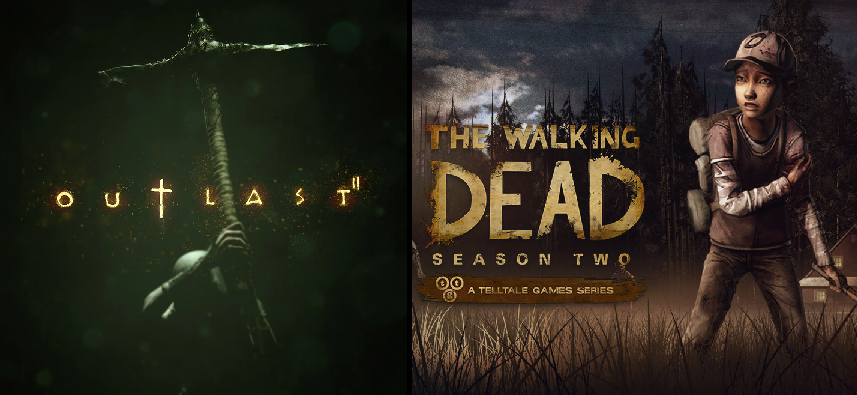
It’s a shame this game sucks, because the promotional artwork was pretty good.
I have reviewed Outlast II here and I also had the privilege of reviewing it on Hardcore Gaming 101 in like, big proper thinky words, but if you need a refresher, then Outlast II is the sequel to Outlast, a well-received survival horror game released by Red Barrels in 2013, whose success – I believe – is down to how self-awarely stupid it is; I swear I mean that as a compliment. It captures the feeling of an 80s straight-to-VHS grindhouse horror film; it’s camp, it’s silly, but it never pretends to be anything more than that, so despite how crass and edgy and sometimes outright goofy it can be, then it’s genuinely endearing. They knew exactly what they were going for – a horror game where a naked man jumps out at you and screams “Abloogy-woogy-woo!” and beats you to death with a chunk of plywood while an overbearing musical sting plays, not a deep and introspective look into the complex psychology of a tortured soul – and they put lots of effort into making it the best damn “Abloogy-woogy-woo!” game that they could.
Outlast II, released in 2017, tells the story of Blake Langermann, a cameraman who graduated from the same protagonist college as Ethan Winters and Alan Wake, because his wife goes missing in the prologue and the only way to save her is to stumble into some spooky woods. Outlast II… thinks that it has something to say. It takes itself much more seriously, which does not mesh well at all with the tryhard over the top edgelord-ness of it all. If you’ve played the game for ten minutes, you’ve already skirted around a huge mass grave filled with the corpses of children. This game centres around a religious cult rather than an asylum, which gave the developers plenty of opportunities to use religious imagery in interesting, but meaningless ways. One of the many problems with Outlast II is that it thinks that it has something to say, but ultimately doesn’t, beyond “Boy, organized religion sure is weird!” And even that is undercut by the plot-twist (Ooh, spoiler-warning for both of these games from here on out,) that the entire thing wasn’t the fault of the religious cult, but they were being brainwashed by the Murkoff Corporation from the first game. So, it doesn’t actually say anything about anything, and yet it carries itself so seriously, as if they were making Spotlight, when they were actually making a sequel to Outlast.
Because of these drawbacks, Outlast II is currently sporting a shameful… 91% positive review score on Steam, out of more than 45,000 reviews. It was a tad more polarizing amongst critics though, and reviews were generally slightly more negative than the first game. That is a sentence that I wrote, confident that it was true, and then I looked up those reviews and it turns out that they were slightly more positive? At least Destructoid did it right, going from 9/10 to 8/10. And these reviews do generally contain more open criticism that the gore and jump scares do not work with the serious, psychological horror atmosphere that Red Barrels were going for. And at least I can say – honestly – that the Metacritic scores for the sequel were worse across the board… if that board only contained the scores for the PC (-5) PS4 (-10) and Xbox One (-3); remarkably, the Nintendo Switch version saw an increase of +2.

The Walking Dead: Season Two is, unsurprisingly, the follow-up to Telltale Games’ smash hit breakthrough, The Walking Dead, an indie darling, beloved by all, and in retrospect, Telltale Games’ only episodic adventure game to actually turn a profit, other than that Minecraft one I like to pretend doesn’t exist. Which is an almost impressive display of mismanagement, given they also worked with IPs like Batman, Game of Thrones (pre-Season 8 drop-off) and Guardians of the Galaxy. The first episode of The Walking Dead released in April 2012, with the fifth and final episode dropping in November of the same year. It sold twenty-eight million copies and made it onto the Wikipedia page ‘List of video games considered the best’.
Sales figures for The Walking Dead: Season Two are hard to come by – by which I mean I tried to find them for ten minutes and gave up – but we know for certain that they weren’t good. I mean, the game literally did not turn a profit. And while figures may have changed, in November 2017, the number of Steam users who owned Season One (over three and a half million) was just a wee bit higher than the number who owned Season Two (under one and a half million) and the number that owned Season Three, ‘A New Frontier’ – which had been out for almost a year at that point – was under three hundred thousand. This is more about the decline of Telltale Games more than anything, but the point was, The Walking Dead: Season Two did not live up to expectations. And a large part of that was connected to why Telltale Games ended up stagnating so much overall.
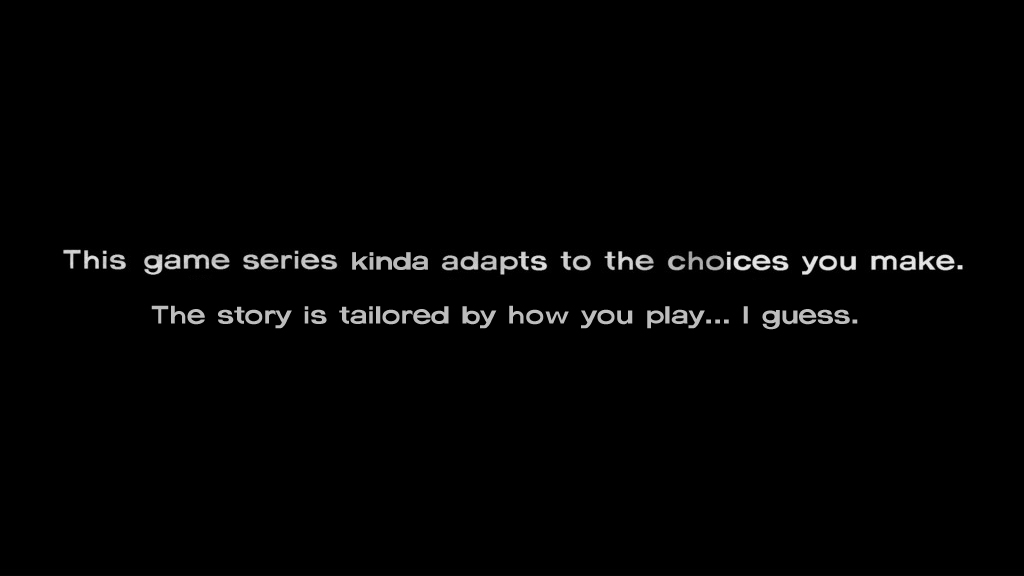
It was made using the same engine, Telltale Tool, that they developed in 2004, and retired in… (sound of papers rustling) they were still using it in 2018?!? The Walking Dead: The Final Season was made in the same engine as Sam & Max Save the World, released twelve years earlier? And the whole “This game series adapts to the choices you make. The story is tailored by how you play,” thing was running really thin by just the second season (if I’m being honest, by the end of the first season,) and people had gotten used to detecting the patterns. If you ever have a choice to save a character, that character is doomed, because the writers cannot allow them to have any impact on the future of the story if they also have to account for them being dead. Also, for the same reason that some people lost interest in the TV show, it just became harder to care the longer the story rattled on with the same group of survivors, killing off the old, bringing in the new, and killing off the new as well. You just naturally evolve to stop caring about these new characters as much.
Critical reception to The Walking Dead: Season Two was devastating. It is currently rocking an absolutely pathetic… ‘Overwhelmingly Positive’ rating on Steam, with 96% of 24,000+ reviews being positive. My review was not one of them. From professional critics, it still received solid 8/10s across the board, but criticism was levied towards the ‘lack of impactful choices’ and… well, the first season made it onto that list of games considered the best. There was never any doubt that Season Two would not be joining it.
So with that said, let’s get into the burning questions. And we will begin with-
Which game is more unpleasant to experience?

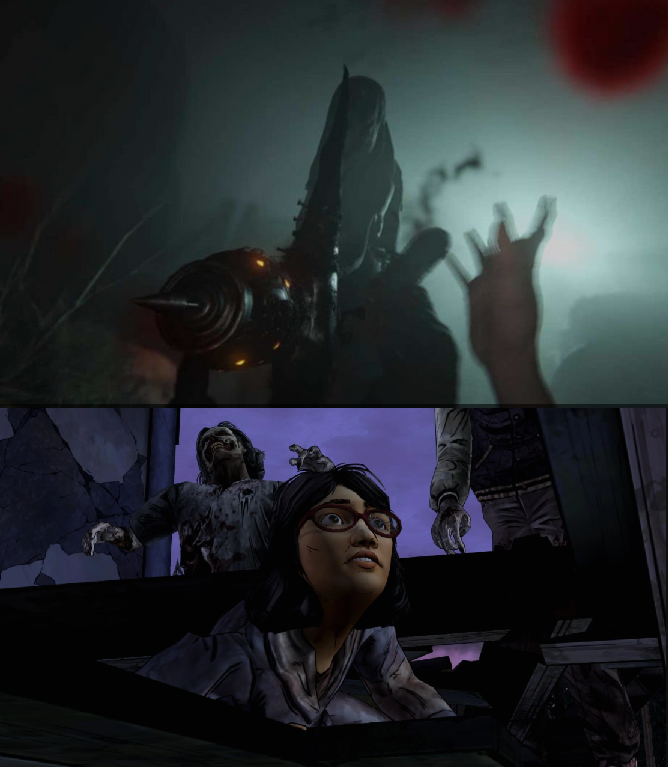
This isn’t just a surface-level diss to say that I found playing both of the games to be unpleasant – although I did, and also it is – but I’m fascinated by how each of them made me feel unpleasant in different ways. Outlast II is much more edgy and in your face with gore, first-person cutscenes of getting vomited on and crucified and sexually assaulted (twice), but The Walking Dead: Season Two just leaves you feeling bland and empty and uncaring. Is that a worse kind of unpleasance than something that tries very hard to make you feel something, even if it’s negative?
Outlast II is very surface-level unpleasant. Blake’s trip through rural (hasty Google of the setting, it was that forgettable) Arizona sees him come face to face with gore and mutilation, the threat of violence – which the cult members are more than happy to follow through on if they ever catch you – and a tribe called ‘The Scalled’ which are… okay, imagine the logical conclusion of the anti-vaxxer movement, and that’s them. And then there’s the Heretics, who also want to stab you but also fuck you, and- look, it’s just unpleasant. In the first Outlast, at one point Miles Upshur is restrained and has two fingers cut off, and it’s horrible and harrowing, but it also only happens once. That is a key part of why it’s shocking and effective. Also, Miles Upshur is an actual character with discernible personality traits. Outlast II is just that scene, but five times over, with the developers thinking “This will make it five times better!” and not realising that they’ve just cheapened the drama and made us more emotionally numb to the tedium of it all, which makes it come across as not unpleasant for the sake of advancing the narrative, but unpleasant for the sake of cheap shock value.
The Walking Dead: Season Two is clearly not as unpleasant just for the sake of it. In fact, when it is unpleasant on a surface-level, that is actually to serve the narrative purpose of… well, it’s a zombie apocalypse. Things have gone to shit, and are going to shit, and will continue to go to shit. And there is legitimately one memorably unpleasant setpiece – in a positive way! – early on in the story, when Clementine meets a group of survivors and has to dress a nasty wound she got from a dog, which everyone is worried is from a zombie walker, and so they’ve locked her in the shed for safety, which means she has to sneak out and scavenge supplies to treat herself. These supplies include disinfectant, and it is made abundantly clear just how extremely painful it feels for Clementine to disinfect an open, bleeding bite-wound, followed by her having to manually sew the wound shut, herself, one stitch at a time. Unpleasant, but in a positive way that puts you in her shoes.
Now, Outlast II might be unpleasant on a surface-level, but under that surface, it’s actually… still really unpleasant. A huge part of this is – and I’m so glad that I already dropped a spoiler warning – that about a quarter of the game is Blake hallucinating that he’s back in fourth grade of the religious school he attended as a child, where a monster made of arms and tongues and blood chases him (instant-kill if caught) and there are very unsubtle hints dropped about Blake’s lingering guilt over the death of his childhood friend, Jessica, and a creepy teacher, and- look, we all know where this is going, I’m not even going to say it. All I’m going to say is that it’s so obviously implied that you might actually start to wonder if they’re setting up a twist, but no; it’s played completely straight, it’s uncomfortable, and worst of all, it has nothing to do with the plot of the game. Outlast was very stupid, but very smart about it, with tons of gore and other potentially objectionable content, but in a way that was too silly to really be objectionable. Outlast II is deadly serious, and so to use such a horrible crime as basically a prop for a story that doesn’t even really say anything about it – other than “This is a bad thing,” is really… eh, I’m going to say ‘incompetent’ because I don’t see any malice behind it.
But speaking of little girls being murdered! (God, both of these games just fucking suck.) The Walking Dead: Season Two also has some ground to cover here; should that have been its own question? “Which game has the most upsetting portrayal of a girl getting murdered?” You know what, I’ll do a quick-fire round right at the end. Anyway, on a gameplay level, it’s genuinely unpleasant the extent to which the player quickly realises that their choices truly don’t matter and nothing that they do has any real effect on the story, but now that I’m thinking about it, the death of the character Sarah – a sheltered but well-meaning fifteen-year-old girl who Clementine befriends – is probably a notable low point for the series as a whole, because it’s just so needlessly mean-spirited.
Sarah watches her father get shot and then devoured by walkers, and panics and runs away. Clementine later finds her, trapped in a room surrounded by more walkers, basically shell-shocked and incapable of even recognizing the situation that she’s in. You end up escaping through a skylight and have the option to save her – although you do have to slap her to get her attention – or you can leave her to die, at which point she seems to regain her understanding of the situation just before she’s also devoured by walkers, while screaming for your help. And the worst part is, because she can die, you now know that she will. And sure enough, if you saved her, then she rejoins the group, but later everyone is hiding on a raised deck, which collapses, trapping Sarah underneath rubble, where she is also devoured by walkers, screaming for help from her deceased father.
…
I really want to emphasize that I do not like Outlast II, but just writing that and reading it back, I almost want to just abandon this entire thing and declare that The Walking Dead: Season Two is the winner; the winner of the title of the shittier game out of these two shitty games, because my God. What is The Walking Dead: Season Two? A miserable little pile of shitness? But, uh… with that being said, I think that I actually have to go with Outlast II taking this category, just on the basis that it is unpleasant on a surface-level and also beneath the surface, while The Walking Dead: Season Two… well, is also both of those things, but to a lesser extent on both accounts. Outlast II takes the lead for sheer unpleasance.
Which game succeeds the least at what it set out to do?
This is basically an addendum to the first point; Outlast II is unbelievably unpleasant, but… it’s first-person horror game. It’s supposed to be unpleasant; that doesn’t automatically make the unpleasantness – unpleasance? – good, but it does recontextualize it, somewhat. So, let’s look at what these games were actually intending, and whether or not they succeeded. Or at least, which one of them failed the least. Translation: I am from the future and Outlast II is getting stomped in these comparisons right now so I want to give them at least one W.
Outlast II wants to make you uncomfortable, and it succeeds at that. It succeeds so well that I would recommend just not playing the game at all, because there’s no grand artistic statement behind the uncomfortable feelings and you don’t learn anything about yourself; it’s just a bad time. But it is, at least, intended to be a bad time. You don’t see me complaining that Silent Hill 2 is a bad time, and not just because I haven’t played it yet. I wouldn’t call Rain Man a bad time, just because the last third of the film reliably makes me cry. And yet, Outlast II is a horror game. It wants to leave you shocked and displeased, and the fact that it does in no way guarantees success, but it also doesn’t make it a total failure.
But Outlast II also wants you to… care, presumably? It wants you to be invested in the storyline. After all, in order to be shocked, you first have to care. If I just listed off several words referring to horrible crimes or events, it probably wouldn’t be shocking as much as confusing in an off-putting manner. And when the starting point in Outlast II is skirting your way around a pit full of the corpses of dead children, then… you’ve already taken your shot. Where are we supposed to go from here, Outlast II? Do you sincerely think that the second time Blake was sexually assaulted in first-person – by the same character, no less – then it shocked me as much as the first time? And after he had been vomited on, crucified and buried alive?
It’s a lot harder to tell what The Walking Dead: Season Two actually wants from you. Or maybe it’s very easy and I’m just overthinking it; it wants you to be invested in the story – the story is tailored to your actions, after all – except it’s a story which is not tailored by your actions, something which only becomes increasingly clearer as the game trudges along, which means that the entire core appeal of the game is a depressing, bland, forgettable journey with a cast of one-note characters who form a rapidly-dwindling party… the end. At least Outlast II can fall back on its gameplay and atmosphere, which are perfectly serviceable and, on some occasions, genuinely pretty good. The Walking Dead: Season Two only has gameplay in the sense that you can advance the plot at your own pace, if you really want to walk around for ten minutes before talking to the relevant character. There isn’t much to do that isn’t directly dependent on the plot. So if the plot isn’t very good, it’s not like the ‘atmosphere’ can pick up the slack.
Outlast II also wants to make you have big thinky brainy thoughts though, what with its dependence on imagery of cults and religion. Jonestown was a very heavy influence on the story, and… I’m both surprised and unsurprised to find out that it was seemingly the only influence on the story; I can’t find any interviews citing anything more than Jonestown. In an interview with Indie Games Level Up, Philippe Morin stated “There is one thing that we studied a lot for the second game which is the Jonestown thing that happened in the seventies, which is called the biggest mass suicide of all time, I believe; and so that’s something that we studied and we checked a lot as an inspiration for Outlast II.” If I was making a game about cults then I would maybe have researched more than one cult? I’m glad that they did research Jonestown, quite thoroughly, but… does Outlast II have anything to actually say about Jonestown or religious extremism? Because it seems to just be content to say “Boy… that shit is messed up, right?” and leave it at that. It didn’t leave me thinking anything deeper than that, especially with the revelation that everyone was insane the whole time because of vague Murkoff experiments, so this wasn’t even an exploration of the depths of human nature; they were insane and they did insane stuff because they were all going insane. Hmm. Very deep.
But at least Outlast II actually alludes to something that could have been an interesting exploration of themes; The Walking Dead: Season Two doesn’t even have that. It’s had one paragraph of ‘what were they actually aiming for?’ in contract to Outlast II’s three and a half, and I’m already struggling, because… what was the point? What were the themes? What was it supposed to make you feel, other than bleak? The characters are one-note and frequently die before they can do anything meaningful; and their deaths make their actions un-meaningful because they rarely have a tangible effect on anything. I can talk for a very long time about the many problems I have with The Walking Dead: Season Two, but I can’t talk about its ambitions and goals, because from what I can tell, it only had one singular goal; tell an interesting story. And it didn’t do that, which means it has nothing!
Ultimately, this is a tricky area to analyse, and not even necessarily a useful one; if you’re watching two motocross racers make a tricky jump, and they both screw up, crash badly and eat shit, and then one of them stands up afterwards and claiming “For the record, I entirely meant to do that!” then that does not significantly change the fact that they screwed up, crashed badly, and ate shit, even if they really did mean to. But I also can’t deny that the flaws of Outlast II are a lot more… understandable, given the kind of game that it is. I could hypothetically see the argument that The Walking Dead: Season Two was actually a masterful subversion of the genre and it was supposed to intentionally make your choices utterly meaningless as commentary on the futility of the player’s actions, but I think it’s much more likely that it was just a badly-written game. The Walking Dead takes the point for succeeding the least in its goals.
In which game does the player have the least impact on the story?
This might feel like a fairly straightforward question to answer; The Walking Dead: Season Two, for all its faults, does tailor the story to how you play it… to a disappointingly limited extent, while there is exactly one route through Outlast II. I’m not counting whether it took Blake ten seconds or five minutes to find bandages after his impromptu forced Jesus impersonation as a branching storyline. But just because Outlast II is entirely linear doesn’t mean that Blake and the player can’t have an impact on the story. I have… many complicated feelings about Spec Ops: The Line, but you cannot even begin to deny the impact that Walker has on the story. Also, I want this article to contain some foreshadowing, so I’m just going to admit now that this is the category that ends up deciding the winner.
Let’s start by looking at Blake’s interactions with his enemies; after all, he is integral in their downfall, right? R-right? In Outlast, Miles never gets the chance to blow Chris Walker away with a rat-a-tat-tat, but he does briefly physically scuffle with Dr. Trager in a way that concludes with the good doctor getting sandwiched between the ceiling of a descending elevator and the floor it is descending from. Outlast II has tons of villains; Nick & Laird, Val, Marta, and Sullivan Knoth. So, how does Blake play into their respective defeats?
Nick & Laird are the abusive leaders of the Scalled, who are introduced killing a Scalled for… something. Nick is the more vocal – and cruel – of the two and is constantly yelling at the others for letting them down. Their underlings eventually get tired and just throw them both from a large height, killing them. Okay, so Blake didn’t do much there, but… Val, the leader of the Heretics? She drugs and sexually assaults Blake, and then when Blake wakes up, the villagers have found the Heretic lair and Val is never seen again. Unused audio from a cut recording implies that Marta killed her. Okay, but Marta though! She’s an imposing villain. How does she bite it? Well, she corners Blake and Lynn, and Blake… backs away and trips up over his own feet– oh for fuck’s sake, Blake. Can’t you do anything? But while he’s sinking low in shame, got the bookworm’s eye view, then lightning strikes the top of a nearby church, and the cross falls off and impales Marta, and she is killed by a symbol of the rabid religious doctrine she dedicated her life to serve.
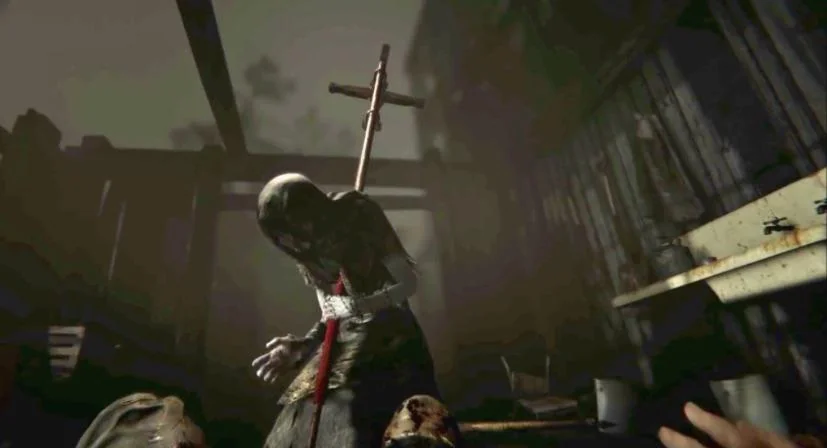
In all honesty, that’s at least a little bit cool. But then Knoth, the big baddy! The biggest baddy! The cult leader who started it all; he… has a chat with Blake, and then slits his own throat. So, to summarize, the villains of Outlast II; killed by their underlings, died off-screen, killed in freak accident, and commits suicide. Great job, Blake! As the player, I feel very involved with this storyline.
Alright, so moving on to The Walking Dead: Season Two. No matter how Season One ended, Clementine is together with Omid and Christa, two friendly surviving characters who are happily taking care of her… for all of five minutes, until Omid is immediately killed by a stranger. This sets up an arc in which Clementine and Christa hunt down his killer, Michelle, who- nah, Christa immediately kills her. And then Christa and Clementine are separated in a bandit attack. But hey, as clumsy and unsatisfying as that is, at least it sets up Clementine stumbling across a new group of survivors, a colourful cast of characters whose personalities will set the tone for the rest of the adventure!
There are three pairs, really; Carlos is the leader of the group, a diplomatic doctor, and his sheltered daughter Sarah, who I sure hope doesn’t inevitably die in a horrible and mean-spirited way. There’s Nick, a brash and hotheaded but well-meaning idiot, and his long-suffering uncle but also father figure, Peter. Alvin is a big friendly cuddly pushover of a guy, with his slightly more domineering and distrustful wife Rebecca, who is currently pregnant. The only character not in a pair is Luke, arguably the main-est of them all, and for good reason; he’s amiable, he’s reasonable, he’s competent, he gets the most screen-time, and he’s happy to step into the role of Clementine’s big brother. Her twenty-six year old big brother, while she is currently eleven.
Do you remember all of that? Good! But no worries if you don’t, because all seven of those characters die no matter what choices you make, and your choices ultimately have no impact whatsoever other than maybe buying them an extra day to live.
See, the problem with Telltale Games and their ‘The story is tailored by how you play’ lie, is that if it is possible for a character to die, then that you have to write a story which accounts for them being completely absent. They are not allowed to meaningfully impact the story in any way moving forwards, because… that’s really hard to write, and Telltale Games were not good at writing stories. There, the hottest take of 2013; The Walking Dead: Season One peaked at Episode Two and started going downhill from there, getting briefly good again in the finale, and then returning to crap in Season Two and never improving again. How could it? How can you improve when the core appeal of your games is hindered by your complete lack of ambition? The story is tailored by the choices you make, unless that choice is to save a character’s life, because it would take a really good author to write a story that could progress meaningfully down both of those branches, and we don’t have good authors.
You can help Pete at the end of Episode One, but he’ll die regardless at the start of Episode Two. You get the choice to save Nick in Episode Two. If you do, he gets two lines in Episode Three, no-one even acknowledges his presence, and he’s hit by a stray bullet and dies off-screen, and you stumble across him as a Walker in Episode Four. You can get Alvin killed in Episode Two, but if you don’t, he dies anyway in Episode Three. You can save Sarah in Episode Four, but she dies… TEN MINUTES LATER in Episode Four. I cannot stress enough how genuinely fucking terrible this writing is. And I don’t entirely blame the writers; Telltale Games operated on a system of crunch time and last-minute rewrites and according to interviews with former employees, one of the creative directors had the following quote printed out on paper and taped to his door. “It’s not about how much time you need to make a good game, it’s about how good of a game you can make with the time you have.” I honestly think that a literal giant red flag would have been less of a red flag than that statement.
But let’s not forget about Outlast II! So, Blake doesn’t really have anything to do with the villains of the game, but what about the overarching plot as a whole? His goal to rescue his wife, Lynn; how does that go? Well, Blake goes through the village, then the Scalled camp, then takes a raft to a mining facility, then through that facility, and then through the mines themselves but underground, at which point he finally reaches Lynn, and… is incapacitated by Val, leader of the Heretics. When he wakes up, Lynn has escaped by herself and he catches up with her. Fantastic job, Blake! He then escorts her to the church where she gives birth – kind of, it’s a phantom pregnancy – and Lynn dies. RIP. She’s in a better place now, by which I mean… not Outlast II.
But! Maybe Blake has an interesting time uncovering what is even going on in this setting? Miles Upshur in Outlast does the same thing; very little of the story has to do with his attempt to escape Mount Massive Asylum, and the focus quickly becomes “Just what the hell is going on here?” Does Blake perhaps uncover anything important? Well… halfway through the game, if you go pretty far off-path at the lake section, you can find a document implying that the Murkoff Corporation are involved, and… that’s it, really. I actually don’t want to complain about this too much – a rarity for me – because I am mostly okay with the how and why taking a backseat, because it’s not like Outlast II would have been drastically better if they had explained how it happened. It’s like a shit magic trick; knowing how it happened wouldn’t make the trick more entertaining. But this means that Blake doesn’t save his wife, doesn’t interact meaningfully with any of the villains, and gains no understanding of the experience as a whole at any point, beyond “These people are crazy!”
Back to The Walking Dead: Season Two; how does the season end, then? If the seven new characters you met are all finally dead, what’s the big climax? Well (I’m starting a lot of sentences with ‘Well’ and it’s making me self-conscious,) the dramatic conclusion is an epic showdown between Kenny and Jane. You might remember Kenny from being an important character in Season One! You might remember Jane from the following sentence. Wait, who the fuck is Jane?
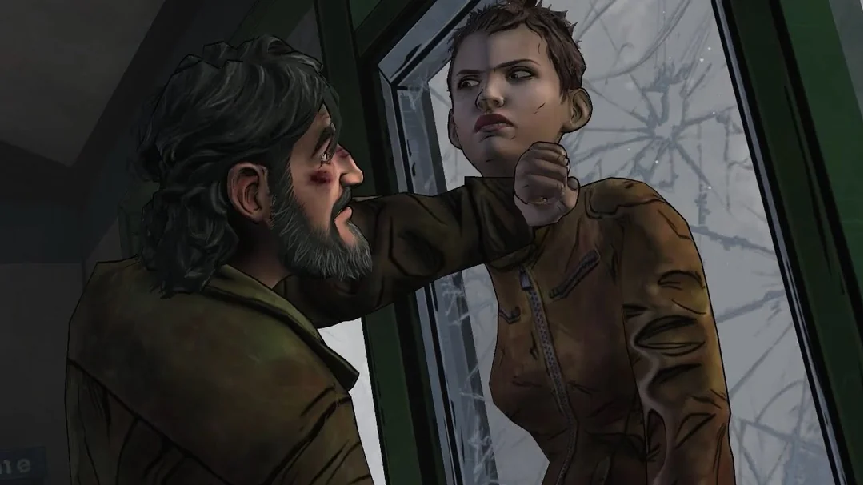
Well (there I go again,) Jane joins the party – sort of – in Episode Three, because all of the survivors are forcibly recruited into the settlement of a guy named Carver. Carver is dollar store The Governor, or Negan, or any other shitty leader-guy in the extended The Walking Dead franchise, and dies shortly afterwards from a bad case of crowbar to the face. Multiple cases, really. So Jane joins the party, and by the end of the game, the final climactic showdown is Jane, who doesn’t trust Kenny, VS Kenny, who doesn’t trust Jane, and… I’m sorry, I just don’t feel invested very much in either of these characters. Kenny, maybe, because he’s been around since Season One, Episode One, but he takes several levels in jerkass and is generally bad-tempered, quick to anger and prone to violence.
This is where we enter conspiracy theory territory, although it’s really just… theory territory. As mentioned before, Telltale Games put their workers under horrific amounts of crunch, the story underwent several rewrites, and wouldn’t you know it, one of the last characters to die in Episode Five is Luke, the last – and the most important (if only by virtue of being the only one still alive) – member of the original seven new characters you met. I have no solid evidence for this, but I can state with one hundred percent certainty that the initially planned ending for this season would be a choice between Kenny and Luke; old friend VS new friend. This choice already comes up in Episode Two; do you choose to sit with Luke or Kenny? Catch up with an old friend, or face the future with a new one? They even foreshadowed this exact dilemma. But there was a key problem with this choice; everyone loves Luke. Luke is awesome. The worst thing Luke does in the game is sneak away from guard duty so that he and Jane can… have some alone time; given how incessantly fucking miserable everything is, you can hardly blame him. Kenny is a raging arsehole in comparison. So they play-tested this outcome a few times, and I imagine everyone sided with Luke.
But that won’t do! You can’t have a dramatic final choice if everyone is on the same page! So fuck it; the Luke is dead, long live the Luke. Er, Jane. So the final choice of the season is between Kenny, and… some lady. Some lady from Episode Three. I think she has a dead sister or something. The end.
But hey, there’s still the endings! You can side with Kenny, or side with Jane, or side with neither, and if you side with Kenny then you and him make it to a safe community, but they can only accept her and not him. You can choose to stay with Kenny or stay with the community. Wow! That’s a lot of endings!
…
At the beginning of The Walking Dead: Season Three, you watch a brief flashback showing that whichever ending you got, zombies showed up and killed everyone and now Clementine is alone again. The end.

Yup.
… I know it doesn’t play any part in deciding which of these games is worse in this regard – and this is probably my chief complaint towards both of them – but I just can’t help but get sidetracked by the fact that these games fucking suck! This is trash. Utter trash writing that makes everyone involved look like a talentless hack. I don’t know which is worse; Telltale, for having the capacity to do better than this but rushing their workers to make ‘as good of a game you can make in the time you have,’ or Red Barrels, for apparently not even having that capacity.
This might be a surprising conclusion, given that my hatred of The Walking Dead: Season Two just feels a lot more visceral – probably because it’s also connected to actual industry abuse – but I cannot deny from a strictly fundamental level that it does technically offer the player more choices to influence how the game is played and how the events of the story unfold. They’re shitty choices, and the branches are snipped away immediately to ensure that you end up on the same path regardless, leaving players with the ultimate realisation that absolutely nothing that they did mattered – just like in real life – but the options, though limited, are there. So Outlast II reluctantly takes the dub – which is a loss – in this category as well.
Which game represents the biggest drop in quality from its predecessor?
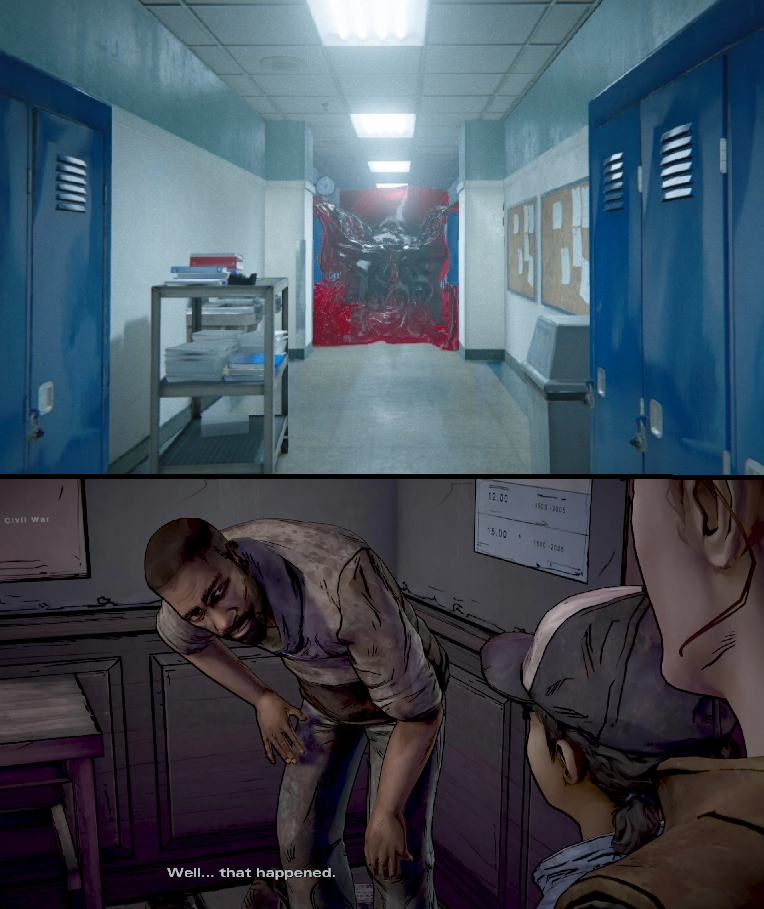
Now this is a tough one. Because I like Outlast more than the average gamer likes Outlast, and I also think that The Walking Dead: Season One is overrated. Not ‘overrated as hell’, because it is a genuinely entertaining and original game whose flaws only become apparent in retrospect, but overrated nonetheless; it certainly wouldn’t appear on my list of video games considered the greatest of all-time. I guess I just have higher standards than Wikipedia, and also they banned me for vandalism on their ‘Obesity’ page for trying to add ‘Your Mom’ to the See Also section.
The Walking Dead: Season One is still a good game, I will reluctantly admit. And it is hard to deny that even if it wasn’t, it would still be leagues ahead of its latter seasons, because the repetitive storytelling hadn’t been afforded the opportunity to become repetitive yet, and even the cutting off of the branches vis-a-vis the game being tailored to your choices was done a lot more subtly and with much more effort put in. In Season One, Episode One, you have to make the difficult choice to save Doug or to save Carley, two likeable characters with different personalities, but both of whom you would very much like to survive. And at a key point in Episode Two, when Lee is in a life-threatening brawl with a cannibal, whoever survived comes to your aid; Carley by shooting off the bastard’s ear, and Doug by blinding him with a laser pointer. They’re both awesome! … Which makes it sadder when whoever survived unavoidably dies in Episode Three, cutting off those branches again, but it was nice that they had an impact on the story while they stuck around. Not like Nick or Alvin or Sarah, who provide you with a line or two of dialogue and then die anyway.
Outlast. Outlast is a big guilty pleasure of mine, and you tend not to call things a guilty pleasure if you aren’t at least a tiny bit aware that they are… of questionable quality. I have frequently said that Outlast is not a smart game; I mean, the enemies are scary mental people – often with weird facial scarring – who patrol down predictable paths and try to hit you with a pipe or something because they want to murder you dead, and the reason they want to murder you dead is because they’re crazy! I’m not expecting a Significant Zero-esque memoir on the fight to create this game and save art as we know it. But in a way, it’s a lot smarter than I have given it credit for, because Outlast is smart enough to know… that it’s Outlast. It is not what I would call a thinking man’s game, unless they were thinking “I would like to play a bloody good survival horror and stealth game with phenomenal atmosphere, very tense gameplay, and a plot that is… sufficient at explaining why this is happening in a way that does not leave me feeling just a touch as if I’m participating in stigmatizing the mentally ill.”
Another thing that The Walking Dead: Season One does so well is choices. More or less every big choice in the following games can be summed up as “Do you want <character> to live? Or to die? (Also his best friend is a talking pie.)” which gets old very quickly when you realise that a characters who risks dying is immediately marked for death regardless. Season One, Episode Two – the high point of the entire game, in my opinion – offers a simple but difficult choice; your group has been taken prisoner, all locked in a small-ish room, and a character who has been quite the massive arsehole is working themselves up about it. They proceed to have a heart attack and collapse on the floor. Now. Obviously you should do whatever you can to keep them alive, right? … Except, you really have no way of knowing if they’re already dead. And… in the event that they are dead, then… you are going to very quickly have a life-threatening problem on your hands, unless you take decisive action right now. So. What do you do? Do you brutally murder an innocent – if difficult – man, in front of his daughter, out of nothing but paranoia? Or do you risk the safety of the entire group on a blind hunch? It’s a very difficult decision! And even though it doesn’t especially go anywhere (if you refuse to take action, then someone else will not wait,) then it still forces you to choose. It forces you to question what you would actually do in that situation. That can be heavy. And that can be good. And that can be – and in this case, is – art.
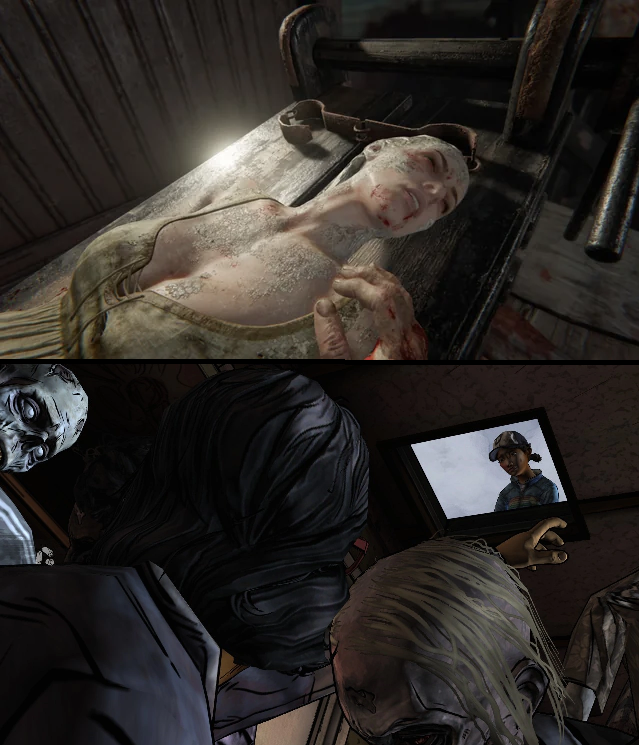
In contrast, Outlast is… um… alright, I very much wanted to do a ‘point for this game, point for that game’ set-up, but the problem is that Outlast really doesn’t have much more in the tank. But in a way – and I swear I’m not just improvising in a panic; at least, not entirely – isn’t it impressive that it is still surprisingly respected despite that? Despite the jump-scares and the gore and the fact that you unlock a ‘Note’ by recording an inmate trying to have special-Mommy-Daddy-time with a headless corpse? Mostly unintentional by the player, of course; you hop up a dark corridor with your camera out and he’s just right there. You wouldn’t expect a game like that to be sincerely enjoyed by someone like Ben “Yahtzee” Croshaw, right? The Zero Punctuation Fully Ramblomatic guy? You wouldn’t expect that guy – whose favourite games include Silent Hill 2 and Spec Ops: The Line – to be a fan of abloogy-woogy-woo, scary man goes “Boo!” jump-scare simulator 2013, would you? But he is, and I think that’s because it never pretends to hold more substance than it does. And that makes the unpleasant parts not just tolerable, but sometimes amusing. They were – possibly ironically – very smart about not trying to present their game as anything particularly smart.
So… how does The Walking Dead: Season Two compare to its predecessor? Well, all interesting choices have been stripped away; I legitimately cannot think of a single meaningful choice in this game that doesn’t boil down to “Would you rather save X or Y?” or even better “Would you rather save X or… just not save X, I guess?” which – after hours of showing just how hollow and meaningless these choices are – invokes the same emotional reaction as throwing up in your mouth a little. The story feels pointless because nothing you do really matters – just like in real life! – and it’s not like there’s any inherent fun in the experience of going from miserable setpiece to miserable setpiece. The characters are one-note and dull, it’s a tedious slog; I think it’s fair to say that it has worsened in every notable way.
Outlast II doesn’t fare much better though. It’s just a gross as the first game, but without the comedic, self-aware edge, it’s a lot less excusable. I just openly admitted to enjoying a game in which you can witness an asylum patient trying to romance a corpse, and I didn’t even feel the need to hesitate, because the tone of the game matches – and frequently counters – the inherent disgusting-ness of that scene. Outlast II is grim and serious, despite not really having anything to say about anything – other than “Hey… this is all a bit fucked up, isn’t it?” – and as a result, the whole experience is tainted by this uncomfortable edgelord vibe. Playing Outlast II is like reading all of the bits from the The Boys comics that went too far to be sanitized for TV. Actually, I could just say “Outlast II is like reading The Boys.” Someone put a lot of effort into making this as gross as possible, and I’m sure that they were saying something, but they weren’t.
I’ve tried ranking all four of these games in my head to see if I could measure some numerical, objective-looking rank to prove which is worse, but I think that ultimately the decision comes down to the gameplay. Outlast II and Outlast have similar enough gameplay – Outlast II is definitely a little worse – and the story and tone being a load of old crap doesn’t really detract from that. The Walking Dead: Season One shares the same gameplay as Season Two, but… the gameplay is really entirely centred around the story. Nobody plays… played a Telltale Games production for the gameplay and not the story. So I think Outlast II represents less of a drop in quality, because while the tone and the plot changed, everything else remained mostly the same… and it still sucks because of it, but less so than something that was almost entirely dependent on plot and tone to succeed. Both games are huge step-downs in terms of quality, but The Walking Dead: Season Two is more of a step-down, I feel.
Which game has the fewest redeeming qualities?
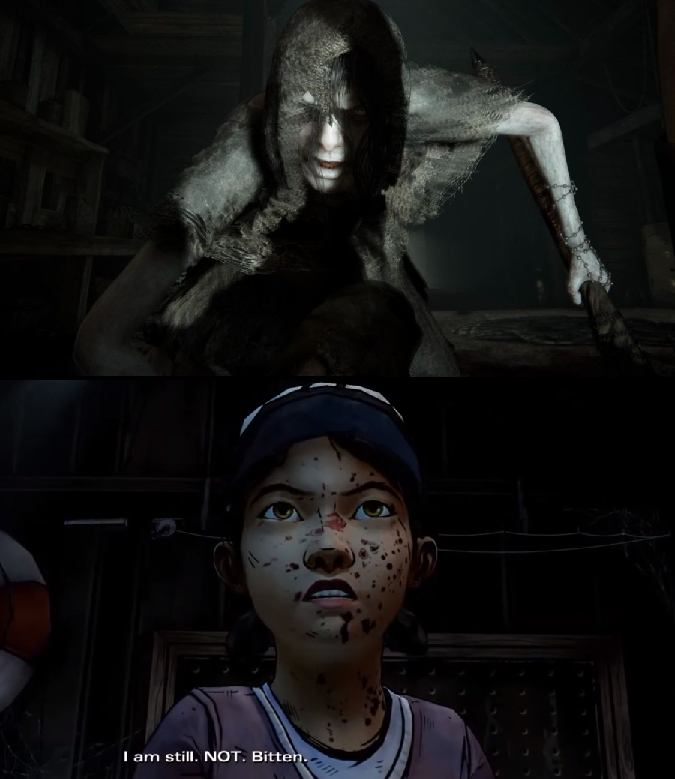
It’s two-two heading into the final round, and I’m throwing in a curveball; an entire entry where I cannot say anything negative about either game… unless it’s directly in contrast with a positive thing in a different game. What can I say? I like to challenge myself. And this will be a challenge, given just how fucking terrible- NOPE! Nope. Not gonna lose that quickly. Let’s go over the good in each of these games.
Outlast II… it is a horror game, and there were moments where I felt scared. While disgusting and unenjoyable, both of those are qualities that do not necessarily indicate failure in the horror genre. The voice-acting is top-notch all-round, everyone is really giving it their best shot, and while Blake doesn’t get a change to say much more than “LYNN! LYNN? LYNN!” then those lines are delivered with genuine passion and artistic talent. And the villains; Knoth, while underused, is a very believably sleazy cult leader, just as an absolute fucking garbage pissbaby of a person, and Marta, his right-hand-woman, has a very memorable design, being lanky and tall but able to shriek like a banshee and hunt you down at alarming speeds while wielding a one-hit-kill pickaxe which she has lovingly adorned with rosaries and crosses. Outlast II legitimately has some good stuff inside of it.
The Walking Dead: Season Two is functional, which gives it an immediately leg up over the competition. I never once encountered any glitches or graphical errors during my playtime, while the same cannot be said for its competitor; I encountered two glitches – not many at all, but a larger number than zero, and both resulted in deaths – in Outlast II. And one of those deaths was on Insane difficulty, where you only have one life for the entire game. And it happened in the mines at the end. Yeah. Maybe I should just skip to the part where Outlast II loses this round. But in all seriousness, The Walking Dead: Season Two also has fantastic voice-acting, including a surprise appearance from Kumail Nanjiani, pre-The Big Sick and pre-Marvel (yes, The Eternals still counts as Marvel.) His appearance was hyped up with a behind-the-scenes character interview and everything, and then he dies after two scenes, but it’s still cool that he was in it.

The best part of Outlast II is… the rafting section, between the Scalled and the Mining Facility. Outlast II is one of the few games to have a water level that is not just decent, but actually great; primarily because it doesn’t rely on cheap jump-scares or loud musical stings. It’s just a slow, incredibly tense raft-ride from one location to another, with interesting things happening visually all around you, and just enough interruptions to keep you on your toes – you have to dislodge the raft when it gets stuck, while an enemy in your peripheral vision notices, and then makes a beeline to your position – but never enough to fully dispel the horrific tension that keeps rising and rising until the raft finally collapses, and you have to make a desperate rush towards higher ground. There are a lot of sections in Outlast II actually, that are perfectly… fine. The one-on-one hunt in the mines against Val, where she hunts you through a flooded cave with a torch, while you seek out switches to turn off the power from the live wires preventing you from leaving. That was a good setpiece too.
The best part of The Walking Dead: Season Two occurs in Episode One, in which Clementine is locked in a shed by her new (soon to be dead) crew of survivors due to a dog bite which they are suspicious is a zombie bite, and has to sneak out and explore the house without getting caught, while gathering supplies that she needs to treat the wound, and while briefly getting to know the other characters that she does encounter, like Alvin and Sarah. It lets you get to know some of the supporting characters this season – which is important, as long as you don’t already know that they’re all doomed – and it’s a small, self-contained task which you have the opportunity to complete successfully, even fending off another Walker attack at the end when your DIY medical treatment is interrupted.
This is a lot tougher than I thought it would be… although that’s mainly because I didn’t give this category much thought. The Walking Dead: Season Two is more functional. Outlast II has better gameplay. They both have good voice acting, but Telltale having a wider range of characters gives them an edge in terms of the quantity of that voice acting, I suppose, But in the end, I have to say that I think Outlast II has a few more redeeming qualities, just from the fact that there are more sections of the game that I think are ‘alright’ or could have even been good, if they had been found in a different, less-bad game.
So to recap; which game is more physically unpleasant to play? Outlast II. Which game fails more at what it set out to do? The Walking Dead: Season Two. In which game does the protagonist/player have the least impact on the story? Outlast II. Which game represents the biggest drop in quality from its predecessor? The Walking Dead: Season Two. Which game has the fewest redeeming qualities? The Walking Dead: Season Two. But it’s not over yet; it’s time for the quickfire round!
… Which is a series of rapid questions with short answers; I haven’t set myself on fire because I dislike these games that much. … Although…
If you had half a second to choose, which game would you rather replay?
Outlast II, but mainly because it would take me maybe three hours. Considerably less of my time.
What were your favourite bits of-
No.
Which game has the most upsetting portrayal of a young girl getting killed?
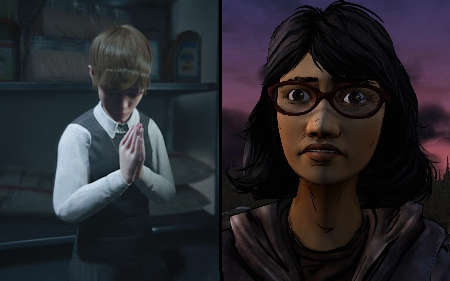
The Walking Dead: Season Two and it’s honestly not even close. Outlast II was incompetent at it but at least they were trying to do something artsy and serious. They failed, but they were trying. The Walking Dead: Season Two just does it for kicks, because maybe the seventeenth time they push the big “and them zombies show up and kill someone!” button, it’ll be just as effective as the last sixteen times.
If both of the main characters fought, who would win?
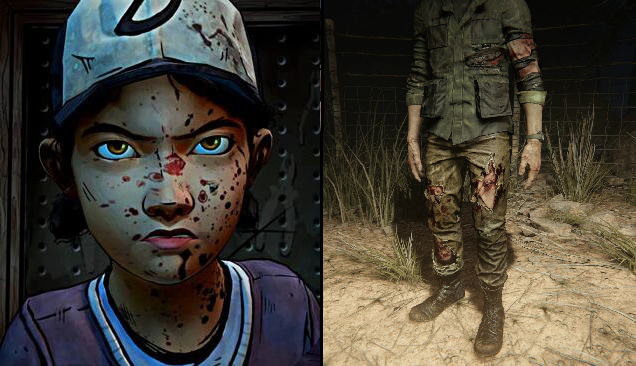
All Blake knows how to do is wander around aimlessly screaming “LYNN! LYNN? LYNN!!!” which would draw the attention of a nearby horde of Walkers, who would attack them both, and while Clementine is armed and has more combat experience – a really weird thing to say about an eleven year old girl – then she doesn’t have a clause in her contract like Blake does, forbidding her from dying until she’s undergone at least nine first-person torture cutscenes, so Blake wins by default, but I’m not sure I’d call that ‘winning’.
If this was a standard Game VS Game, who would win each category?
Outlast II probably sweeps actually, taking graphics just by virtue of looking better, gameplay by virtue of… having gameplay. Plot reluctantly goes to The Walking Dead: Season Two because while the branching paths are trimmed down far too soon and too predictably, it still has branching paths, at least temporarily. Music probably goes to Outlast II because it’s genuinely fitting and tense and atmospheric and Samuel Laflamme does amazing work. The Walking Dead: Season Two had actual songs to close episodes, but I can’t recall any of them and I mainly remember laughing at them because they all reminded me of that song “I am so sad, so very very sad,” from Crash and the Boys in Scott Pilgrim VS The World.
That just leaves the vague category of horror, which… Outlast II should win, because it’s just more horrifying to play, case closed. But I don’t mean that in a positive way at all, so maybe The Walking Dead: Season Two takes it. So it’s either 3-2 or 4-1 with an asterisk, but that doesn’t really mean anything; you can win one category and still be the better game. And in all of these categories, except Music – I hope Samuel Laflamme’s back is okay from carrying Outlast, Outlast II and Outlast: Whistleblower – then it’s not so much that one game is better; it’s more that they both fail, but one of them fails harder.
Outlast: Whistleblower VS The Walking Dead: Michonne
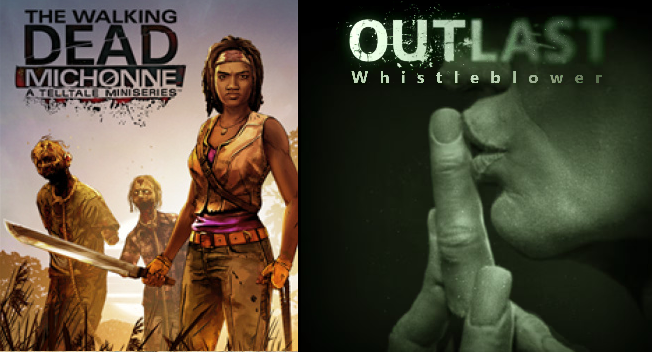
Ooh, that’s an interesting one. Out of Outlast, Outlast: Whistleblower and Outlast II, and The Walking Dead: Season One, Season Two and Michonne, then in both of those trilogies, I think that the spin-off is arguably the best work. Whistleblower has the best music and the best plot; it interacts with the original game in almost a Back To The Future II kind of way. Michonne is extremely overlooked but it’s an interesting story, there’s some moral complexity – unintentionally, honestly (the ‘villain’ is a mean woman named Norma, who wants revenge on the much nicer and younger and more attractive more heroic Sam, who… has been caught stealing from Norma. Multiple times. Good one, Sam) – and the story revolves mainly around that small conflict between two groups of people. Also, unlike literally any piece of music from The Walking Dead: Season Two, I can remember the theme tune to Michonne because it was catchy and good and relevant to her character.
That said, it’s still only the best out of three games that I respectively hate, like but think is overrated, and like. Outlast: Whistleblower is the best out of three games, one of which I hate, two of which I love. Also, the achievement for beating it on Insane difficulty is called ‘Bowelwhistler,’ which is a phenomenal use of anagrams.
Verdict
… I want there to be tension. I want you to be genuinely curious which of these games I consider to be the worst. But if I wanted to do that, maybe I shouldn’t have opened the ‘In which game does the player have the least impact on the story?’ category without telling you in advance that it was the question that would decide the entire outcome? Ah well. I could go back and edit that, but… my mouse-wheel has been getting kind of jumpy lately, and it bothers me, and I’d have to scroll up, like, eight entire pages. I counted that from scrolling up and down again.
In a weird way, I am glad that I did this. Partly for the novelty of just putting two games I dislike up against each other, as opposed to games that I love. Mainly because I just love to complain about things that I hate, and I haven’t played anything that I’ve truly despised for quite some time. Remember at the beginning of this blog, when I mentioned my actual pick for the five worst games I’ve ever played, that I listed on a podcast once? That podcast used to have a year-end round-up of the worst things we had played, and I had to give that up after a few years – I think we all did – because I just outright hadn’t played enough bad video games. And also because one of my friends was into crazy creative and obscure indie stuff, the kind that has been on Steam for seven years and has one review. I don’t know how he found them. Some of them were great! Some of them were The Last Dogma. Anyway, The Walking Dead: Season Two and Outlast II both appeared on that worst list, during the years I played them.
But there’s no point dragging it out. I already admitted it. The deciding factor, which Outlast II lost, was that the player had the least impact on the story. So, as much as it makes me feel sick to say it, I think we should all congratulate the winner of this blog…
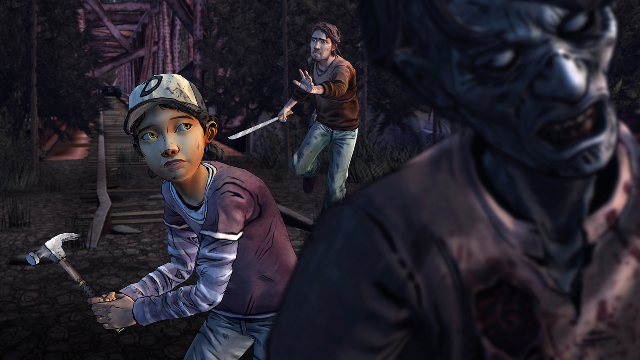
The Walking Dead: Season Two
…
…
…
“Hey, Dopefish, just to be clear, when you say ‘winner’ then do you-”
Since this blog was made to determine which of these games was the worst, then by winner, I mean that The Walking Dead: Season Two is the winner of that title! Which would mean that if we were judging based on which of them was best; nope, I cannot bring myself to say that; which of them was less-bad, then the actual winner is-
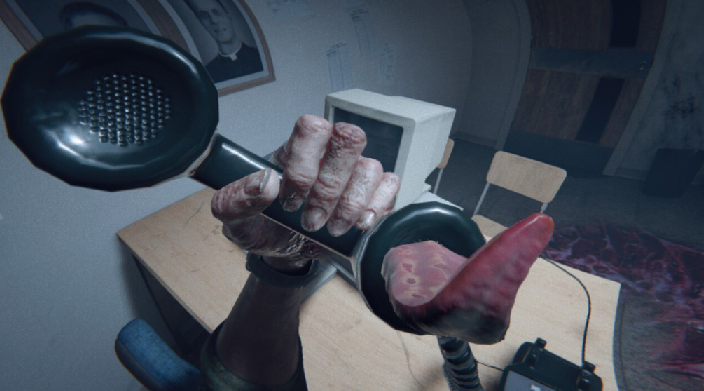
Outlast II
“But Dopefish! You said that the deciding category was-”
Please stop interrupting me, imaginary reader! I’ll explain it all shortly.
I wasn’t lying when I said that the deciding factor was how little impact the player has on the story. And from a purely objective standpoint, the player has less impact on the story in Outlast II. There are no branching paths in Outlast II. There are branching paths in The Walking Dead: Season Two. You objectively have more of an impact on the story in the latter. And I try to be objective when reviewing this kind of thing. This is definitely true and not something I made up as an excuse to have a bait-and-switch.
But in order to get a full measure of quality, we need to examine the context of these branching paths. Namely, this context.
Outlast II is a single-player horror game.
The Walking Dead: Season Two is a narrative-driven ‘choices matter’ game, where the entire fucking selling point is that your actions will have consequences in the story. In which game do you have less impact on the story? Outlast II. In which game is it substantially less acceptable the extent to which the player has an impact on the story? The Walking Dead: Season Two, hands down.
Outlast II is edgy and grimdark and borderline offensive in how tasteless it is, but Outlast was all of those things when it was good. The Walking Dead: Season Two is just a failure. A complete and total failure of storytelling. It is not engaging. It is not interesting. The ways in which it is uninteresting are not a thematic commentary on the nature of choices. When you have the choice to rob a guy, and the outcome of that choice is either that he ambushes you later, or that he ambushes you later but with a slightly sad face, then that game has utterly failed to be tailored to the choices you make. The Walking Dead: Season Two isn’t just bad; it’s false advertising.
And despite Outlast II’s clumsy attempts to say things about organized religion and sexual abuse that just come across as crass posturing in order to feign seriousness, I can at least say that there’s nothing directly in the game to suggest that Red Barrels had a toxic work environment. The Walking Dead: Season Two isn’t just a bad game; it is a morally bad game. This was made with crunch, by overworked employees who were not even encouraged in the first place to make a good game, but to make as good a game as they could in the time that they had.
The Walking Dead: Season Two is functionally a failure, morally abhorrent, and while I sincerely was not expecting to come away from this with a clear idea of the ‘winner’ then having weighed up all of the pros and cons, I can firmly state that I believe it is considerably worse than Outlast II.
The Walking Dead: Season Two may not be the worst game I’ve ever played – not even close – and I may not even have as much fun complaining about it as I do with Outlast II, on the basis that the mistakes in that game are often laughable and not genuinely frustrating and a result of a toxic workplace. But it will always spring to mind whenever I have to recall possibly my least-favourite game. Meaningless decisions, a cast of two-dimensional zombie fodder characters, and a completely unenjoyable story. Telltale should’ve told a better tale.
…
Well, that was negative. Join me next time on Game VS Game, when I’ll be looking at… I don’t know, but I promise that it will be two games that I liked! Maybe I could finally get around to Dante’s Inferno VS God of War III? And as always, thanks for reading!
-Dopefish

 The Dopefish