


In June 2024, Dan Olson uploaded a video to his YouTube channel ‘Folding Ideas’ titled ‘I Don’t Know James Rolfe.’ It’s a video about James Rolfe, his most famous role as The Angry Video Game Nerd, the difference – or lack thereof – between character and role, his autobiography ‘A Movie-Making Nerd’, his ambitious 2014 indie film ‘Angry Video Game Nerd: The Movie,’ the avant-garde experimental 1967 film ‘Wavelength,’ the… unique way in which James solves a problem regarding the placement of a camera tripod, but most of all, it’s about Dan Olson.
I enjoyed The Angry Video Game Nerd for quite a while in my teenage to late adulthood years, but gradually stopped keeping up with the episodes and by 2014 I was no longer following the series. At no point did I grow to dislike it, but I began to like other things more. I’ve never seen the film. I started watching HBomberguy videos around 2017, and from him I discovered that I actually quite enjoy longform video essays – fitting for someone who’s writing is intolerably too long; didn’t read – and I began watching other video essayists like Dan Olson, Jenny Nicholson, and Lindsay Ellis. Is this BreadTube? Am I just describing BreadTube?
Anyway, I like James Rolfe. I like Dan Olson. Dan Olson opens his video by explaining that he feels a certain kinship with James Rolfe. I do not feel a certain kinship with either of them. The video is critical of James, critical of Dan, critical of Dan for being critical of James, critical of others for being critical of James for reasons that are substantially less valid/more stupid than Dan’s criticism of James, and critical of Dan for being critical of James in a way which is ultimately critical of Dan himself. It’s… it’s not a hard watch, but it’s a deep watch. There’s a lot to unpack in a way that not only makes you reconsider how Dan’s words apply to himself, but also how your view of an internet celebrity may reflect your feelings.
I don’t want to spoil the video – go watch it, right now, it’s up and it’s free and it’s a better use of your time – but if, for whatever reason, you want to read this blog without watching it, I do need to explain the context behind it. Dan Olson spends about an hour looking into the impact that James Rolfe had, his self-published autobiography, which Dan finds to be of questionable quality, the odd and frequently insufficient ways in which James solves camera issues, in ways that only raise more issues in the future… and it all builds towards the revelation that Dan appreciates the Nerd, likes the Nerd, but he doesn’t really believe that James Rolfe is a filmmaker. At least, not a real, professional-standard filmmaker. And all of that builds towards the revelation that the reason why Dan is so interested in James Rolfe, the reason why he can’t stop thinking about these little mistakes and questionable actions, is because he doesn’t believe that he is a real filmmaker either. James Rolfe’s flaws are also Dan’s flaws – at least, some of them – which is why it affects Dan so much to see them in someone else’s actions. In this video, Dan Olson is frequently critical of the work of James Rolfe, but frequently in a way that reflects back on himself.
I like the video. It’s a good video.
…
But, it’s weird. It’s weird in a way that sticks in my mind, much like the way that James’ completely baffling tripod set-up stuck in Dan’s. It is uncomfortably parasocial in a way that is very self-aware, but the self-awareness does not counterbalance the parasocial…-ness. I’m sorry, there isn’t a word for this yet. Microsoft Word is telling me as I type that ‘parasocial’ is not yet a recognized word itself. I supposed if there was a word for it, it would be parasocialism, which sounds like the punchline to the joke, “What do you call Karl Marx when he goes skydiving?” (I am aware that he would more accurately be described as a communist than a socialist but please, just let me have this.)
But it’s not just the parasocial element; it’s also that… as I said, I do not feel a certain kinship with Dan Olson, but I am fairly confident that he did not make this video as a takedown of James’ character or skills. I strongly believe that Dan Olson does not believe that this video is in any way, shape or form, a mean-spirited and unnecessary critique of James Rolfe. I do not believe that it is a mean-spirited or unnecessary critique. But I could see merit in the arguments of someone who believed differently.
Not only that, but the video ultimately being about Dan Olson himself, his doubts about his own abilities, and whether he fails to qualify as a filmmaker in the same way that he believes James Rolfe has failed; it ultimately reduces James Rolfe, a sentient human being with his own feelings, to a… prop, or much worse, a cautionary tale. I’ve seen positive comments about the review that express the opinion that Dan was looking at James with a sense of “There but for the grace of God go I.” An admission of humility, an acknowledgement that on a different path, Dan Olson could have made the same mistakes – and possibly did – that James made in his career, and that’s why he is so captivated with the journey of someone who in broad strokes has a similar job to him – media analysis on YouTube – but ultimately went in a very different direction. Or maybe it’s the differences that are superficial and they’re much more alike than I/he initially thought. Either interpretation is valid, and it makes for a truly fascinating video. I have no doubt that Dan Olson will make more fantastic videos, and there will probably be some that I think are of higher quality than this, but I don’t think that he’ll ever make another video that captures the same tone as I Don’t Know James Rolfe.
And yet, I feel that this leaves out something basic but important, that being… if someone said about you, “There but by the grace of God go I,” … would you not find that incredibly insulting? That someone sees your current existence as a potential negative outcome that they were fortunate to avoid? The phrase “There but by the grace of God go I,” is widely-attributed to John Bradford, a 16th Century English Reformer, clergyman and martyr, who is alleged to have said it upon seeing a group of prisoners being led to their execution. Imagine someone saying that about you; comparing the fate of being you to a literal death sentence.
Of course, it would be widely unfair to claim that Dan Olson actually said this, or even intended to imply it. But the foundation is there. And the criticism of James – even if it is ultimately supposed to reflect on the critic – delves a lot further than just his professional body of work. Some of it comes very close to criticizing him as a person, which is a level of parasocial activity (isn’t that a horror film?) that I think goes beyond social acceptability. But then, is it possible at all to non-parasocially criticize someone’s work for revealing or implying something about themselves which does reflect negatively on them as a person?
So, in conclusion (of my introduction,) I had some mixed feelings about the video, and I would like to discuss them in more depths. We’ll be talking about Dan Olson, James Rolfe, Wavelength, and in the spirit of the video, how my concerns about the video ultimately reflect on me and how my own doubts and insecurities are in some way influencing this reaction in the first place. That’s going to be a lot of fun. But first of all,
What is ‘Parasocial’?
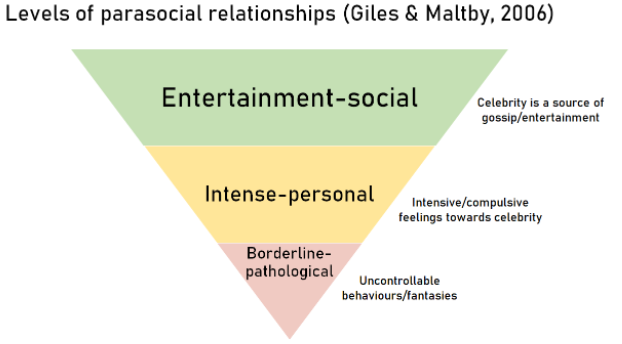
… I just found that image on Google and I will not be explaining it further. I just wanted to have an image for this section.
I mentioned earlier that I do not feel a kinship with Dan Olson. Part of why that is can be explained by how we would each approach this task. I think Dan Olson would make an absolutely fantastic fifty-five minute video explaining the roots of parasocialism – oh, fuck you Microsoft Word, right-click, add to dictionary, we’ve barely started and I am sick of that judgemental red squiggle – notable instances of it happening throughout history – I expect there are a lot of crimes performed by obsessed fans of celebrities to bring up here – why it happens, why it needs to stop but why we could stand to be more understanding of those who are inclined towards it, and how best to rectify the problem when it occurs.
Meanwhile, I just googled ‘parasocial’ and the highlighted result from ‘find a psychologist dot org’ was really spot-on, so I’m just going to use that. “Parasocial relationships are one-sided relationships, where one person extends emotional energy, interest and time, and the other party, the persona, is completely unaware of the other’s existence.” So yeah, the kind of person who would plot to kidnap a celebrity under the belief that things will work out really well for them, or the kind of person who thinks that they have a close personal relationship with their favourite VTuber, just because they tricked them once into saying “Eating Mike Tyson’s Ass,” on stream. And they weren’t even the original guy who started it.
You might wonder why I included that one little line ‘why we could stand to be more understanding of those who are inclined towards it’, and maybe that’s just me trying to be diplomatic, but it’s also because… let’s be blunt here for a second; there is nothing about unhealthy parasocial behaviour in itself that is deserving of sympathy or acceptance, but it’s also probably not the behaviour of someone whose personal life is… going great. This is neither an excuse nor a justification, but I felt that it was worth a mention. And what is also worth a mention is that in the vast majority of cases, this non-excuse and not-a-justification is entirely inapplicable anyway.
Luckily, while I was writing this, Lindsay Ellis released a video on Yoko Ono and The Beatles, named ‘Yoko and The Beatles’ – very to the point, love it – and it’s a video exploring the (false) theories that she is an evil creativity-sucking harpy who broke up the band. It’s not a video solely about parasocial behaviour, but it’s a constant undercurrent in the way that this woman – and several other women in high-profile relationships, Courtney Love, Meghan Markle, Amber Heard – are both held responsible for the actions of their partners’, and also the victim of this very weird… assumed familiarity. Like, it’s okay to say that Yoko Ono is a talentless bitch who broke up The Beatles, because you know her! You know her very well! I mean, there’s… I mean, there’s just the general vibes you got from her. And then there’s also that one documentary or YouTube short or fever dream you can vaguely recall, which you are pretty sure validated all of your concerns, so… yeah! You’re not being parasocial, you just genuinely learned all that there is to know about the Amber Heard trial off of those three funny videos you saw on TikTok, and the fact that Depp sued a paper in the UK for libel and lost because the judge conclusively stated “Taking all the evidence together, I accept that she was the victim of sustained and multiple assaults,” doesn’t matter, because that pales in comparison to the expertise of the fucking ‘body-language specialist’ on Twitter who asserted with confidence that the way she looks to the left is indicative of undeniable psychopathy, and- sorry, got a bit sidetracked there. The point is though, Parasocial = Bad, generally speaking.
Speaking of terrible parasocial behaviour, Dan Olson’s video also highlights undeniable examples of this kind of thing happening to James Rolfe, in the form of shitty obsessive Reddit comments made about James’ personal life. I knew that he got married in 2007, but I was blissfully unaware that there were people who theorized that any problems they had with James’ schedule or the production of his videos was secretly the result of his evil shrew wife. It’s not a generally applied observation – or maybe it is and I just don’t want the hassle of dealing with the comments – but it really does speak to the toxicity, immaturity, and… something else about the certain parts of his air-quotes ‘fandom’ that when something happened that they were displeased about, their natural instinct was to blame the nearest available woman.
But the primary reason I bring up parasocial behaviour in regards to Dan Olson’s video is that you could make a case that Dan is guilty of this; he opens a section near the end, discussing how James has both metaphorically and literally ‘trapped himself on the couch’ with “I did the thing any normal person would do and built a one twelfth diorama of the Nerd room.” This could easily be because I am terrible at media literacy, but I struggle to properly dissect each measure of this statement, in terms of how much of it is obviously ironic tongue-in-cheek humour, and how much of it is supposed to be brutally, self-critically sincere. It’s a detailed diorama. But to get into this, first we would need to look at both James Rolfe and Dan Olson more closely, so let’s do that now.
Dan Olson and James Rolfe

Image from Dan’s most famous video so far, ‘Line Goes Up – The Problem with NFTs’. Did you know that video has a Wikipedia page, but Dan doesn’t? That’s weird.
Dan Olson is… number years old – look, I’m not an in-depth researcher and frankly, right after going on an extended tangent about parasocial behaviour, I don’t want my Google history to include ‘how old is dan olson,’ or ‘where does dan olson live,’ or ‘is dan olson secretly hbomberguy but from twelve years into the future?’ Those details aren’t even remotely relevant to what I actually have to say about Dan Olson in the first place. I’m going to be missing a lot of what anyone invested in Dan would consider his origin story. What I will say is that Dan Olson is… smart. Smart in the way that actually makes me feel kind of self-conscious.
Dan Olson is behind the YouTube channel ‘Folding Ideas’, which has been posting video essays, reviews, minisodes and thinkpieces since 2011. His most famous works are ‘This is Financial Advice,’ about the GameStop short squeeze, but moreso about what happened after the dust had settled, ‘The Future is a Dead Mall,’ which outlines the development of/his experience in ‘Decentraland’ – basically Second Life but with BitCoin – ‘Contrepreneurs: The Mikkelsen Twins,’ an examination of the get-rich-quick scheme of ‘done-for-you audiobooks’ pushed by a pair of talentless hacks, and his most famous work ‘Line Goes Up – The Problem with NFTs,’ a very thorough dissection and takedown of the entire cryptocurrency sphere.
These videos may appear to an outside observer to be… heavy? Not hard to follow, but demanding of your attention throughout, although that’s hardly a flaw. He’s also made fantastic videos on what I would call lighter or easier topics, such as Jamie Oliver’s bizarre obsession with/war on the humble chicken nugget, or a critique of Doug Walker’s bafflingly misguided and inaccurate review of Pink Floyd’s The Wall. He’s also done- I could just list every video that Dan Olson has ever done that I have seen, which would be a lot of them. I like Dan Olson a lot, I enjoy his videos a lot, and he has that special kind of friendly on-screen charisma that effortlessly conveys one of the most important qualities for any longform video essayist to have; he is genuinely fascinated by the topics that he covers and he sincerely wants to talk about them. Not once does it feel as though he half-assed a video on a topic that he had little genuine interest in.
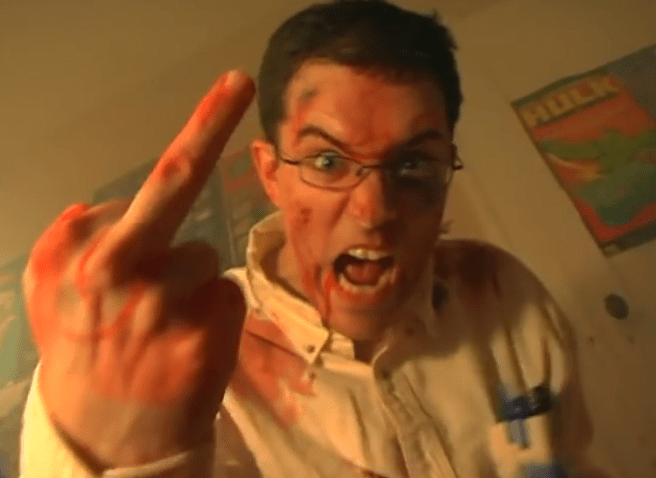
I chose this image because I remember Die Hard being my favourite Angry Video Game Nerd episode back when I was into the show. Sorry for the low quality, but these episodes were uploaded in 360p.
James Rolfe is one of the pioneers of internet content in general. Creative from an early age, drawing comics and making amateur films with his friends, he is undeniably most famous for his series ‘The Angry Video Game Nerd,’ which has been running since 2004. The AVGN is an exaggerated persona of James who crudely and comedically describes why certain video games – usually retro, usually badly-designed, and usually patently unfair in some regard – are so bad that he would rather, quote, have a buffalo take a diarrhoea dump in his ear, end quote, than play them.
The format of the show hasn’t significantly changed beyond the initial quality-bump in the first few years, as it went from a hobby to James’ actual livelihood, which is surprising considering that… well, it’s been twenty years. Production of the episodes has slowed, but that’s understandable considering that James is now married with two daughters. Only a completely unhinged, ungrateful and unserious person would begrudge him for prioritizing his real-life family over a web-series about video games. Only the most entitled, belligerent… yeah, some of James’ fans are not too happy with this, but generally James is still incredibly well-respected and widely-recognized, and rightfully so, as one of the most influential creators in the history of the internet. Normally I’m not a fan of overstating someone’s importance, but without discovering the Angry Video Game Nerd in 2006, I would not have found Gametrailers and then ScrewAttack, which allowed users to write their own blogs, which I did. And my first big series was ‘Elmo’s Rants’ (I was ‘Elmo 3000’ at the time; I do not know why,) in which I complained about things in video games that annoyed me. Sound familiar?
James is known for other series, though; ‘Board James’ sees a much calmer James Rolfe happily and enthusiastically explaining the various board games he’s played throughout his life, ‘You Know What’s Bullshit,’ is more or less The Angry Video Game Nerd, minus the video games – just a series of exaggerated complaints aimed at things that grind James’ gears; exaggerated, but things that sincerely annoy him – and ‘Monster Madness,’ a retrospective on monster/horror films which occupies James’ channel every other-ish Halloween, and much like Board James, it’s a show in which a really big fan of the films and the genre explains sincerely why he loves them so much. Monster Madness and Board James are probably functionally identical to just the real James Rolfe talking about things that he loves.
So that’s Dan Olson and James Rolfe, but there’s a big difference in the way they portray themselves. James Rolfe once mimed having a liquid bowel movement over the face of someone in a Bugs Bunny costume. Dan Olson, in his Contrepreneurs video on the scam of done-for-you audiobooks, actually wrote a twenty-five-thousand-word book on ‘A Skeptic’s Guide to Hypnosis,’ which is the exact kind of morally questionable topic that people have paid others to ghost-write about. It’s not just the numbers – a one-shot Teen Titans fanfiction from me approaches at least half of that – but the fact that it was all done to a professional standard. Dan Olson wrote a book… just as a supporting anecdote for one of his videos. Professionally, the man is capable of wearing many hats.
But in terms of his on-screen persona, if you could call it that, I don’t think that I’ve ever seen Dan Olson playing a role that is remarkably dissimilar to his own real-life personality. He doesn’t wear many hats at all; except for one instance, in a parody of the Nostalgia Critic, with long-running character Hat-Dan: The Dan with a hat!

There are moments in Dan’s videos where I’m sure I’ve seen him acting, either replicating a reaction he would have experienced to a revelation that he uncovered, mimicking the style of another content-creator in order to make a point, or playing up an emotion such as anger or humour where appropriate in his work. But I don’t think that the Dan Olson who patiently explains to you the problem with NFTs for more than two hours is a substantially different person to Dan Olson as he lives his day-to-day life. I don’t believe that he makes statements ‘in-character’ that the real Dan Olson does not agree with.
In contrast, James Rolfe is the Angry Video Game Nerd, but James Rolfe is also not the Angry Video Game Nerd. James Rolfe plays the role, but I do believe that I can state with relatively certainty that James Rolfe would not, in fact, rather eat the rotten asshole of a roadkilled skunk (and down it with beer) than just play a generically bad video game. This is an opinion of the exaggerated persona and not of James himself. But… this isn’t consistent. It’s fair to assume that the problems the Angry Video Game Nerd has with the games that he plays are also problems that James Rolfe had when playing them with complete sincerity. The series ‘You Know What’s Bullshit?’ has the same bombastic over-the-top-ness of the AVGN, but it’s explicitly about things that annoy James in real life.
In the seventh episode of The Angry Video Game Nerd – the McKids review – The Angry Video Game Nerd criticizes the placement of a card that he needs to collect; it’s visible, but only reachable via walking and falling through clouds that had previously functioned as walls. Not the hardest puzzle in the world, but bound to trip some people up. The Nerd narrates “So how do I get that card? Oh, every kid knows how to do this; just get the secret passageway under the clouds. Yeah, that’s easy to figure out. Kids will have the patience to figure that out. Cause, y’know, kids have a lot of patience. Especially the ones with ADD such as myself.” We can all agree that this is definitely James Rolfe and not The Nerd, right?
This is not a matter of discussion limited solely to James Rolfe; we could talk for a while about the differences – or lack thereof – between Ben Croshaw and Yahtzee, between Harry Brewis and Hbomberguy, even between REDACTED and Dopefishblog, but in ‘I Don’t Know James Rolfe,’ Dan makes the point that reading James’ self-published autobiography, the way that James approaches media criticism is not hugely – or even fundamentally – different to the way that the Angry Video Game Nerd would. So… what does that mean in the context of criticizing the Angry Video Game Nerd?
The Ethics of Critique
The ethics of critique are… unspoken rules. They are practically non-existent in some circles and widely-respected in others. I think that in order to best bring up one of those rules, it’s time to talk about one of the oldest media-critique shows on the internet.

Retsupurae – based on the mispronunciation of ‘Let’s Play’ – was a show in which competent Let’s-Players with charisma and experience, commentated over and playfully riffed on Let’s-Plays that were significantly less… that. Bad sound quality, uninteresting commentary, melodramatic reactions; there are a lot of bad Let’s Plays out there, and watching people who know what they’re talking about turn ‘Michael Mute-Mic plays I Wanna Be The Guy Part 54’ into a Mystery Science Theater 3000-esque work of art is extremely entertaining. Retsupurae covered a wide range of topics beyond just commentating over bad LPers, and a lot of their work was genuinely hilarious, especially when the videos they were covering were just… so bizarrely terrible.
If this sounds up your alley and you’d like to watch some new Retsupurae videos, then congratulations! You can’t. The last video they uploaded was in 2018, and it was a Wrongpurae – commentary over a longplay of a bad game, not a bad Let’s Play – but they had also been drifting away from covering other LPers for some time. There were a few reasons why; copyright-strikes, people intentionally trying to make bad reviews for the sake of being covered, but a major factor was also that… well, they made a video making fun of LPer ‘QueenieZ’ who was playing Eternal Darkness. She was apparently quite bad at it. So they made that video, moved on with their lives, and years later were horrified to discover that she was receiving harassment and even the odd death threat, all for the crime of not uploading a particularly good Let’s Play.
Many Retsupurae hosts and viewers were in the Something Awful community, and while that’s nowhere near as bad as the Chans (please no,) they’re also not especially an internet community that you would want to annoy, and not because they would dissect your opinions with acerbic wit. A popular Retsupurae host, Chip Cheezum, delisted all of the videos that he made riffing on other LPers. It is not an uncommon opinion among fans that Retsupurae did not age well, and it’s not uncommon for the hosts to express remorse over some particularly harsh comments towards people who were, essentially, just filming themselves being bad at Streets of Rage. There is no way for two people who are very good at something to make a video ruthlessly mocking people who aren’t as good at them, without it coming across as at least kind of dick-ish.
… Hey, wait a minute! If being good at something means that you can’t criticize someone for being bad at it, how is anyone ever allowed to criticize anyone? Isn’t the whole foundation of criticism ‘I think that the way that you have done this is bad, and in recognizing this, the implication is that I would have done it better?’
And that is why the ethics of critique are complicated! Even if your criticism is entirely valid, there are ways to critique something that make you come across as… well, a dick. It could be that your audience is substantially larger than theirs, or it could be that your criticism goes far beyond professional and into personal, or it could just be – as was the case with Retsupurae, and ‘Protectors of the Plot Continuum,’ an online community that did/does the same, but for fanfiction – that the work you’re criticizing doesn’t even require criticism to the extent that you are delivering. That’s a very wibbly-wobbly, open to interpretation line, but what I mean to say is that if you come across a five-hundred-word fanfiction with terrible grammar and a barely cohesive plot that seems as though it was written by a ten-year-old, then if you write a five-thousand-word review and/or version of their story which mockingly highlights all of the mistakes and possibly kills their OCs, then you are the one with a problem, not them. You’re probably not helping them to improve their work; you are scaring them away. “Well tough shit, if they can’t handle a little light mockery then they shouldn’t be on the internet in the first pl-“ Yeah well, you don’t get to decide the extent to which it is socially acceptable to insult people, just because for some reason you seem to really enjoy making children cry.
Once again getting off-topic – boy howdy, I sure am projecting a lot this time! – but how does this even relate to Dan Olson and James Rolfe? Dan does not have a bigger audience than James, so that line of reasoning is irrelevant. That leaves ‘his criticism veers from professional into personal,’ and ‘the criticism itself is of unnecessary size and effort related to the subject.’ I feel like it would be possible at least to make an argument for the latter – I Don’t Know James Rolfe is seventy-six minutes long, plus credits – but Dan’s video does cover a lot of ground; James Rolfe, the Angry Video Game Nerd, James’ autobiography, the AVGN movie, the assistance from Screenwave, Wavelength, separate critique of James that is openly ludicrous and not worthy of even responding to, James’ response to that critique, Dan’s response to James’ response to- as I said, it covers a lot of ground. Besides which, the Angry Video Game Nerd has been a series for close to two decades now; you could very easily make a two-hour video focusing solely on the episodes of the show, without even examining outside factors or events.
So that just leaves the ‘personal’ side of things, which leads us to a very simple question.
Personal and Professional
Criticism of James Rolfe’s work is fair game; he is the creator of a series, the writer of an autobiography, the co-director of a movie, and much more. It is entirely reasonable to say whether or not you think he did a good job at any of this. Criticism of James as a person is… shaky. He’s notoriously a rather private guy, he rarely weighs in on big issues, he keeps his personal life personal, and he’s never invited that level of discussion about himself. So, the simple question is, was Dan Olson’s examination of the works of James Rolfe personal or professional?
And the simple answer to that question is… yes.

There is no easy answer here, because much like the ethics of critique, there are no conclusive guidelines. Let me spell out the problem of trying to separate the personal and the professional here; someone reviews James Rolfe’s autobiography and says “The sentences didn’t really flow, there were actually a few spelling mistakes, and also someone hollowed out a square hole from pages forty-five to seventy-three and it was filled with angry wasps. I checked with the retailer but they said it was actually intended to be sold that way. So yeah, it’s a thumbs down from me.” This is a strictly professional review. The reviewer is not making any judgements on James Rolfe on a personal level, but simply assessing the quality of the book.
Now let’s read another fictional book review that I just made up. “Not only is this a bad book, but James Rolfe does not have the intellectual capacity to ever make a good book, and he will never amount to anything.” That’s extremely personal. You’ve gone above and beyond talking about the product and are now speculating on the abilities of the author in a rather presumptuous way.
But here’s the kicker; the third review says “The sentences didn’t really flow and there were spelling mistakes. The impression that I got from the way that this was written indicates to me that James Rolfe does not have the capacity to write something good, etc. Also, yeah, the angry wasps were a real buzzkill, which is ironic because they were very much alive, and angry.” This is… a bit of both. It is still strictly professional; the reviewer is just giving their honest opinion on what the structure and quality implies about the author, but it’s still delivering broadly the same critique as the review that makes judgements about the personal life of the author. So, is this personal or professional? Once again, the answer is simply ‘… Yes.’
A lot of people – Dan Olson included, I think – understand that there’s really no way to make a professional criticism in a way that someone couldn’t hypothetically take as personal, so they just accept that their criticism can be taken as both, and that’s that. Dan previously did this in his video on Doug Walker’s review/parody/clusterfuck of The Wall, where he delivers possibly the politest burn to have ever been recorded in human history.
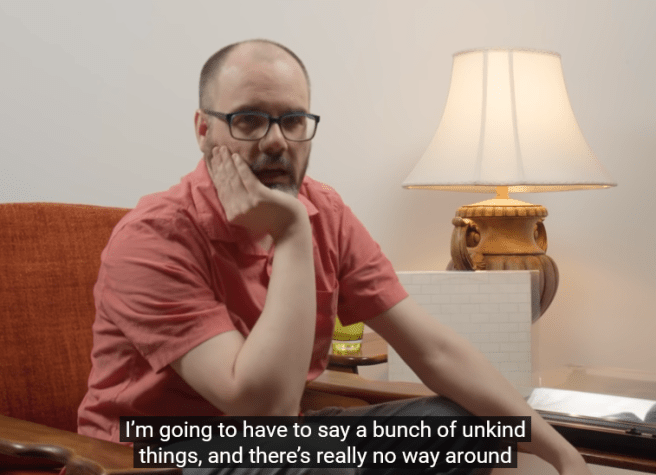
“I’m going to have to say some unkind things.” Savage. And this is justified, because frankly, there is a substantial amount of objective evidence that Doug Walker simply did not understand – and did not care to understand – what The Wall was, which reflects badly on him as a critic, and a little badly on him as a person as well. The professional ethics of reviewing something without making an effort to understand it are somewhat tied to the personal ethics of… being lazy. At one point, Dan calls Doug ‘fundamentally incurious’, and I was reminded of this quote when watching ‘I Don’t Know James Rolfe’, because he says the same thing about James, but it sticks out to me a little bit more.
For one thing, the body of work that James covers is… primarily bad video games. I don’t think that the Angry Video Game Nerd missed the point of Milon’s Secret Castle when he called it a shitload of fuck. But for another thing – and this is more a personal call – I feel that there is less of a distance between Doug Walker and the Nostalgia Critic than there is between James and The Nerd. It all depends on the context, they both express their genuinely held opinions via these characters, but the Nerd feels more consistently like an exaggerated persona. More likely to feign anger at something in a game that the real James Rolfe would probably find either amusing or just be apathetic to. I don’t think that the Critic has ever criticized a work in a way that Doug would not also criticize the work.
So calling James ‘fundamentally incurious’ strikes me as much more judgemental this time around, because it seems as though this isn’t gleaned from a repeated failure to understand themes and narratives in films, but rather… a failure to properly examine bad old video games? James notably doesn’t weigh in on political issues and keeps his personal life private, so the scope of work from which Dan could have reached this conclusion is a lot smaller. It’s possible that Dan is talking about the impression he gets from James’ self-published autobiography, which is entirely fair, but…
The way Dan reads from James’ autobiography leaves me a little unsure of how I feel about it. Dan makes the point that as a self-published book with no editor, the structure in parts can be a little bit basic, and it doesn’t really flow in the way that a well-written book should. Dan provides examples, and this is undeniably a good thing; if he had just said “Book’s bad,” and not expanded on it at all, I would have been left thinking that it would have been nice if he had quoted some of it for us. Especially the bad bits.
… And yet, despite wanting this, the actual act reminds me of Retsupurae again; someone who is good at something, drawing attention to someone who is less good at something, and in a way that approaches mockery. It’s definitely not in the same ballpark as the extremely-openly-mocking Retsupurae, but there’s just something about it…

Maybe it’s just the presentation? Dan is both literally and metaphorically shining a spotlight on what a terrible writer James is. And there is once again this undercurrent of… not superiority, that’s far too strong a word, but the underlying implication that by recognizing that this is bad writing while James did not realise – or care – then Dan is a smarter person than James. Which he probably is, but it’s still rude to say, which is probably why he didn’t say it. Dan calls the book impressively self-destructive, and says that the only reason he can’t make sweeping claims about the way James sees the world, is that is isn’t written well enough for him to be able to discern between ‘the total lack of self-reflection’ and the plainly weak writing.
But if you think this is an unfair criticism for me to make against Dan, then congratulations! You are entirely correct, and I agree with you! He reviewed James’ book in a professional manner and cited his sources, highlighting for the audience that, no, it isn’t written in an especially engaging way. He did nothing wrong here, and yet there’s still something off about this. I think the closest I can come to explaining this is that when you factor in the ending twist – that Dan sees his own doubts and insecurities in James’ work – then… it doesn’t feel like this part of the video changes. As mentioned before, Dan Olson has written a twenty-five-thousand-word book, just for the sake of the experience, to supplement a video on the topic of a related scam. Dan knows how to write, so… this isn’t a part of Dan’s own insecurities; I don’t think that he sees himself in James’ inability to write an engaging book, so it’s just standard criticism, which feels a little out of place post-reveal.
Since that was so shaky, I’ll move on to a moment where I have a much easier time explaining why I think it was unnecessary; Dan is critical of Screenwave – not in a conspiratorial way, he covers some of those complaints and explains why they’re rubbish – for making James’ channel more financially successful, but for basically churning out more content, putting people in front of the camera who lack the charisma to be entertaining, but also for just failing to manage James. Not in the sense that he requires management, but in the sense that their job is to provide him with advice and ensure the smooth running of his channel, streams and videos.
…
Dan highlights a time when James Rolfe and Mike Matei were recording a Let’s Play, and James knew in advance that there was a time that he would have to leave due to family commitments. When that time is reached, James visibly begins to panic and the video is cut short, with Mike explaining that James will be back to finish the game later. It’s not pleasant seeing someone in a panic, but it’s literally just five seconds of James appearing to be in a mild state of alarm that he didn’t realise what time it was. Dan shows a clip of this, but he also describes it as ‘a humiliating panic attack’, and it’s a point against Screenwave that, hey, someone should have told them to cut this part of the video out because it doesn’t reflect well on James or on whoever was editing/managing this.
… Was it really necessary for Dan to show what he thought was ‘a humiliating panic attack’? By definition, he believes that this footage is humiliating to James. If this was about Screenwave, there are so many other things you could have criticized them for which you didn’t mention; perhaps out of fear of looking like he’s cribbing from HBomberguy, Dan doesn’t even mention the infamous plagiarism incident where a Screenwave employee just copied and pasted text for James to read; that was much more humiliating in a professional capacity, not… showing your audience – at least ninety percent of whom had not seen it – footage of someone’s ‘humiliating panic attack’ in order to make a point. That comes across to me as approaching an ethically questionable decision.
Another sticking point for me is Dan’s interpretation of James’ interpretation of Wavelength, the aforementioned experimental 1967 film which is… not exactly polarizing, but it has a reputation as one of the greatest underground, art house and Canadian films – the big three, we call them – but also as an extremely challenging work, because it is intentionally incredibly boring. As mentioned in a 2007 edition of Cinema Journal, published by the University of Texas Press “The film inspires as much boredom and frustration as intrigue and epiphany.” Yes, I found this quote from Wavelength’s Wikipedia page.
Dan’s opinion on James’ opinion of Wavelength is seemingly that he just didn’t get it, and he hasn’t made an effort to get it; it’s only as I type this that I realise how similar this is to Doug Walker’s approach to The Wall, which may explain where that ‘fundamentally incurious’ comment came from. The problem is, though… James’ opinion is valid. The film is boring and frustrating and James found it boring and frustrating, so what’s the issue here? On what grounds can James’ opinions be judged as incomplete or invalid?
Full disclosure; I have a huge chip on my shoulder regarding art of this nature, almost certainly due to Spec Ops: The Line, a game that I’ve reviewed more than once and am currently working on reviewing yet again (my opinion on it has softened greatly but I still think it has a lot of issues.) The problem that I have with a lot of art which intends to be purposefully negative in some way, i.e., a film that is boring and uneventful to watch, or a game that is intentionally unenjoyable to play, is that if you engage with them on their own merits but still do not enjoy them or find them engaging, it acts a beacon for someone who thinks that they’re smarter than you to travel at near-lightspeeds to your location, just to inform you “Oh, so you didn’t like it? Well, that’s not surprising, you probably just didn’t get it. Your tiny little pea-brained mainstream mind probably just utterly failed to understand the point of this artistic endeavour. If you’d like then I could try to explain it to you in smaller words.”
However, in order to fully understand Dan and James’ takes on Wavelength, there’s really only one thing I can do. Yep, that’s right; I built a 1/12th size diorama of Dan Olson’s recording studio, complete with scaled down models of- I’m kidding, I’m going to watch Wavelength.
Wavelength

Well, I can start off with an interesting observation; Dan Olson clearly made a mistake that I caught. He claims – and I foolishly repeated – that Wavelength is an experimental avant-garde film made in 1967 by Michael Snow, but being rather familiar with the work, I can tell you that Wavelength is actually Episode 8 of Season 3 of Teen Titans, the 2003 animated series, and focusses on Cyborg’s ongoing feud with Brother Blood, while also introducing the character of Bumblebee. Pretty basic mistake there Dan, be better. Unfortunately, someone plagiarized the name of this Teen Titans episode and made a 1967 film based on it, so… let’s give it a shot. It’s been uploaded in full to YouTube and it’s available to watch right now.
So… first impressions; well, that’s forty-five minutes of my life that I won’t get back. I mean, technically every forty-five minutes of your life is forty-five minutes that you won’t get back; time marches onwards regardless and death is inevitable; that’s a James Acaster joke, I’m sorry, towards the end my mind drifted off and I began to think of other things I could be watching. But in conclusion, I genuinely attempted to go into Wavelength with an open mind towards what it was attempting to do, and I can only conclude that it did not strike a chord with me at all. “Ah, but in order to conclude that it did not strike a chord with you, surely you are engaging with its ideas and in rejecting those ideas, you have learned something about-“ Oh my God, fuck off, I will get to you later.
A brief synopsis, for those who do not wish to watch the forty-five-minute experience. We open on a shot of the interior of a loft. The camera slowly zooms in for the entire forty-five minutes. Two men enter and place a bookcase, directed by a woman, and all three leave again. The woman returns shortly afterwards with a companion, and they listen to Strawberry Fields Forever by The Beatles, before leaving again. There is a low-pitched hum and the screen varies in colour in a way that may have seemed revolutionary at the time, but today is more akin to someone idly flipping through TikTok filters. How far we’ve come, eh?
Twelve minutes later, during which the viewer is left to pontificate on the meaning of the… lack of anything occurring, aside from the slow zoom and increasing noise, there is the sound of a glass breaking and a man staggers into frame and falls over, seemingly dead. Twelve more minutes later, a woman enters and calmly makes a call to someone to report that she has found a man injured, maybe dead. The zoom has increased to the point where only the opposite wall is visible, and the woman’s actions are then superimposed over the zooming shot and shown again. The noise increases in pitch and volume to the point where it’s painful to hear, and the camera zooms onto a picture of some waves. Fin.
… I don’t get the fuss, it didn’t make me want to more deeply examine my own biases and interpretations, and what I’m bringing to the viewing experience, and finding this out about myself was not a shocking revelation that has forced me to reevaluate my approach to art in general. And a huge sticking point for me – about any artistic statement in which the intended audience reaction is negative – is that supporters will assume that any negative reaction is therefore a success, and I fundamentally disagree with that. “If you enjoyed Wavelength (??? How?) then it’s good. If you didn’t enjoy Wavelength then that was intended which means that it’s still good, and if you didn’t enjoy Wavelength and you also feel as though you didn’t learn anything from it and it didn’t make you think more deeply about cinema, then… well, that just means that you’re engaging with it, which makes it still good.” I don’t want to sound crass, but this chain of understanding is not fundamentally dissimilar to a racist shitpost YouTube comment declaring “I think we should kill all (ethnic slurs); thumb me down if you agree.”
To be fair, I can see the logic in “Even in deciding that you don’t like Wavelength, you are engaging with its ideas; ideas such as ‘Can a forty-five-minute shot of a wall be considered cinema? If so, why? If not, why not?’” but… could you not also apply this logic to every negative work of media, ever? I didn’t like Outlast II, it’s one of my favourite games to complain about. But in deciding that I didn’t like Outlast II, was I not still engaging with it on its own merits, and learning things about myself? Things like ‘I don’t like Outlast II.’? In all honesty, there are things to be discerned from that; I did not enjoy the way that the game referenced serious topics but in a way that was more exploitative than exploratory and used them as fodder for jump-scares, but I knew that before I played Outlast II. I’m not lining up to call it an avant-garde masterpiece just because it taught me that I didn’t like it.
The work that Wavelength reminds me of the most is John Cage’s 4’33, which I worry would be a mainstream comparison. For those not familiar with the piece, it is four minutes and thirty-three seconds of silence… but, as there is no such thing in the modern age as true silence, it could be claimed that the ambient noise you hear during those four and a half minutes is the real song. After all, what is music but a series of noises? Is there a limit to the kind of noise that could be considered music? Are our lives not constantly being soundtracked in real-time by our own personal experiences? I can understand why some people would find this pretentious – that’s a valid interpretation as well – but at the very least, listening to 4’33 is not a negative experience. How could it be?
For those who don’t own a copy of James’ autobiography, Cinemassacre uploaded a video in April 2022 named ‘What’s the Worst Movie Ever?’ in which Wavelength is mentioned extensively. And to be fair to Dan, some of James’ criticisms legitimately do strike me as… trivial. Critiques such as “Where’s the pay-off to the guy dying?” or “If you’re going to zoom into something for forty-five minutes, couldn’t it at least be a pretty view, like a beautiful countryside or something?” What Wavelength did didn’t work for me at all, but I do acknowledge that if it had been a beautiful, engaging environment, then the work would have been completely different; it would have been more engaging and less intentionally dull to watch, less time for the viewer to contemplate their experience, less time to consider that maybe the real story of Wavelength is your experience in watching Wavelength, and the simplicity of the setting reflects the beauty that lies all around us and raises questions about what even is cinema, and- any first-year film student could bullshit their way into seeing something deeper here.
But, in complete sincerity… James’ opinions are entirely valid and deserving of respect. If the setting had been more visually appealing – and if it hadn’t been accompanied by a high-pitched noise that slowly veers into physically painful – then opinion of the viewer might not have been predisposed away from considering the philosophical ramifications of what Michael Snow was trying to do, and onto the topic of “Jesus Christ, what’s that terrible sound? It’s been thirty-eight minutes; do I really have seven more minutes of this utter shite? Staring at a wall while someone blares an off-key harmonica directly into my earholes? Is this supposed to be making me think more deeply about what constitutes cinema or something? All I can think about is that I want to punch whoever decided that this should be a mandatory part of every film school curriculum.”
And I don’t know if admitting this just reveals bias on my part or if it’s a fair point, but in looking up videos on Wavelength, I found some negative reviews of it, and the comments on those reviews are… holy shit.
“Your ignorance speaks volumes – hating on artists for expressing themselves is miserable.”
“Dear Mr. Philistine. Before you belch out a childish, one-word reply, consider [reasons why they think the film is good].”
“This guy clearly did not care to get the movie, there’s no time in grasping complex ideas that challenge your notion of cinema when you’re chasing internet clout.”
… Ho, lee, shit; do people even like Wavelength or do they just get off on the feeling of superiority that comes from believing that you like smarter things than other people and are therefore an empirically better person? I understand completely; these people are not Dan Olson and he would never say something so self-serving and smug; when Dan Olson likes something, he prefers to explain why, rather than chide the people who don’t. But there’s something specifically about the accusation that the viewer didn’t make the effort to ‘grasp the complex ideas’ of Wavelength that really irks me.
If a viewer fails to grasp the complex ideas of a work of art… is that entirely the fault of the viewer?
One of the reasons why Dan’s video on Doug Walker’s review of Pink Floyd’s ‘The Wall’ – that’s a lot of possessive apostrophes in a single sentence – is that Doug is so overwhelmingly clearly wrong. Roger Waters wrote about how, still reeling from the death of his father in World War 2, he was thrust into the British education system in the 1950s, where teachers had free reign to beat the students. Doug Walker’s interpretation of this was “Oh, so he’s saying that school sucks in general because all teachers are evil and algebra is stupid, right?” That’s such a bizarre misinterpretation, and the information was right there in the film and in the album for him to glean. It is an utterly baffling take and I’m not sure how Doug missed what Rogert Waters was saying.
Wavelength… is a forty-five-minute shot of a camera zooming in on a wall! That’s it! It is physically painful to watch with the sound on! If the viewer ‘did not get’ the complex ideas put forwards by this piece, is it not fair to criticize Wavelength for being extremely bad at communicating those ideas? When it comes to media like Wavelength, it also seems to me as though the artistically correct opinion is that the work is flawless; if the viewer isn’t able to ascertain the broader point of the nature of cinema, while trying to cover their ears to avoid going deaf, then it’s their fault. The onus is entirely on the viewer to decipher what the underground avant-garde arthouse film was trying to say; a subculture of film which is defined by a lack of mainstream appeal, and not being easily comprehended. And I know that phrasing my response this crudely only opens up the chance for my opinion to be dismissed because I wasn’t intelligent enough to ‘get’ the work, but the most honest expression of my response would be… fuck off! Fuck off with this shit! Being hard to understand does not automatically make a work intelligent or good. Being intentionally unenjoyable does not imbue a work with quality.
I am clearly projecting a bit; I don’t know if this is an outright trigger for me but I’m definitely more impatient towards this kind of thing after several years of Spec Ops: The Line discourse that reliably goes “I didn’t like this game.” “Oh, so you didn’t get it? You’re not meant to like the game.” “Oh no, I understand what they were going for, but I didn’t enjoy it, even on the merits that they intended.” “… But you weren’t meant to enjoy it, which means that it was a success.” “No, I- you’re not listening to me, I understand that it was not supposed to be enjoyable in a way that most video games are, but it was supposed to be thought-provoking and a metacommentary on the nature of player agency, deindividuation and power fantasies, but on those merits, I still found it unengaging and the points that it made were rather poorly-constructed.” “… So what you’re saying is that you didn’t get it-“ “Oh my God fuck off.”
I think part of my dislike for Wavelength is just that I sat through it for the entire forty-five-minutes – well, forty-three on the version on YouTube – in the hope that the experience as a whole would reveal something that I would have missed had I only skimmed through it in five minutes, and I just don’t feel that it did. And for the message – well, one of the messages – of the piece to just be “Art is what you, the viewer, bring to it,” is just… I work in an office where at least three middle-aged people send out inspiring ‘Positive Thought of the Day’ emails, and “Life is what you make of it,” is one of the most common and uninspired recurring themes of them. Michael Snow could have just written that on a piece of paper. Or better yet, unveil a painting and it’s just a blank sheet of A4; a metaphor for how the beauty of art is in the potential of the unstarted work, the limitless interpretations from each and every patron, the- this was supposed to be a genuine point, I swear, but I worry that it sounds sarcastic.
…
But with all that being said, if art is what you bring to it…
What am I bringing to ‘I Don’t Know James Rolfe’?

I was always a smart kid. Not MENSA smart, but the kind of smart where teachers took notice and my parents sat through some meetings about accelerated studies that never materialized because the school simply didn’t have any. The one change they implemented was that while other kids learned spelling, I would go to a different teacher to learn definitions instead. I remember being very annoyed when I found out that ‘inflammable’ means more or less the same thing as ‘flammable’. I thought that that was inappropriate; which for the record, means the opposite of appropriate. I never took the initiative to learn anything on my own time. I was content to just be a smart kid. I think I still consider myself ‘a smart kid’, but I don’t think that there’s a significant difference between a smart kid and a below-average intelligence adult.
It wasn’t until I was about fourteen that I first heard the phrase ‘big fish in a small pond.’ I didn’t like it.
–
Alright, so it’s very, very clear that I have a strong dislike for implications that people – often me – are less intelligent or less capable of ‘getting it’ based on the media that they consume and the media that they enjoy. That’s obvious, and that no doubt has an impact on my judgement of Dan’s criticism of James for not understanding the full artistic merit of a forty-five-minute film in which a camera slowly zooms in on a wall. I remember years ago on a podcast, we were talking about our favourite video games of the year, and other people were saying “This adventure game which is an allegory for the trans struggle for representation and respect, the desire to be normal yet special,” and my pick was “Uh, I liked Rayman Legends a lot, because the gameplay is really good and it’s very fun to play. Also there’s a bonus level where the background music syncs up to you running and then the monsters start singing “Whoa Black Betty, bam-be-lam, Whoa Black Betty, bam-be-lam,” and it’s really cool and good so that’s my favourite game of the year.”
I struggle generally to reconcile the idea that I am wasting my time and failing to learn, to evolve, to improve, by focusing primarily on silly things that make me happy instead, with the issue that… I also do want to be happy. So if I have to pick between an experimental hard-hitting game that I may not enjoy but will cause me to reflect on who I am as a person, or… a platformer about a farting sheep who plays the accordion, I will almost always go for the farting sheep.
I don’t still watch The Angry Video Game Nerd but I can see why it would be personally upsetting to me for someone to criticize him for a lack of evolution in his twenty-year show. As the saying goes, “If it ain’t broke, don’t fix it!” but maybe it also hits me because… I have failed to evolve in the last twenty years and reminding me of that makes me feel like a failure. And I’m too busy ruminating on that failure to evolve now; and that’s if I even want to. What if I evolve into something even worse, like Vigoroth into Slaking, or Graham Linehan circa 2014 into Graham Linehan now? I am using jokes to detract from the sincerity with which I openly express a desire not to change, because change is risk; not just a risk of things getting worse, but… a risk that things may fail to get better in a way that is entirely my own fault. If ignorance is bliss, is it such a crime to want to be happy?
–
Other than video games – and writing about video games – my big teenage hobby that has continued into adulthood was/is writing fanfiction, specifically Teen Titans. Beast Boy was my favourite character, probably because he’s something of a sad clown, and I didn’t realise at the time that basically everyone considers themselves to be a sad clown. My stories weren’t – and aren’t – very good, mostly consisting of something bad happening to Beast Boy, and Raven stepping in to offer moral support and probably end up dating him. It’s not specifically a me-problem – several fantastic authors use this same technique – but I generally find that the easiest way to make a character sympathetic is just to have bad things happen to them for no adequately-justified reason.
When I was having a rough time at school, I would sometimes imagine – not fantasize, but not not fantasize – about something terrible happening to me; not as dramatic as losing a leg or my house burning down, but maybe being in a car accident, or losing a relative whose death would be close enough to upset me, but not enough to significantly impact my life. Then everyone would have no choice but to pity me, and I was certain that pity was the most reliable way to get other people to like you.
After all, how else was I supposed to do that?
–
I mentioned before in passing that Dan Olson is ‘smart in the way that actually makes me feel kind of self-conscious,’ and that was not hyperbole. His most famous video, ‘Line Goes Up – The Problem with NFTs’ opens with a brief explanation of how in 2008, the economy functionally collapsed. Banks were issuing bonds (well, ‘mortgage-backed securities,’, but they’re basically the same,) which were comprised of several thousand mortgages, and the bonds were so overwhelmingly profitable that banks took on riskier and riskier mortgages (subprime mortgages; subprime lending just means ‘lending to someone who is more likely to have trouble paying you back,’) in order to keep them coming, until the bubble burst, a lot of people defaulted on their mortgages, and the bonds became worthless, at which point, economy go boom because the banks were obligated to pay those bonds back, and couldn’t. Do you understand that?
Because I sure don’t!
Dan Olson covers this topic briefly, in simple terms, and I have watched him cover this topic about five times and I still don’t fully get it. I don’t think I even got it enough to outline it correctly above, I’m sure an expert on the matter would be grimacing and shaking their head at my definition of a mortgage-backed security. I have the Wikipedia pages open for Mortgage-Backed Securities, the 2000s United States Housing Bubble, Collateralized Debt Obligation, the Subprime Mortgage Crisis, and I still don’t fully get it. If I wasn’t typing this at 3am, I would be texting my friend to ask him to please put ‘The Big Short’ on his plex server so that I could watch it in full instead of gleaning what I can from the funny YouTube clips where Margot Robbie in a bubble bath explains things to me like I’m five. I am… trying, but there’s just so much. But do you know who I’m sure understands all of this? Dan Olson. He would not have permitted himself to cover the topic – even in passing, as a prelude – without fully understanding every term that he used along the way.
Trying to understand this brings back a bad memory. I was always good at maths. Quick, mental mathematics, times tables – if you asked me to multiple 764 and 283, then it would take me a minute because I would still use that nine-by-nine grid format, where you separate it into 700, 60, and 4 multiplied by 200, 80 and 3, but I could do it. Give me a minute and I actually will.
(One minute later) It’s 216,212. There. I am officially as useful as the world’s slowest calculator.
But like I said, I was always good at maths. Meaning… my skill in maths has not significantly changed since I was eleven. In Year 4 (I was nine; UK schools have a weird different tiering system which I will not bother to explain) I sat a Year 6 SAT test in maths and got every question right. Maths is one thing that I am really good at. When it came to GCSEs, I excelled at maths. When it came to picking my A-Levels, I obviously chose ‘Further Maths’. I was also switching schools during this time – a ‘Dad’s job requires him to move’ situation, I wasn’t starting fights or doing any light arson… the occasional heavy arson, perhaps – and when I arrived at my sixth-form college to complete my A-Levels, confident that I would continue to excel in maths, then I made an unfortunate discovery.
I was probably the most stupid student in the class, or at least the least-educated. This was a good college. My last one had been ‘Our goal is for you to get a passing grade (C or higher) and as soon as we think you’re there, we don’t care anymore,’ and this college was ‘Our goal is for you to get an A+.’ Literally the first thing that the new (to me) teacher said upon entering the classroom was asking if we had all had a chance to look over/get a head-start on the supplementary material she had assigned us at the end of the last school year. This was my first lesson with her.
But I was confident; after all, I’d always been good at maths. Sure, I smiled and nodded and didn’t raise my hand when I didn’t understand something, and as soon as I left the room, I stopped thinking about maths entirely until the next time I entered the room, but I was sure it would work out. I didn’t need to ask for help or even check what that supplementary material had been. I would just naturally catch up, sooner or later. Also, I was sixteen, and a year prior, my friend had just told me on MSN Messenger that you could emulate NES and SNES games on your computer, so… yeah, I had no interest whatsoever in extracurricular activities. Or even curricular activities. Even when a few months in, I switched from ‘Further Maths’ down to ‘Maths’, and was still struggling, I didn’t ask for help, and I made no effort to improve myself.
Cut to two years down the line, it is the night before my final exam, and I am finally trying, but it’s too late. I am reading my textbook, I am trying to understand, but I see things like “∫cosec x dx = ln |cosec x – cot x| + C” then it makes me want to cry. And I can tell that it makes me want to cry, because I am crying. I don’t get. But it’s maths. I’m good at maths. So I’m good at this. But I don’t get it. Why don’t I get it?
I don’t feel kinship with Dan Olson or James Rolfe, but I do feel kinship with Algernon, the fictional mouse in the novel Flowers for Algernon, which you may not have read, but you’ve definitely heard a version of the story; it’s been the basis for a Spider-Man comic (Flowers for Rhino) and a Simpsons episode (HOMR; the one where it turns out there is a crayon stuck in Homer’s brain and he becomes hyperintelligent when it is removed.) In the novel, Algernon the mouse is the original test subject for a procedure to enhance his intelligence, but while it is a success, Algernon shows signs of regression. Previously, he was able to solve a maze with ease, but some time after the treatment, he is getting lost again, and worse, he reacts to this by angrily ramming the walls of the maze, either trying to brute-force a solution with dumb muscle, or out of anger at either himself or the circumstances.
I’m smart. I like smart things, like a smart person should. So if Wavelength is a smart film, I must like Wavelength. But I don’t. I think that it’s bad. But if I think that it’s bad, that means that I didn’t get it, so I must be stupid. But I’m not stupid. So… I must have gotten it, but I just didn’t like it anyway. But if it’s smart, and I don’t like it, then… it must not be good. It’s actually bad. Wavelength is bad, and the people who like it are pretentious. And I don’t like the way that they look down on me and call me stupid just because I don’t like their dumb film. It’s not my fault that the film is bad. And they’re being very rude and snotty about it, because I made no effort to seek out people who weren’t being rude and snotty about it, which means that my anger at their rudeness is justified. And I was getting angry.
I empathize with Algernon.
–
The only unfinished Teen Titans fanfiction of mine that I have consciously decided not to finish some day is one in which the team splits up; not due to tensions or the loss of a member, but from the passage of time. Starfire will return to Tamaran, Raven to Azarath, Robin to Gotham, Cyborg will join the Justice League, etc. Beast Boy is in complete denial, having made no plans for his future, and continues to make no plans, believing that his life will not significantly change. It isn’t until most of his friends have left and said their tearful goodbyes that he realises that they genuinely expect that they may not see each other ever again, and worse, they have accepted it. Too embarrassed to ask for help, he remains behind at the Tower, alone, with nothing left to do. An undisclosed amount of time later, having failed to adapt to his future, he returns to the old Tower as if merely revisiting the location will bring him back to happier times. It doesn’t, and he prepares to kill himself, when Raven appears through a portal, revealing that of course she kept tabs on all of her friends and he can come with her to Azarath if he wants, and they can pick up right where they left off. With tears of relief and happiness in his eyes, he accepts, and leaves to start a new life with her. It is then unsurprisingly revealed that this was merely his dying dream, and no-one came back for him.
I stopped writing the story because it wasn’t like my usual work, and it kept making me cry.
–
I’ve also mentioned several times that unlike Dan to James, I do not feel a kinship with either of them. I think that this is because they’re both much more successful than me. Dan started making content for the internet in the early to mid-2000s, and so did James, but – not counting those Teen Titans fanfics – I didn’t start writing about media (games) until at least 2007. And unlike James, who defined a genre and is one of the most recognizable early YouTube stars, and Dan, who is currently approaching one million YouTube subscribers, then my sum total of accomplishments is… uh, I think I have two patrons. And that is one hundred percent not a guilt-trip to try to get some patrons; I upload once a month, and there’s no bonus content to offer. What I’m saying is that I like James Rolfe and Dan Olson, but I don’t see myself in either of them.
I have occasionally considered the possibility of trying to turn one of my long-form articles into a video, but… I know just enough about the process to know that it would be a truly monumental amount of work. And money; my microphone right now is suited for rounds of Golf With Your Friends on Discord and not a lot else. I don’t know how to edit, and recording footage for the things that I would say is… hmm. Let me put it like this; I somehow tricked the guy who runs Hardcore Gaming 101 into thinking that I can occasionally write at a professional standard, and one of those articles I’ve written was a review of Sonic Generations. I needed to provide twenty-five to thirty screenshots, and just the process of gathering these took me about eight hours. That’s longer than it takes to beat the game. Because I immediately thought “Right, I need at least one screenshot from each of the eighteen levels, and I need to make sure they are the best shots of each level, I also want the Shadow, Silver and Perfect Chaos boss fights, a shot of the opening and the ending, maybe one of the overworld-“ and… yeah, it always takes me a while to put screenshots together, because I overthink them a lot. Imagine that, but with a fifteen-minute video. I would be found dead at my desk a week later.
That is also a handy excuse though. I did briefly try to make a review, more than ten years ago. It was going to be of Killer7, and I got about… an hour into the process and I had successfully recorded thirty seconds of intro. I also hadn’t even written a script. And my microphone at the time was even worse. I also enjoy writing more than speaking because I’m not a particularly charismatic person; at least, I have no reason to believe so. These are all genuine reasons not to spend several hundred pounds on the professional equipment that I would need to attempt to start a career I am completely unqualified for, but… it’s also very cozy for me. I never need to worry about the potential missed opportunities; that I could have succeeded but didn’t, because… I almost certainly never would have. So why try?
Why should I try anything that I think I’m likely to fail at?
–
I’ve always found ‘I think I have low self-esteem’ to be a fascinating oxymoron. There are many facets of the condition that I am leaving out, but in a broad strokes, layman’s terms way, low self-esteem could be described as ‘You think that you’re worse than you are.’ You feel inadequate, or incompetent, or undeserving of respect or love or happiness. The contradiction comes from the logical conclusion that, if you think that you have low self-esteem, then you must… think that you think that you’re worse than you are. Which would mean that on some level, you acknowledge that you’re not actually that bad, and you don’t deserve to feel this way. But if that is the case… why do you?
Intelligence, maturity, capacity to grow; these things do not exist as concepts without people who are unintelligent, immature, and fail to grow. I watch Dan Olson’s video on NFTs and I laugh at the man who spends twenty thousand dollars on a jpeg of a monkey. I laugh because I think I am smarter than him. Should he have low self-esteem? Should he feel as if he is inadequate? If he does, then is that low self-esteem in the first place, or is that an accurate reflection of how he should feel based on his actions? Does the man who has never taken a risk have any right to judge the man who risks and fails?
If people exist who should feel bad about themselves, how can I possibly be sure that I am not one of them? Do unintelligent people know that they’re unintelligent? Do I?
What if the amount of self-esteem that I have is entirely appropriate relative to the person that I am and the life that I live? What if I deserve to doubt myself because I should doubt myself? What if I deserve to feel inadequate because I am inadequate? What if the nagging voice reminding me that if I never existed – or ceased to exist – then the world at large and the lives of the people I care about would not be negatively affected in any significant way, is correct? How can I be sure that it’s not?
What if I don’t have low self-esteem at all? What if I’m genuinely just… bad?
–
Dan Olson, as a successful – deservedly so – and talented YouTuber, feels a kinship with James Rolfe, another deservedly successful and talented YouTuber. I don’t. I have said this before. But why not? Am I just fundamentally incapable of feeling a kinship with people who are more successful than I am? I certainly empathize with them – their doubts, their feelings – hell, I would not have enjoyed a seventy-six-minute video of Dan Olson talking about his doubts if I did not find it engaging. But I don’t connect with it. Why not?
Is it the same reason that I don’t feel like I can connect with people at work, people in positions of management, people with successful careers or flourishing home lives? Do I believe that the gulf of success – social or professional – is too far between us for me to relate to their problems, even if they resemble my problems? Is it just that I like Dan Olson and James Rolfe, and I don’t like to imagine them wasting their time on the same issues that I have? Because if they’re successful, but they still have those problems, then that makes it harder for me to be jealous of them for their success.
Or maybe I just don’t feel a kinship out of spite. Dan Olson made a video about his own doubts and it was viewed by 1.7 million people in a month. People related to it because he’s talented and charismatic and he can make them relate to that. I can’t do that. I don’t know if I have the potential to do that. How could I ever feel a kinship with someone successful? How could I-
Awkward Transition Back To Conclusion

… Well, I have absolutely no idea how to return to normalcy. It’s going to be very odd to go from this back to next month’s article ‘Sonic 06 isn’t that bad actually.’
“There but by the grace of God go I,” works both ways, I suppose. Dan sees himself in James; his flaws, his imperfections and insecurities, but does he also see his success? Did the success of someone who he could have been ‘but by the grace of God’ inspire him, or was it more like a taunt? Which is worse; comparing yourself to someone because you can’t help but project your own flaws onto them, or not comparing yourself to them because you don’t think that you’re even worthy of being a part of that comparison?
Maybe the crux of my issue with ‘I Don’t Know James Rolfe’ isn’t the criticism that delves into unhealthy parasocialism – regardless of whether that criticism is then turned on yourself – but just because I am incapable of analyzing a situation like this without the approach of “But how would I feel if someone said this about me?” Is it really beyond the pale that Dan Olson called James Rolfe a fundamentally uncurious person, or am I just upset because if someone said that about me, I would take it as a personal insult, even if there was validity to the claim?
I cut a paragraph from the part where Dan is negatively reviewing James’ autobiography, because I ultimately couldn’t explain why I felt the way that I did. I felt that there was some kind of… not hypocrisy, but an uncomfortable imbalance in the way that Dan debunked the ridiculous, ungrateful “How dare James Rolfe spend less time making videos for me and more time with his wife and kids! The selfish bastard!” claims… while also claiming that James was incapable of growth, incapable of self-reflection, his book sucks, his film sucks, his opinion on Wavelength sucks and his short films suck. If I was James, I would be way more hurt by that than by the dickhead conspiracy theorists who hate that I have a wife. But… maybe – there’s no maybe, it 100% is – the reason why that would hurt me more is because despite the brashness of the phrasing, it’s completely legitimate criticism. I wouldn’t be able to just brush it off, as I would the complaints from the guy who wants me to get divorced so I can spend more time talking about Glover.
Hell, I’m not the first person to make a response to this video named ‘I Don’t Know Dan Olson’; someone else made a YouTube video about it just four days after it was released, although admittedly they spelled his name ‘Olsen’ by mistake. I’m not even the first person to write a response to the video named ‘I Don’t Know Dan Olson’; on June 21st, two days after the video was released, Jack Benjamin of IndyFilmLibrary dot com released a positive review of the video. And unlike me, Jack Benjamin also posted nine other articles that month. If I ever had to post ten articles in a single month, they would either be three paragraphs each, or I would just die. Those are the only two possibilities. I’ve considered changing the name, making this stand out a little bit more, but I think it’s perfectly predictable. Completely fitting, for a content-creator of my abilities.
If this review-turned-self-indulgent-ramble turned out to be good, does the credit for that even go to me? I never would have written this or thought about it if it hadn’t been for Dan Olson. But Dan Olson would have never made that video if it hadn’t been for James Rolfe. Oh Jesus, if that’s how credit works, then Dan would have never made that hilarious takedown of Doug Walker’s ‘The Wall’ without Doug Walker; nope, never mind, aborting this line of thought entirely.
Still… “even in rejecting it, they learn something about themselves.”
I don’t know if I like what I learned from I Don’t Know James Rolfe. I don’t know a lot of things. Dan Olson makes me feel more aware of the fact that I don’t know a lot of things. I don’t know if I like that.
…
You know, it’s not all bad; for all of the “Wah, I’m not successful, I have not amounted to anything,” then I mentioned that I’ve written some things for Hardcore Gaming 101. One of them was a very positive review of I Wanna Be The Guy, and the influence it had on both difficulty and comedy in indie games and eventually the mainstream too. And when it was published, Kayin, the creator of the game, posted a link to it on Twitter and had this to say.
“oh my god this is so incredibly generous to me what a lovely piece (crying smile emoji)”
I made someone happy. Maybe I still don’t know what ‘homousian’ means, and I will never understand how a mortgage becomes part of a bond in the first place, but I am capable of making people happy, and that makes me feel happy. Or at least, I know that it should. I always thought, from my own experiences as a child/young adult, that there was a correlation between getting smarter – or at least, finding out more things – and getting more depressed. But look at me now! I’m not trying to be smart, and I’m still depressed, so… I guess there’s no harm in it!
I don’t know James Rolfe, and I don’t know Dan Olson. I don’t know how James feels about Dan’s video and I don’t know how Dan would feel about this. I don’t know if he would tell me ‘I appreciate that you got what I was trying to do and it made you reflect on yourself!’ or if he would tell me ‘… Not to be rude, but I think you missed the point entirely of what I had to say.’ Or if he would say A while thinking B. I don’t know if I would want for him to read this. He probably has better things to do.
Maybe there is a version of Wavelength that I liked. A version that forced me to think about myself and my relationship to media, and what it says about me as a person… but also wasn’t physically painful to watch. Maybe that version is called I Don’t Know James Rolfe.
Thanks, Dan.
And thank you all for reading.
-Dopefish

 The Dopefish
Hey, I just wanna tell you that this is a fantastic piece of writing. Better than any of the videos I’ve seen rescuing to Olson’s work, that’s for sure. As someone who’s always enjoyed AVGN and quite liked “I Don’t Know James Rolfe,” I found your takes to be balanced, challenging, and insightful.
I also deeply related to the more personal things you shared. Like, I’d love to do video essays but video production just seems like so much work! It takes a lot just to finish writing something, why add recording and editing on top of that T_T Writing fan fiction while pushing 30 is also a thing for me, haha, though this started much more recently in my life.
As I seem to say each time I comment on one of your articles, I’ve been following you since your Elmo 3000 days (what do you MEAN you don’t know why you called yourself that). Never forget that we all saw you as the top writer in ScrewAttack’s blogging community, and let me assure you that you’ve only grown more skilled and intelligent since then. I’m glad you’re still writing and posting your silly thoughts about gaming. Thank you so much for sharing this.
LikeLike
Thanks! That means a lot. 🙂
LikeLike
Can you even comment anonymously? Oh, no, apparently you can’t. I’m not one for commenting – at best I click the “like” (or thumbs up, or whatever) if there is one – for the engagement, to court favor with The Almighty Algorithm on the content Creator’s behalf. Maybe I’ll share with some friends; when I was on social media I’d probably post a link and add my own thoughts on it (spanning from a sentence to multi-paragraph).
I share the above because I hope to impart some weight to my own self-reflective ramblings (I’ll endeavor to keep it brief even though it’s too late).
I don’t comment because I don’t feel my voice is necessary, certainly not important. But something in your writing really resonated with me, so it seemed… poignant, in typing out a response. I don’t know Dopefish (it took me a second to realize I had recognized the cartoon fish from playing Commander Keen when I was a kid), but I FEEL like I know you. Guess it’s a bit parasocial.
Dan Olson is one of my favorite content creators, and, due to an injury that’s kept me mostly bed-bound in pain the last couple of years (I’m getting better, though, finally) I’ve spent a lot of time (“accidentally”) getting into the so-called BreadTube creators. I mean, I would watch the occasional video when it came up, or I happened upon it, but it wasn’t until the past few years that I started watching the creators’ back catalog, branching out to other creators thanked and referenced and cameod and contributed to – discovering all the ways that different authors and artists that I already like ALSO already knew and liked the same ones I did.
A recent rewatch of IDKJR had me thinking about… everything you wrote. Not particularly deep or insightful, it does seem to be the intent of the video to evoke such things. While it was fresh in my mind, Dan appeared on the current run of Desert Bus for Hope, wearing an “I don’t know Dan Olson” shirt (or was it a hoodie?), and my partner and I are fascinated by the implications of its existence and Dan wearing it. Did he make it? James? Someone else? What’s the intent, is it mere merch, a shallow attempt to capitalize on a media phenomenon, with an existing audience?
It was searching for that that I found your article? Essay? Journal? And, even though it was well passed my bedtime (hello 1:15 am) and I really should have been minimizing my screen time, lest it disrupts my circadian rhythm, I was sucked in.
As someone who considers themself a writer but doesn’t (I don’t even write fanfic – Teen Titans is an excellent muse, tho), who has spent well over a DECADE mulling over the appeal of comfort and the possible trap of not even trying, the challenge and effort of it all to “be successful”, especially when there’s all these examples of people who are, demonstrably “more talented” – or, perhaps, more motivated? – than you, where it looks like it just comes easy enough for them to just DO it…
There’s a video of Dan doing a ted-talk-esque presentation at XOXO, where he talks about Envy – about his own insecurities, the things that he gets hung up on, that can serve as a hindrance when they should be a motivator. If you haven’t seen it, I recommend looking it up.
That thing you said at the end where you felt good that your writing – your work, your craft – made someone feel good… I felt compelled to break my silence and let you know you’re still doing that, and you should keep on doing what you’re doing (acknowledging this is a comment on a post over 3 months old, hah)
LikeLike
Since discovering your blog through your comparison between little nightmares (one of my favourite games) and limbo (which I bought on your recommendation and loved) I have been working through your backlog over the last few weeks. You are an amazing writer, wonderfully combining humor with sincerity, and I want to thank you for being a reliable constant in my life. After finishing this post, I know this is just parasocialism but I emphasize with you greatly. Having also experienced the transition from being one of the smartest kids in a small school to being completely out of my depth in my much larger school (calculus is so confusing), I feel you.
And then I read the end of your post, and… wow. You have given a voice to my own doubts, my own fears, my own belief that I will never amount to anything, my own self-hatred. So thank you from the bottom of my heart.
You are not alone.
LikeLike