

It is very rare amongst fandoms to stumble across a consistently held opinion throughout the entire fanbase of diverse people with diverse tastes. Every new Zelda game brings with it announcements that it’s either the greatest game in the series thus far, or the worst (usually paired with insistence that it was actually the previous game that was the best, even if the speaker has historically made the exact same claim about that game too.) There are Game of Thrones fans who will vehemently defend Season Eight as ‘not that bad’ despite mounting evidence to the contrary. Some Teen Titans fans think that Beast Boy and Raven make an amazing couple, while other Teen Titans fans are objectively wrong. The Harry Potter fandom- (word in earpiece) … my lawyer has advised me not to finish that sentence. There are Outlast fans who insist that a sequel to that game exists, even though it clearly doesn’t. There are even fans of the Edmonton Oilers…
…
No, sorry, that was it. There are actually Oilers fans. Can you believe that? Seems insane, doesn’t it? Oilers fans. Wow. What a concept. (I am British and have never watched a hockey game in my life, but my Canadian friend Stevan insists that a) This joke works, and b) The Oilers do, in fact, well and truly suck. Go Flames. He told me to say that, and I have no idea if that’s another team name or if my friend is just a big fan of arson.)
One fandom which I am very proud to be a part of – to the extent that I… own and enjoy the video games and privately recommend them to friends, and nothing more – is Ace Attorney. Phoenix Wright: Ace Attorney is probably the quickest I’ve ever seen gameplay of something and immediately known that I would love it. Because Ace Attorney is, at its core, a series of logic puzzles, but rather than just “You have twelve coins and a scale, but you can only use it three times!” or “How do you cross this river when you have a wolf, a sheep, and a cabbage?” then Ace Attorney dresses up its logic puzzles in the guise of intriguing and unique crime-related scenarios as part of an engaging story. A witness on the stand tells you “I couldn’t possibly have committed the crime! I was at home by 10 o’clock, watching that Will Ferrell and Rachel McAdams Eurovision movie!” And it’s up to you to look back through your evidence, find the relevant newspaper clipping, and scream “OBJECTION! According to this document, that film didn’t start until 11 o’clock, giving you plenty of time to commit the murder!” And you do a hundred of these and the music swells every time and the prosecutor always looks stunned at your riposte, and that’s basically an Ace Attorney game. And I love them for that.
Ace Attorney is one of the increasingly few franchises that demands a Day One purchase of any new release, and now that I think about it, they’re probably the only franchise that gets away with demanding that of me, if only because I tend not to play new games that much (and why would I pay full price for a new release of something when I can just go back to RollerCoaster Tycoon and wait a few months?) And yet… The Great Ace Attorney Chronicles, Day One, immediately paid full price for it. Because it was an Ace Attorney game. Which meant that I knew it would be worth it.
There has never been a bad Ace Attorney game and there probably never will be. I may have mentioned in passing a few times that Ace Attorney is one of the few franchises that I would support having a FIFA/Call of Duty-esque release schedule, at least for a time, because I am that certain that I would not get sick of them. And you might think that this is because I am an idiot who does not realise that the reason I have not gotten sick of them is because their releases have been paced out gradually, and I would be inclined to believe you; I am an idiot, I still have a Twitter account, and I get into arguments in the comments on Death Battle videos. But regarding Ace Attorney, I pretty much marathoned the original trilogy as soon as I got a DS, and I never once came even remotely close to thinking “Hmm… I’m getting a little tired of this.” It’s a phenomenal concept, fantastically executed.
This is just the introductory set-up to the main piece, but I really can’t stress enough just how much I love Ace Attorney. It feels strange to call it my favourite video game series when none of its titles are close to my favourite game, but that’s only because basically every single one of them is tied for a place on that list. A lot of other titles on that list come from franchises that are too small to even really be considered series (Earthbound, Mother 3,) games that I wish came from series with fewer titles (RollerCoaster Tycoon,) one-off entries in franchises I like, but never recaptured the magic of that one great game (Resident Evil 4,) one-off games entirely (Ivy the Kiwi, Moonglow Bay,) and… whatever the fuck Killer7 is (Killer7.) No other genre is as consistently good as Ace Attorney. … Except Zelda; alright, my favourite game franchise is Zelda, followed very, very closely by Ace Attorney.
And yet…
If there’s one thing fandoms just love doing, it’s complaining about the things that they are fans of. Go to the subreddit of your favourite game, and you will find at least one post by someone complaining about their least-favourite part of your favourite game. And then go to a subreddit that has discovered time travel and go back in time to stop yourself from doing that and ruining your hobbies, your mental health and your life. But despite being inherently negative, the complaints aren’t… an inherently negative experience; everything has flaws, those flaws are worth addressing, and it can be genuinely interesting hearing what people didn’t like about something that they love.
And what’s fascinating about this is the wide range of answers that you might get. If you ask Resident Evil 4 fans what the worst part of the game is, they might say the Water Hall in Chapter 3-1, they might say the Novistadors – sewer or hive – or the Cabin Fight, or the Wrecking Ball room; all of these are valid choices, even though none of them prevent the game from being great. What’s the worst fight in Punch-Out Wii? Aran Ryan because he’s the only one you have to intercept instead of countering? Title Defence Bald Bull for requiring a star-punch to knock down? Title Defence Glass Joe, for the embarrassment of losing to Glass Joe?
It is incredibly rare for a fandom to have an almost universally agreed-upon answer to a question like that. A question like “What is the worst part of this series?” And, perhaps somewhat surprisingly, Ace Attorney has an answer to that question. What is considered the worst case in the series?
Ace Attorney: Justice For All. Case 3. Turnabout Big Top.
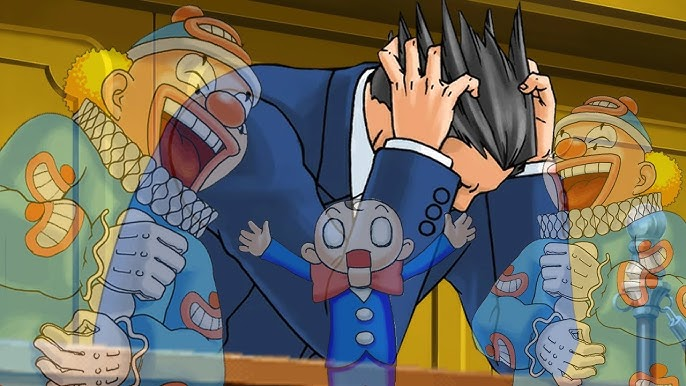
(This image is the thumbnail to this YouTube video of Let’s Play highlights from Duel Screens – which showed up when I Googled ‘Turnabout Big Top’ looking for a header image – which I have not watched because I have not watched anyone else’s comments on this case, because I’m scared they would be almost word-for-word identical to mine, but shorter and snappier and better, thus completely removing any incentive I had to post this. I’m still going to cite my sources though, I’m not an animal. Or James Somerton.)
… But why is it considered the worst case? Is there a radical departure in the gameplay? Is the story not as engaging as it usually is? Is the dialogue clumsier, the puzzles harder, the punishments severer? Well, yes and no; the gameplay is the same, the story and dialogue isn’t great, the puzzles are fine and you do get penalized more harshly. But I’ve rather dishonestly presented this matter, because there’s a very straightforward answer to the question “Why is Turnabout Big Top considered the worst case in the Ace Attorney series?” and that is simply this.
It’s because Turnabout Big Top is – by a fairly comfortable margin – the worst case in the Ace Attorney series.
And since I bought the Phoenix Wright Ace Attorney Trilogy on Steam last year and started replaying it, I figured it would be a good opportunity to answer that question, and take a step closer to fulfilling my lifelong dream of… being cited on the Your Mileage May Vary page on TVTropes in an entry explaining why people think a level of a video game is bad. Keep on reaching for those stars, Dopefish. You’ll get your dream one day.
So without further ado, why does everyone hate Turnabout Big Top?
Ace Attorney: Justice For All – Case 2-3: Turnabout Big Top
Victim
Russell Berry (Ringmaster)
Defendant
Maximillion Galactica (Magician)
Witnesses
Lawrence Curls (Moe the Clown)
Ben Woodman (Ventriloquist)
Regina Berry (Animal Tamer)
Prosecutor
Franziska Von Karma
Opening Statement
Everyone kind of just sucks
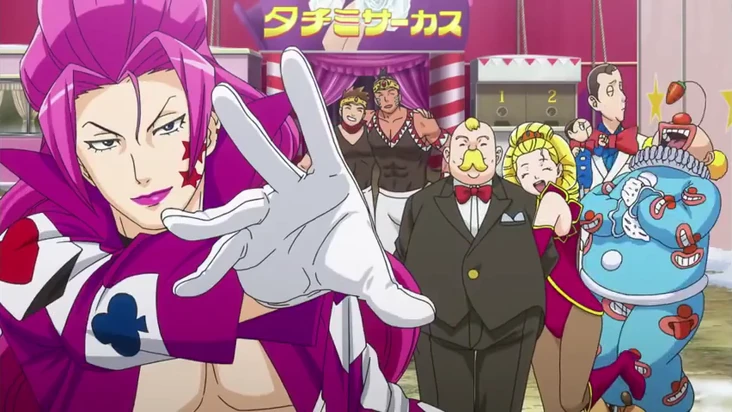
… That’s really it. I think a big part of why everyone doesn’t like Turnabout Big Top is just that… everyone kind of sucks. There’s no character from this case who you would be excited to see appear in the later game – although Regina Berry does show up briefly for a cameo appearance as a witness in Ace Attorney Investigations 2 – because for a franchise known for bombastic, over-the-top, larger than life characters, everyone in Turnabout Big Top kind of just… sucks.
Maximillion Galactica – real name: Billy Bob Johns – is accused of murdering the ringmaster, Russell Berry, and even the case against him isn’t particularly interesting. Ben the Ventriloquist saw someone walking towards the spot where the body was found, and Moe the Clown saw something happen in the dark, but this is pretty tame by Ace Attorney standards. Usually, the defendant is seen holding the gun at the scene of the crime, or the body was found in the trunk of their car. In this case, the evidence against Phoenix’s client is just “Some people vaguely remember seeing someone who could have been him near the place the body was found.”
But hey; that’s just a theory by the prosecution. We’re not focussed on the how and why yet, we’re talking about the characters! And Maximillion Galactica just exudes character. And that character is – in a bold new direction for the series – … asshole.
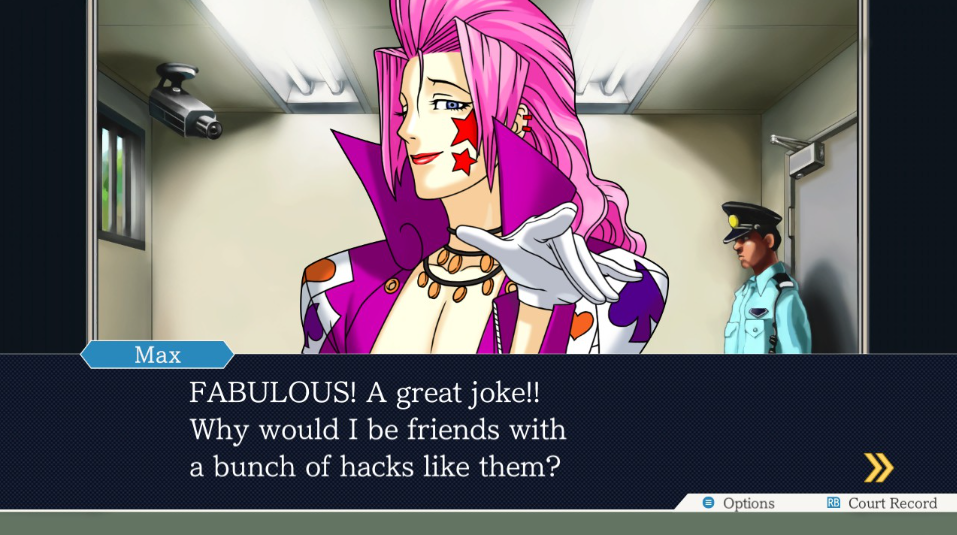
Okay, that might be a little harsh, but Max is the first defendant in the series to notably be kind of a jackass. He’s the number one star attraction of Berry Big Circus, and he knows it, and he constantly flaunts it; he is aware that he is keeping the entire operation in business, and he loves reminding his colleagues of that fact. Max the Clown hates him. Ben the Ventriloquist really hates him. Only Regina likes him, and she likes everyone. But! Ace Attorney characters are known for their hidden depths – for being more than meets the eye – and Max fulfils that criteria too – and not just by occasionally slipping back into his real, Country Mouse voice and sincerely pleading with Phoenix to help prove his innocence – because… he’s an arrogant jerk to the rest of the Berry Big Circus performers, but only because he wants them to work harder and reach the same heights that he has. You see? That’s kind of noble! He’s just like me playing Squad Mode in Fall Guys, yelling at my teammates that if they put the work in, they might even be as good as me someday. And they took my suggestion and said they would play lots of games without me and would not ask me to rejoin them until they were certain that they were up to my standards. And they must be working really hard, because it’s been years and they still haven’t asked me back.
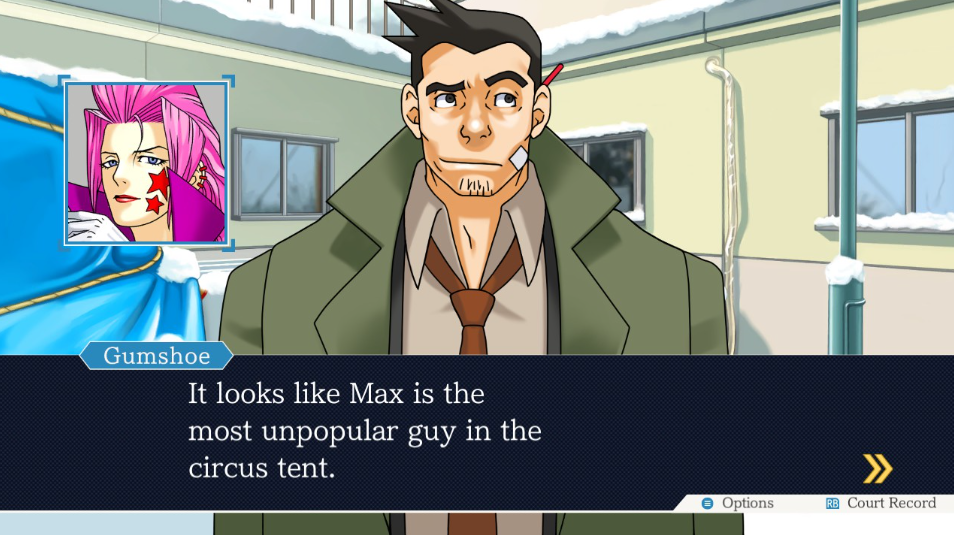
So Max is a jerk, but what about the witnesses? Ben the Ventriloquist is painfully shy to the point where he can barely confirm his name or disclose any information about the case, and on the morning of the murder, Max even bashed him over the head with a bottle in the cafeteria! What a jerk. Of course, Ben is only shy until you find his puppet, Trilo, at which point he quickly reveals himself to be the worst character in the whole case; rude, crude, and one bad dude. And bad in a specific way that we will get to because it deserved its own point.
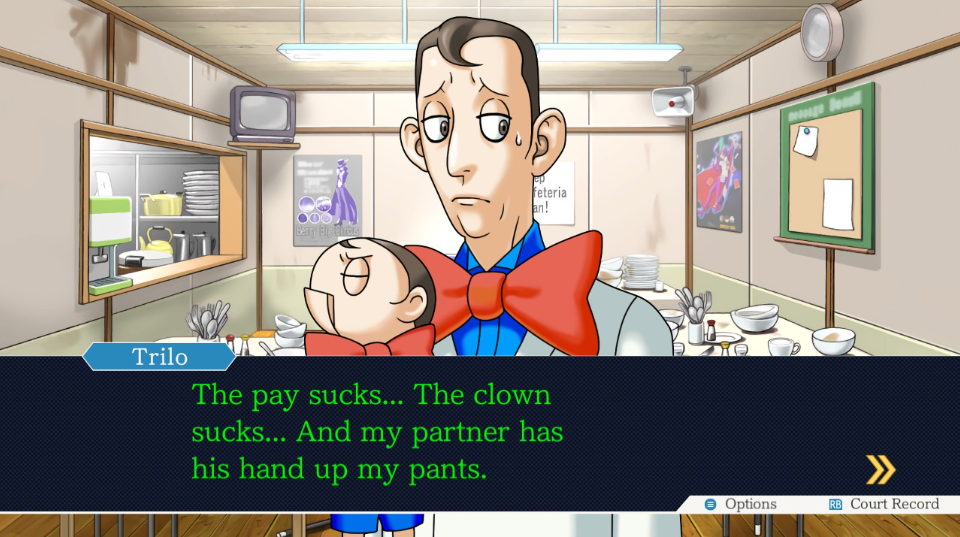
As mentioned before, Ace Attorney is full of larger than life characters, but Ben is a bit of a weird one, because it’s left slightly ambiguous whether Ben is using Trilo to just say all of the things that Ben wants to say but can’t, or whether he legitimately has some kind of split personality thing going on. And the split personality would be taking the gag way too far, but it’s also the only way that the specific thing that we will get to isn’t much, much worse. The point is though, Ben (with Trilo) is kind of a jerk to everyone, generally unhelpful to the case, and it turns out that he barely even half-saw anything relevant, but he – not unreasonably – just assumed that the perpetrator of the murder was Max, on the basis that he hates Max and that Max is a jerk. To be fair, Max had smashed a bottle over his head that morning… because he – through Trilo – was calling Max an untalented overhyped jerk who everyone hates. Which was rude. Not necessarily wrong, but rude.
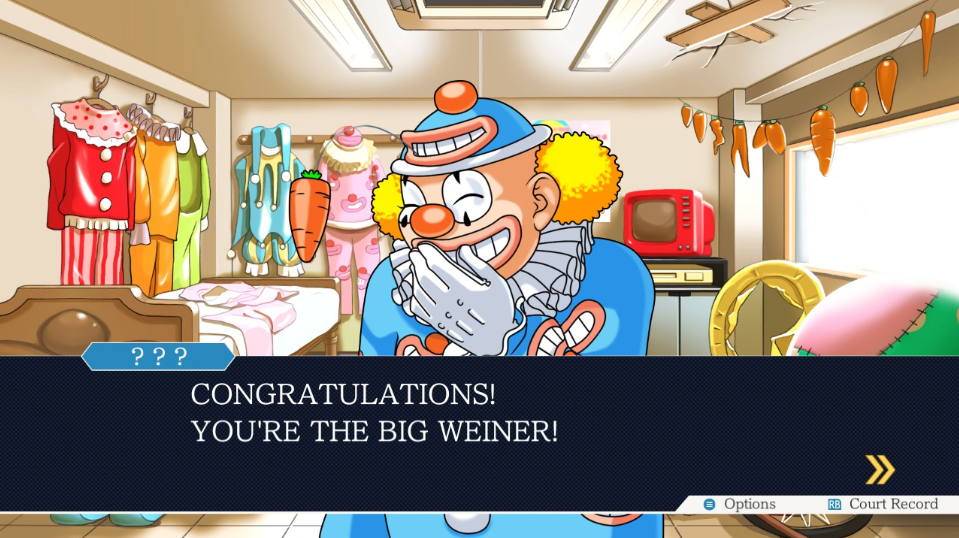
And this brings us to Lawrence Curls, AKA Moe, because why settle for one Three Stooges reference when you can have all three? Moe the Clown is not vindictive at all and genuinely wants to help with the case, having been a long and close friend of the deceased, Russell Berry. The problem is that he’s a clown, and he’s not funny. So every line of dialogue is filled with jokes, but bad jokes. And as a huge appreciator and repeater of terrible puns, you may assume that I have no problem with this, but the thing is… it’s actually very difficult to write a good bad joke. It should make you roll your eyes, but you have to at least work to suppress a grin. Bad bad jokes are just… uh, let me give this a shot. Hey, his name is Moe? What, shouldn’t he be busy running a tavern in Springfield? … Pop culture references are always entertaining and not at all lazy!
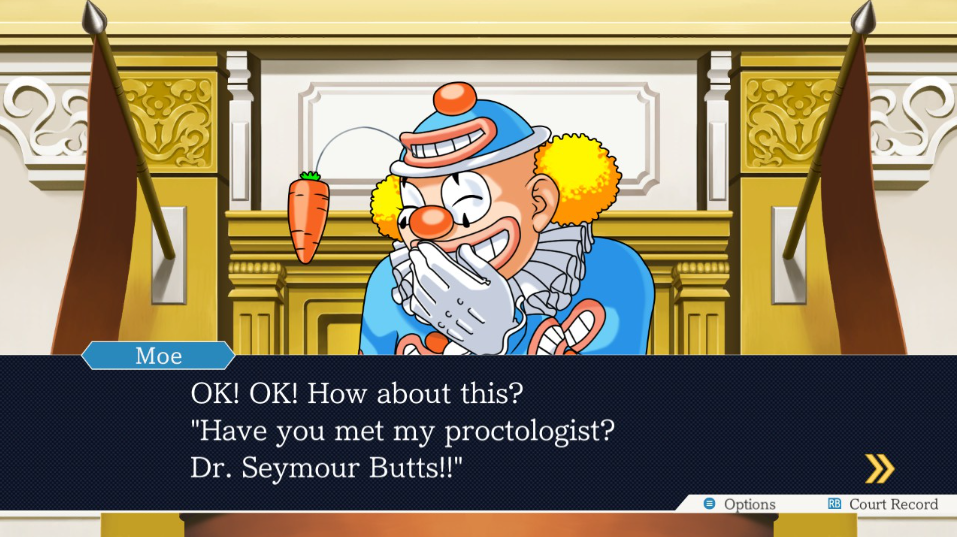
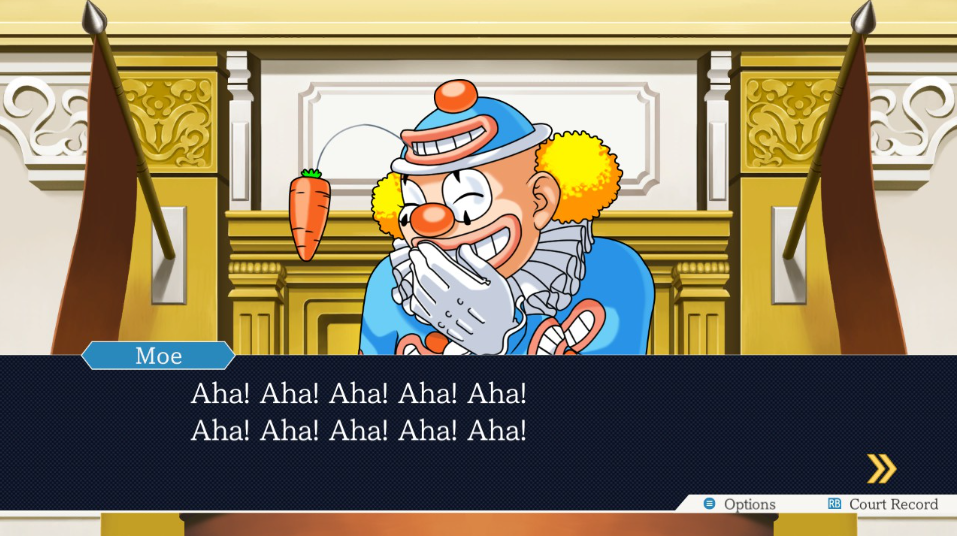
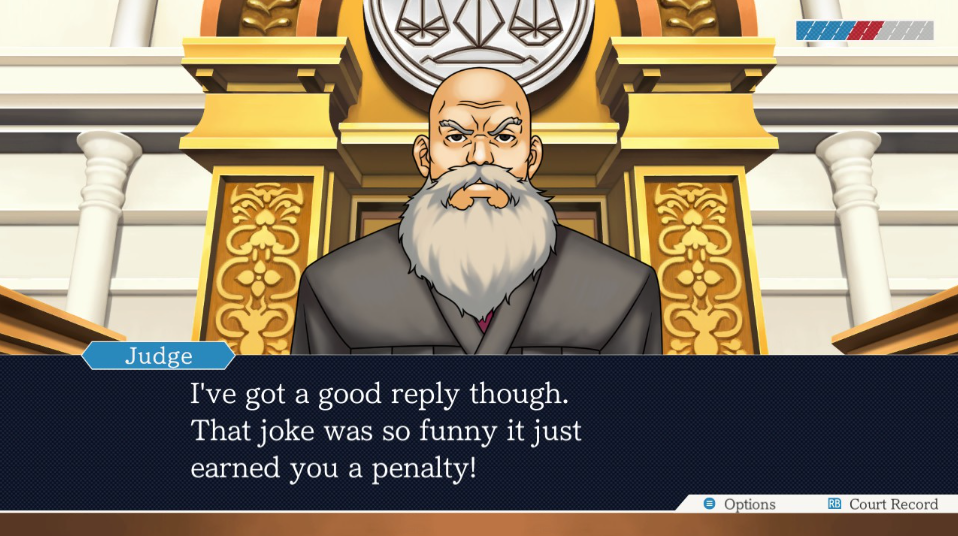
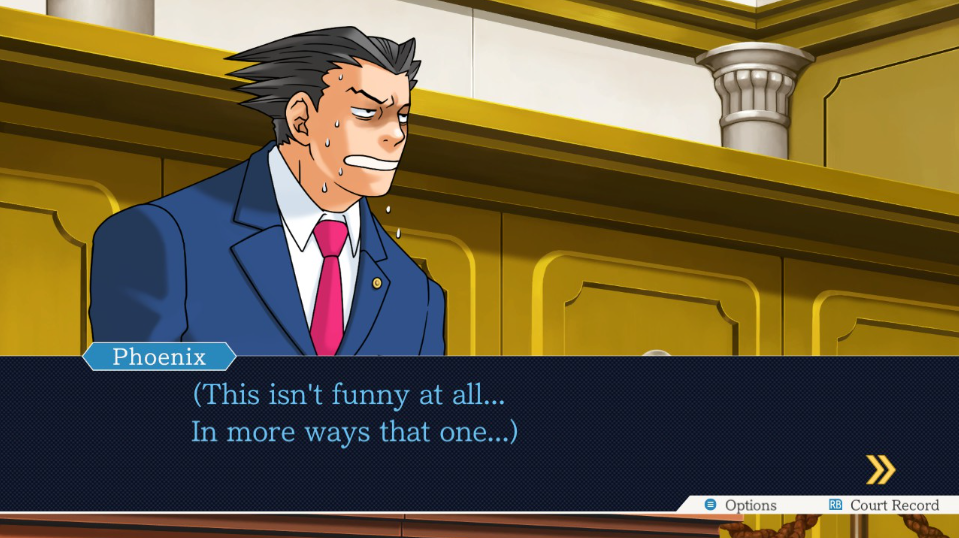
And that brings me to Moe’s Cross Examination on Day One, widely regarded as one of the worst in the series, because the whole point of cross examination is to press the witness for information on what they saw, and you are actively penalized for pressing certain statements from Moe, because he is so annoying that the Judge will issue a penalty for any lines of questioning that don’t go anywhere, solely because he is that desperate not to hear from this guy. And about the third time he gets whipped by Franziska after referencing The Fresh Clown of Bel-Air or The C-Team, you’ll empathize with him. The Judge, not Moe. At the very least, Moe does show the most hidden depths out of the cast, treating the murder of his friend with the utmost sincerity – at least when he isn’t testifying about it – and shocks Phoenix by openly revealing on Day Two that he too has figured out exactly who did it. Thanks, Moe. I would be impressed if your open mic improv hadn’t gotten me three penalties so far.
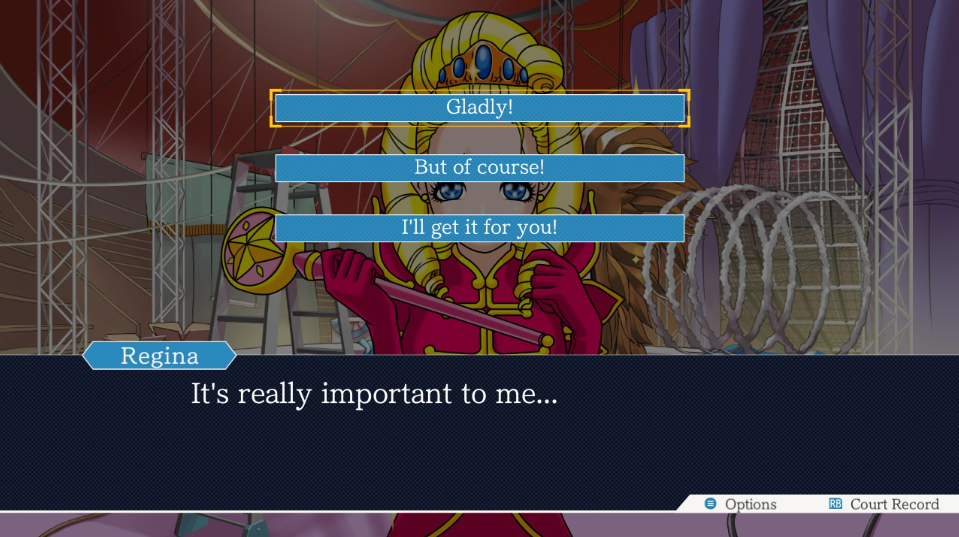
Last but not least is Regina Berry, the victim’s daughter. She is sixteen years old. No idea why I’m putting that bit in bold. I’m sure that fact won’t form an important part of the next point. Regina is… nice, but I italicized that for a reason. Regina is a nice enough person, but she’s also more naive than a song by The Kooks. (… It’s fine when I do pop culture references, okay?) I mean that she’s very friendly and open and wants to help in any way she can – to the point where she doesn’t even seem all that torn up about the death of her father – but she also thinks nothing of setting a tiger on Phoenix and Maya as an amusing way of introducing herself. She’s also sixteen.
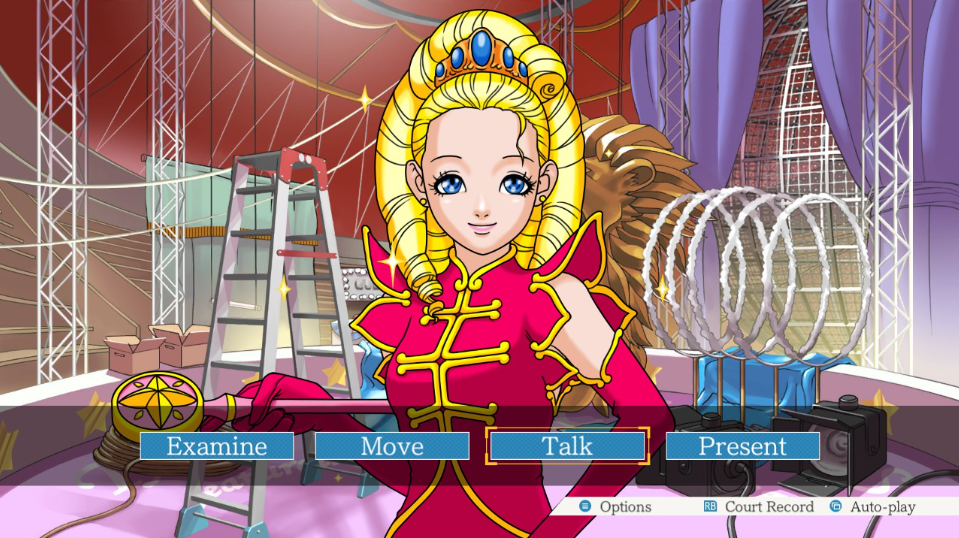
Regina’s primary character trait is how cute she is, and how even Phoenix and Maya end up falling for her charms, which makes her sound a little bit like a femme fatale… but she isn’t, she truly is just extremely innocent and her colleagues and admirers (there is some overlap between Group A and Group B) all find her adorable. And while the constant reminders of how great she is can be a little grating – or great-ing as Moe would say – then it does lead to some moments of comedy.
So… those are the four main characters of Turnabout Big Top. The defendant is a jackass, the first witness is a jackass, the clown’s jokes are so unfunny that you receive penalties on behalf of his behaviour for how he conducts himself in court, and the victim’s daughter is so clueless that you could make an Alicia Silverstone and Paul Rudd film about her. Not a phenomenal cast, but not an awful one either. But it certainly does the case no favours, especially when diving into the second point, which, if you are familiar with the case, I’m sure you were expecting me to bring up.
There’s a love triangle with a 16 year old girl
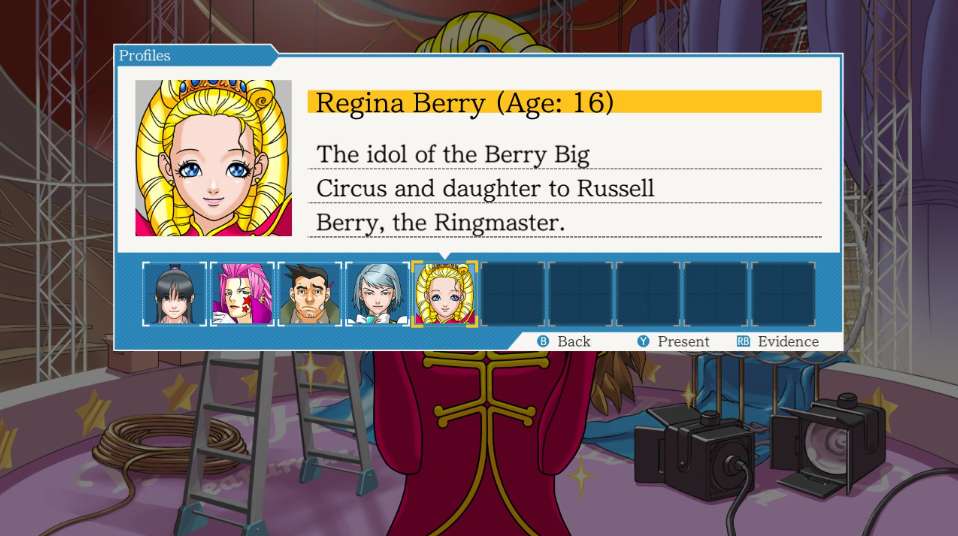
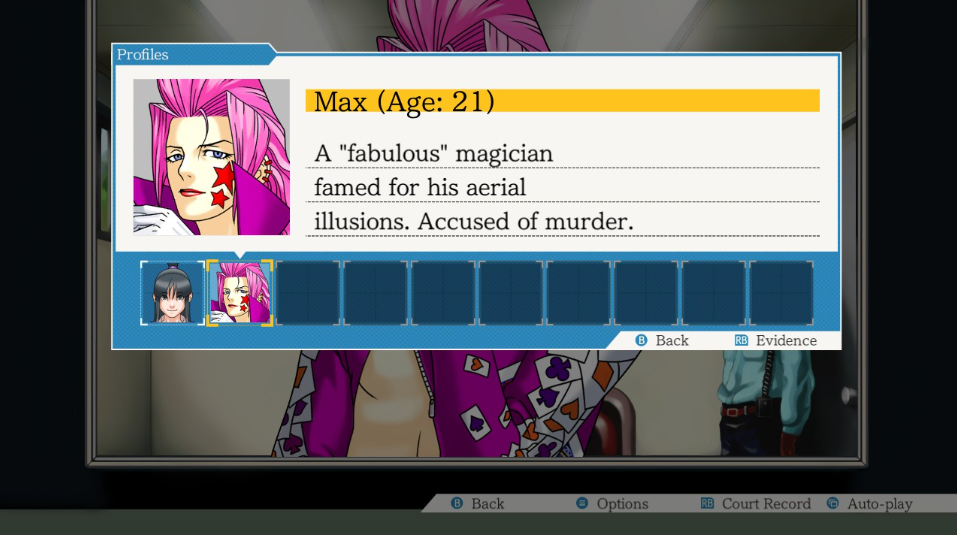
Regina Berry is sixteen years old. Maximillion Galactica is twenty-one years old. Maximillion Galactica is in love with Regina Berry.
Okay, so… ick.
Now, I live in Britishland, which not only means that I have a wonderfully intellectual accent and am obviously a closet racist, but it also means that where I live, the age of consent is sixteen, so there’s nothing legally wrong with this. I understand that in America, the age of consent is also sixteen in most States, but seventeen and eighteen in others. I would like to thank my friends on Discord for answering this question for me – especially the one who was familiar with Ace Attorney and so understood why I was asking – because I really didn’t want my Google search history to contain questions along the lines of “Hey can you tell me the age of consent in every State in America?” I don’t want anyone to mistake me for a Libertarian. I don’t even like South Park.
So Maximillion Galactica is a twenty-one-year-old who wants to date a sixteen-year-old. That’s gross, and just another reason to think he’s a creep, but… you know, he still deserves defending for a murder that he didn’t commit. It’s all legal and above board. And he’s only been with the circus for less than a year at this point, so for all we know, Regina Berry has been sixteen for the entire time that he has known her. It’s still gross, but it would be considerably more gross if it turned out that he had been working at Berry Big Circus for, I don’t know – let’s just pick a random measure of time out of thin air – four years or something. And he had known her since she was twelve. That would be gross. I don’t know why I’m spending so much time going on about something that isn’t the case. Foreshadowing is a literary device in which-
Now, this is all gross and horrible, but it still doesn’t change the fact that nothing illegal has occurred here. And (given the solemnity of the topic, then while it completely ruins the joke, I do feel the need to state in advance that this is mostly set-up for a bait-and-switch) in all honesty and sincerity… it could be worse. Sixteen and twenty-one is, to quote myself from last paragraph, “gross,” but… when people think of ‘the p word’ – Jesus Christ, I really don’t like that I’m talking about this in an Ace Attorney post – then I think most of them think of a guy in his thirties or forties. I really don’t want to talk about this any longer than I absolutely have to – and I especially don’t want to say anything that could be construed as minimising a heinous and disgusting crime – but I think we can all… at least, see the reasoning behind the thinking that a sixteen-year-old dating a twenty-one-year-old is gross and wrong, but a fifteen-year-old dating a forty-year-old is even worse. Right? Right.
Christ, I’m glad that’s over. Anyway, I said that this was a love triangle, didn’t I? So, the other person who likes Regina is Ben-
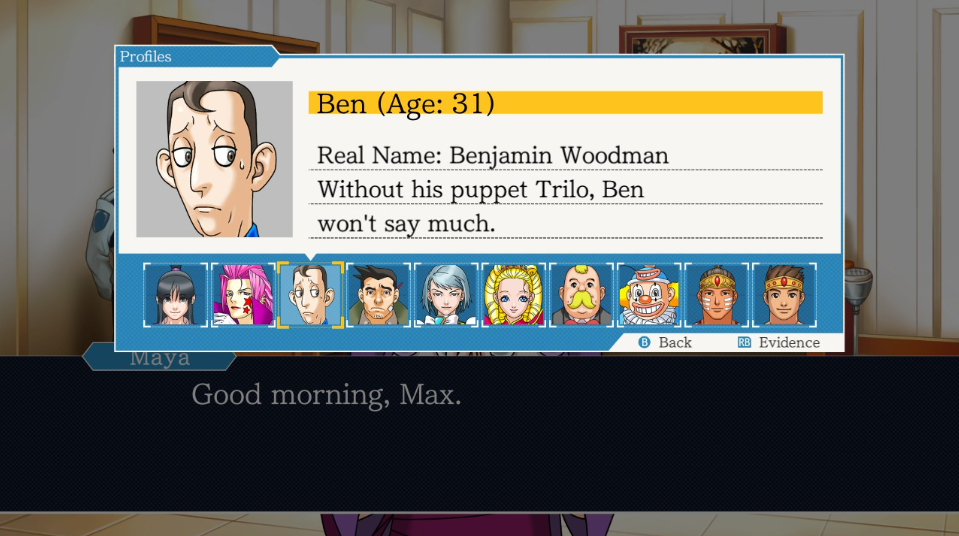
Ben is thirty-one years old.
Okay, so… ICK. Say, Ben. When did you start working at Berry Big Circus again?
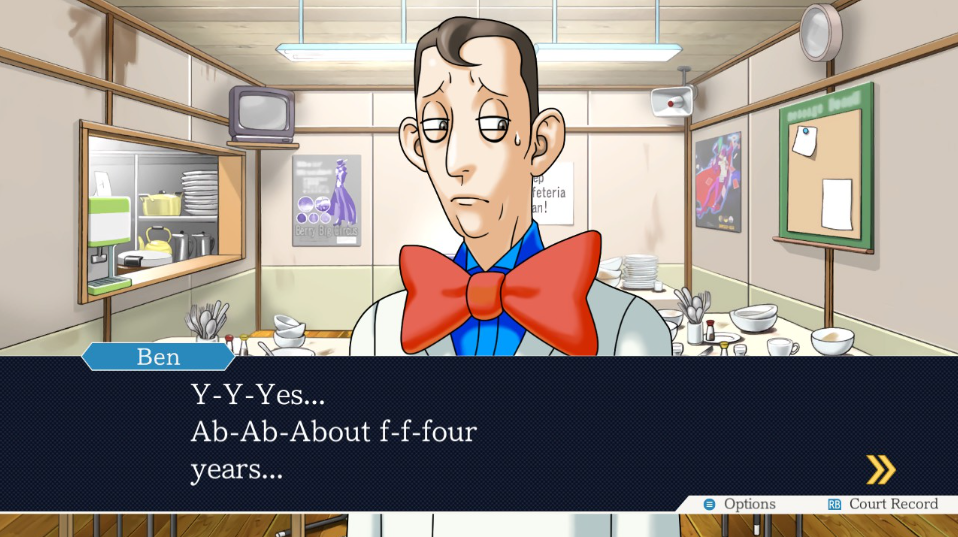
So, when she was twelve. Okay. At least he has the decency to sweat. Say Ben, have you ever been to Pizza Express in Woking?
Anyway… that’s really gross, Ben. And that’s really gross, Capcom. Nobody at the office realised how uncomfortable this was? If Twitter existed in the Ace Attorney-verse then Ben would have been cancelled a long time ago. And Franziska Von Karma would probably retire immediately and go into hiding after discovering how many fan blogs there were from single men and women begging her to step on them. And the most popular of those fan blogs would be named OnlyFranz.
What makes this weirder – in a way which is no less uncomfortable for the player – is that replaying this case really made me question how they were trying to portray Ben when he’s speaking as Trilo. Because if you were to ask Ben, then he would meekly stutter that he’s not really interested in Regina. But Trilo, the puppet, is. Trilo wants to propose to Regina and even had a ring made that was engraved with their initials; T & R. T. For Trilo. Not Ben. So… is Ben, a thirty-one-year-old man, lusting after a sixteen-year-old? Or is this just a bit that he’s really dedicated to? It sounds like the latter is just an excuse for hiding the former, but you do walk in on Ben in conversation with Trilo once, so… um, Ace Attorney is used to straddling the line between “This character is really committed to their one big personality trait,” and “This character might actually be mentally ill,” but I’m not sure that was a great choice when the result in this instance is that Ben the Ventriloquist is either schizophrenic, or– I don’t want to say it, so I’m not going to. But needless to say… ick.
Oh, and it’s actually a love quadrangle because there was an acrobat named Bat who grew up in the circus and was infatuated with Regina, who asked her on a date and-
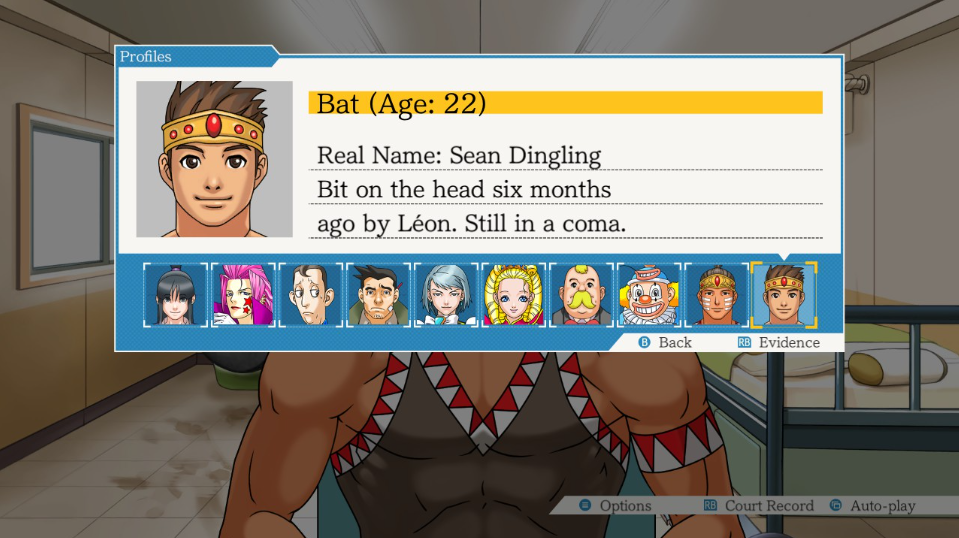
And he joined the circus as a kid, just- fuck it. Hey, Moe? As the only person here not involved in this whole disgusting affair, then I know that you’re thinking about hanging up those big red shoes and becoming ringmaster yourself to keep Berry Big Circus going, but maybe you should just let it die.
You don’t meet the killer until Day 2 (and it’s immediately obvious)

Speaking of Bat! If you have played this case, then you might be wondering “Hey, Dopefish? When you were listing the witnesses earlier on, how come you didn’t mention… you know, that witness? Acro the Acrobat? He’s… pretty relevant to the case, I think you’ll agree!” and then you winked at me, and while I was insulted by the presumption that I had overlooked his presence, then you actually have a very pretty wink and I was flattered and flustered in equal measure.
But anyway, this was actually a cunning plan on my behalf. See, this is an analysis/review of Turnabout Big Top, in which you don’t actually meet Acro the Acrobat – despite his immense importance to the plot – until halfway through Day Two, the last day of the case. So I just thought that it would be thematically appropriate if I completely neglected to mention him until at least halfway through the article.
In case you were wondering who could possibly be behind the dastardly murder of Russell Berry – after all, Moe, Ben and Regina certainly don’t strike you as killers (although Ben might strike you as a different kind of criminal- nope, done with that, moving on,) – then surprise, it’s the guy you meet on Day Two. Just phenomenal storytelling right there. I love trying to solve a murder-mystery when it takes significantly longer than half of the entire case for you to even find out that the character who turns out to be the murderer even exists.
However, Ace Attorney sneakily throws off the scent in order to maintain the surprise. Acro could not possibly have committed the murder… because he is in a wheelchair. Nobody in a wheelchair could do something that bad. Charles Xavier, Bran Stark, Oswell Spencer, the guy from Dr Strangelove; all totally great dudes (I wrote this as an obvious joke before the release of Resident Evil Requiem, and now it’s… nope, no spoilers. It’s just… something.) At least the court gallery have the same reaction that the game seemingly expected you to have, leading to some good lines.
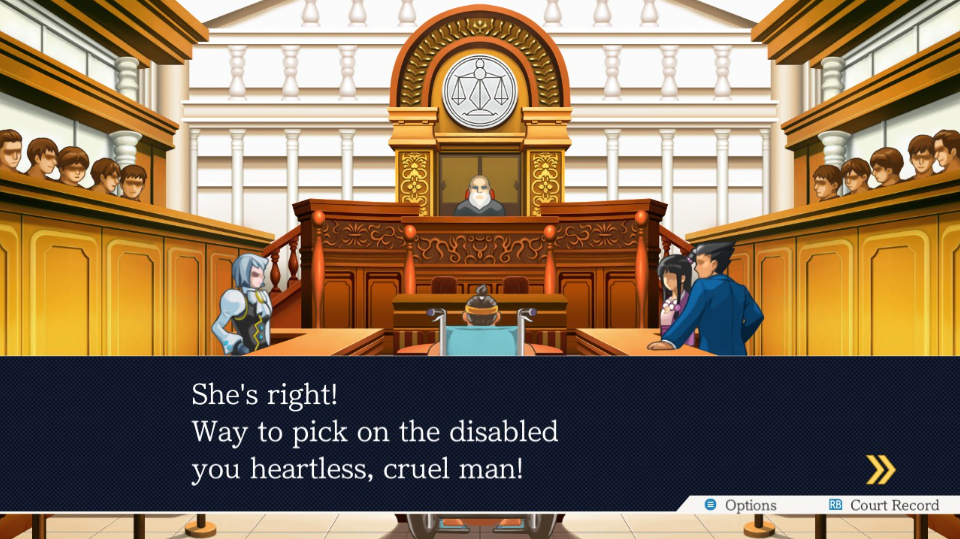
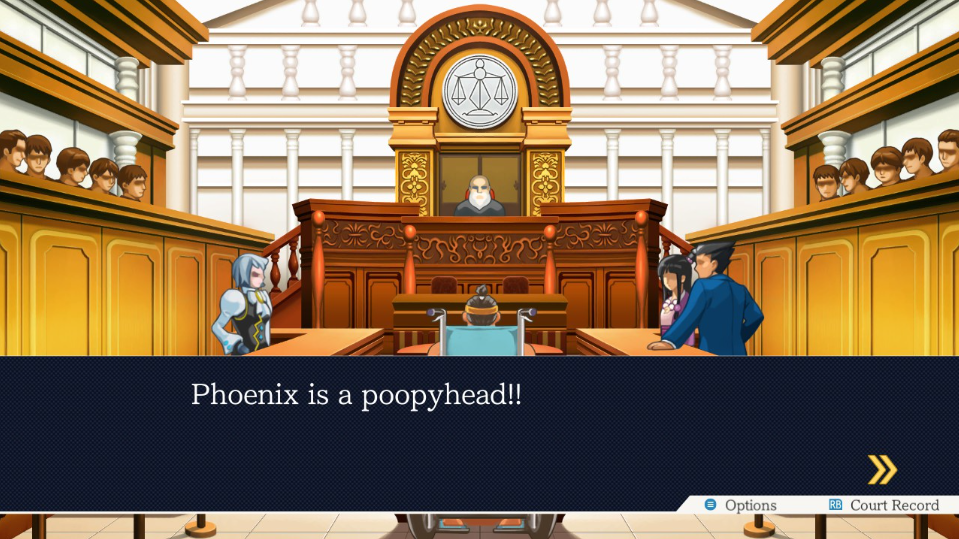
How would someone in a wheelchair even commit a murder anyway? Speaking of which, I haven’t really gone over the details of the murder yet, so here’s what happened. Russell Berry was killed directly outside of the building where Acro’s bedroom is, and there was only one set of footprints leading to his body, and he was killed by blunt force trauma to the head. Almost as if something really heavy was dropped on him from a great height. Also, no-one has found the murder weapon, as if it was then hoisted back up on a rope or something.
…
Okay, so maybe it is Acro. And to be fair, Acro does have one of the most interesting motives in the game, if not necessarily in the franchise. His brother, Bat, is in a permanent coma after an accident – the same one that put Acro in a wheelchair to begin with – that can be traced directly back to the lethal naivety of Regina, who was his actual target. Very shortly after meeting Acro, you will notice that he speaks fondly of basically everyone at the circus… except for Regina, making it even more obvious that he has something to hide, and if someone has something to hide on Day Two of a two-day case, then it’s probably that they’re the murderer.
Acro isn’t a bad character, or a bad murderer, he’s just an obvious murderer. Which is frustrating when you consider that there’s really no reason that he couldn’t have been introduced to you on Day One, because part of what makes him such an obvious murderer is that he’s sprung on you at the last minute. Everyone else has no motive and very little means and opportunity, so of course the new character you’ve just met and is pulling a Sam Reich “I’ve been here the whole time!” is going to jump straight to the top of your list of suspects. It could have been a genuine surprise to find out that it was Acro, but instead, he’s about as shocking a murderer as the killers who are explicitly shown in the opening animation of the case to be the murderer.
Imagine if the player met Acro right away on Day One with the rest of the crew, and he was genuinely nice and seemed to be telling you everything that he knew, and he concealed his vendetta against Regina for just long enough that it wasn’t immediately obvious that he had something to hide. I think there would still be some suspicion cast his way because… being in a wheelchair makes it seem as if it very clearly can’t be him, which in any murder-mystery story is a good indicator that it is him, but as it stands, his introduction just as the case is coming to a close may as well have been accompanied by a flashing neon sign declaring “IT WAS ME, I AM THE MURDERER.” And that’s not a phenomenal recipe for a case in a video game where the fun comes from finding out who the murderer was.
Third Case Syndrome
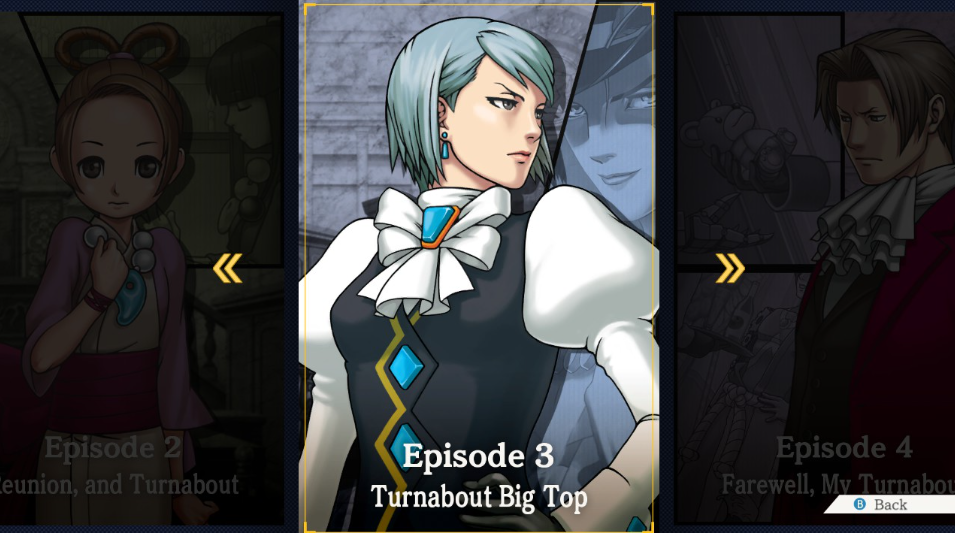
Turnabout Big Top is the third case in an Ace Attorney game that only has four cases, and I have a little theory about Ace Attorney that I would like to share with the class; I think that the third case in Ace Attorney is almost always the weakest part of the game, and I would like to take this opportunity to explain why, because it is for very unusual – and frankly coincidental – reasons.
Firstly, we need to talk about the other cases in Ace Attorney games. The first case always takes place solely in the courtroom, at the trial, to serve as a kind of tutorial for just the evidence-presenting and finger-pointing bits. As a result, these cases are usually not difficult at all – I mean, you literally solve the entire case in one session by just looking at the evidence that is available at the time; usually just the autopsy report, the suspected murder weapon, and maybe a photo of the crime scene – but they are short and snappy, and you can hardly begrudge them their easiness, because… they are the first cases of the game. Everybody has to start somewhere.
The second case is also a tutorial of sorts, because it’s the first trial to involve investigation as well as a trial, and so you’ll be exploring scenes, searching for clues, interrogating witnesses, and so on and so forth. These are also cases that take place over more than a single day, leading to multiple investigations, cross-examinations and courtroom sessions. Still technically in the tutorial phase of the game, but these cases are fun, and the game has no problem throwing more challenging questions at you by now.
Skipping ahead to the fourth case; there’s a lot of variance here. In Justice For All and Apollo Justice, Case Four is the final case of the game, so obviously a lot of drama there. In Trials and Tribulations, Dual Destinies and Great Ace Attorney 2, the fourth case leads directly into the fifth and final case, often as part of a storyline so big that it requires two cases to tell it all. In Spirit of Justice and Great Ace Attorney 1, Case Four is something of a palette cleanser before excrement hits the fan in the finale. Phoenix Wright: Ace Attorney is a weird one to try to explain, because case four is the finale – wrapping up the ongoing Phoenix and Edgeworth storyline – but the DS game then added an extra fifth case as a second finale, and it doesn’t undercut anything and is actually even more amazing. The point is, the fourth and fifth cases are where drama is happening.
So where does that leave Case Three?
Case Three never has any relevance to the overarching plot. … Except in Great Ace Attorney 1, but even then it’s only part of a sub-plot that is only tangentially related to the real main plot. And I’m honestly not sure where to put any of Ace Attorney Investigations in this theory. But in the main plot, Case Three has no relevance… and yet it’s also the point where the cases are as long as they’re ever going to be. Case Three of Phoenix Wright: Ace Attorney – Turnabout Samurai, the introduction of Will Powers and Wendy Oldbag – is three days long, with three investigations and three trials, and it really feels upon replay that they could have easily narrowed it down to just two. I think Turnabout Samurai is the only Case Three to ever take three days, because they realised that it was dragging on a bit.
But going back to Cases One and Two; they’re not just tutorials, but also introductions. Introductions to the characters you’re going to meet in this game; usually important, recurring names. The Prosecutors; Edgeworth, Franziska, Godot, Klavier Gavin, Simon Blackquill. You meet these characters, and your relationships with them are established – although the pay-off to that set-up does not occur until whenever the final case is, and you know that – and you get to know how they operate, inside and outside of the courtroom. And then there’s Case Three, where… they just repeat that.
Let’s use Phoenix Wright: Ace Attorney as a spoiler-heavy example. Case One; holy shit, it’s Ace Attorney! This is awesome. My very first trial! Case Two; holy shit, it’s my first investigation, plus meeting Maya Fey and Miles Edgeworth and Dick Gumshoe! Case Three; you are also here. Case Four; holy shit, it’s the finale of the Wright/Edgeworth plot and you take down Manfred Von Karma and solve a fifteen year old murder! (Somewhere, that obnoxious magician and creepy ventriloquist just heard ‘fifteen year old’ and their ears perked up like meerkats.) Case Five; the holiest of shits, the chief prosecutor is charged with murder and you solve the case, and uncover a murder/forgery/blackmail plot from two years ago implicating the Chief of Police himself!
So… you can see how Case Three just doesn’t really compare to the rest, right? And it seems to be the same in every game. If you had to rank cases by how forgettable they were, how irrelevant to the plot they are, and how little you would miss them if you absolutely had to remove one case from the game, then it’s pretty much always Case Three. … Except maybe in Apollo Justice, where Case Two isn’t that hot either. But overwhelmingly, Case Three is the ‘I don’t really care all that much’ case. And hey; that doesn’t guarantee that Turnabout Big Top is bad! It just means that it has a steep hill to climb. And that hill only gets steeper when you recall-
Justice For All was already the worst game of the trilogy
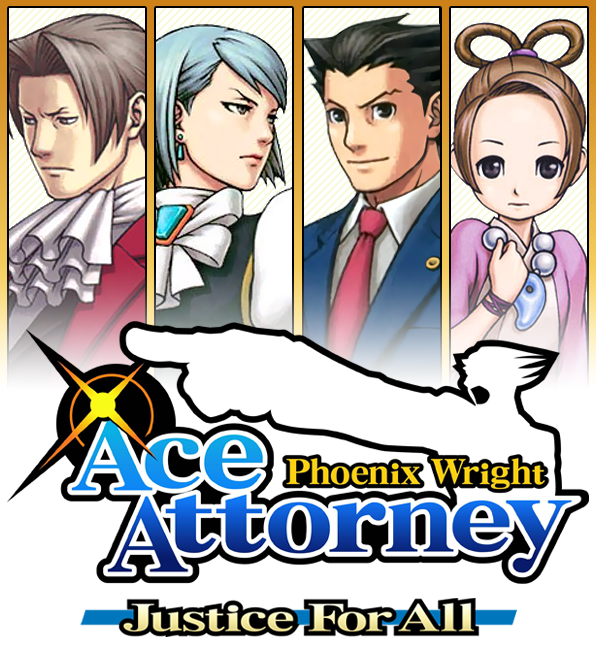
If you have ten delicious pizzas in front of you, and you have to rank them all, then one of them has to be last. Doesn’t mean that it’s not still delicious! It just means that it was the least-delicious out of all of the options available. And Ace Attorney: Justice For All is probably the worst – and the least-delicious – Ace Attorney game. It’s definitely the worst of the original trilogy. I mean, it’s the only one that has four cases instead of five, and one of those cases is Turnabout Big Top!
Justice For All hits all the same plot points as the other two games – I don’t mean identical plot points, that would be bad… er, worse – but they’re not quite as good. Your prosecutor this time around is Franziska Von Karma – not bad, but easily the worst prosecutor of the trilogy by a country mile – intriguing new characters introduced include Pearl Fey, Maya’s little sister who can also channel spirits, and Maggey Byrde, a plucky detective with hopelessly bad luck who doubles as a love interest for Dick Gumshoe, and the overarching plot of the game is THIS VACANT SPACE CURRENTLY AVAILABLE TO RENT.
It is for these reasons that Ace Attorney: Justice For All has an abysmal Metacritic rating of… 76/100; the lowest of any game in the series. Placing it just above Chibi-Robo and Sonic Mega Collection (75/100) and just below Rayman 3 and I-Ninja (77/100.) Yes, I went to Metacritic to look exclusively at GameCube games to make this comparison, and it was there that I saw that Spider-Man – the first movie tie-in game – is sitting pretty at 76/100 as well, and now I am incoherent with equal parts confusion and rage and forgot whatever point I was trying to make.
Anyway, Ace Attorney: Justice For All is… fine. It’s better than fine, it’s good! If Justice For All was the only Ace Attorney game to have ever been made, then a) I would be extremely confused at how they just threw this ‘spirit-channelling’ thing on us with no warning, b) I would be clamouring for more! I would be begging for Capcom to give one of the most overlooked games in history a sequel! And once they had made Asura’s Wrath 2 (if only so we could get a rematch to the worst episode of Death Battle in seven years,) then I would have asked them to do the same thing to this tragically underdeveloped Ace Attorney series as well.
But the fact remains; this isn’t the only Ace Attorney game. It’s part of a trilogy. And it’s the weakest entry by far. And allow me to repeat one of the primary complaints about this game; there’s no overarching plot to get invested in.
In Phoenix Wright: Ace Attorney, the second case introduces you to Miles Edgeworth, Phoenix’s old school friend who has now become a prosecutor and seems cold, distant, aloof and ambivalent to the truth. Finding out what happened to make him that way – and defending him from a false murder charge orchestrated by the man responsible – forms the core emotional arc of the entire game, and this even extends into Case Five – added for the DS release (you’d be forgiven for not knowing that Ace Attorney started life as a Game Boy Advance game; Japan-only, of course) – in which you can see the man who Miles Edgeworth is becoming after the events of the last case have wrapped up. And also, it turns out the Chief of Police is crooked and you have to take him down. Fun!
The overarching arc of the third game revolves around Dahlia Hawthorne, lifelong (and deathlong) rival of Mia Fey – Phoenix’s mentor – who was murdered in the first game but frequently comes back via spirit-channelling to offer words of wisdom, or to help flirt information out of that one old pervert in Recipe for Turnabout. Dahlia’s machinations – even after her own death (caused by Mia when Dahlia is given the death penalty for trying to pin a murder on a young Phoenix Wright) – cause trouble for the entire Fey clan, from Mia, Maya, Pearl, Morgan, and even Mia & Maya’s estranged mother Misty. The final case involves just about every major character – Phoenix, Maya, Mia, Edgeworth, Pearl, Larry, Gumshoe, Franziska, Misty, and Dahlia herself – in an important role, and Dahlia is finally defeated for good… inasmuch as someone who is already dead can be defeated.
In Justice For All, the overarching plot is…
…
Okay, so there is no overarching plot… but in two ways. The first way is that I don’t think that something can qualify as an ‘overarching’ plot if it’s first mentioned at the end of Case 3. Of 4. And resolved in a cutscene immediately afterwards, and then expanded upon on the first day of trial on Case 4. Maybe my definition of ‘overarching’ is different to everyone else’s, but that just doesn’t qualify for me. But even if it did, the second problem is that… there’s no plot in this plot. The alleged plot is that Phoenix talks about Edgeworth as if he died or something, but he really just took a gap year to discover himself. But Phoenix mystically talks about him as if he’s gone, even describing him as ‘dead’… with such gravity that you would be forgiven for expecting him to leap out from behind curtain and explain “That’s right; dead serious about going to Itchy & Scratchy Land!”
It turns out at the end of Case 3 that Edgeworth is alive, and he comes back to prosecute for the final case, which is about an actor who hired a hitman to kill his rival. … Cool, I guess. It is a fun case; namely because the actor is your client, and he does a really good job of coming across as a ditzy celebrity idiot, providing you with a morally complex situation (due to him also ordering the kidnapping of Maya to ensure your cooperation) in which Phoenix is tasked with defending a client who he knows – after day one, at least – is guilty! But… as unique of a case as it is, it’s not the end to an arc. It is just a small, self-contained arc. The closest thing to character development comes from Franziska Von Karma helping out a little, which-
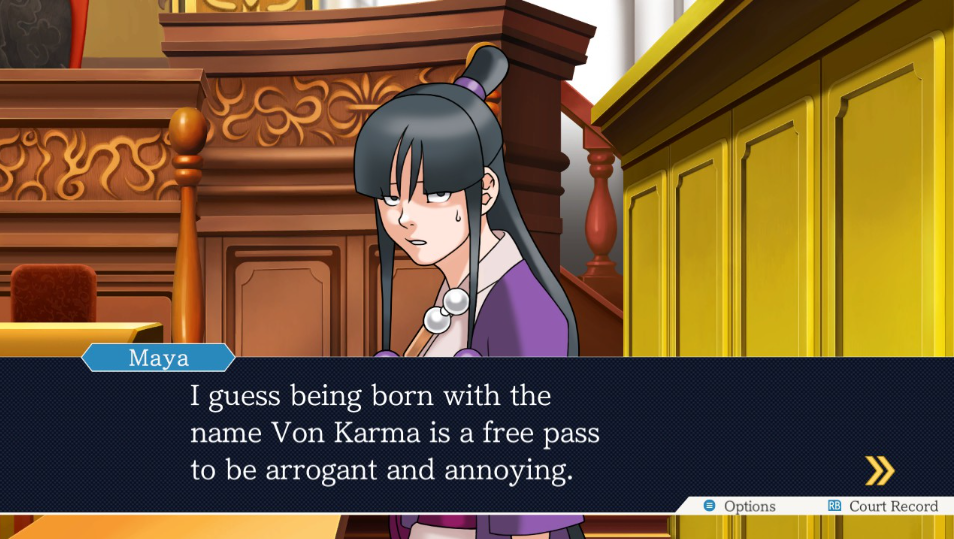
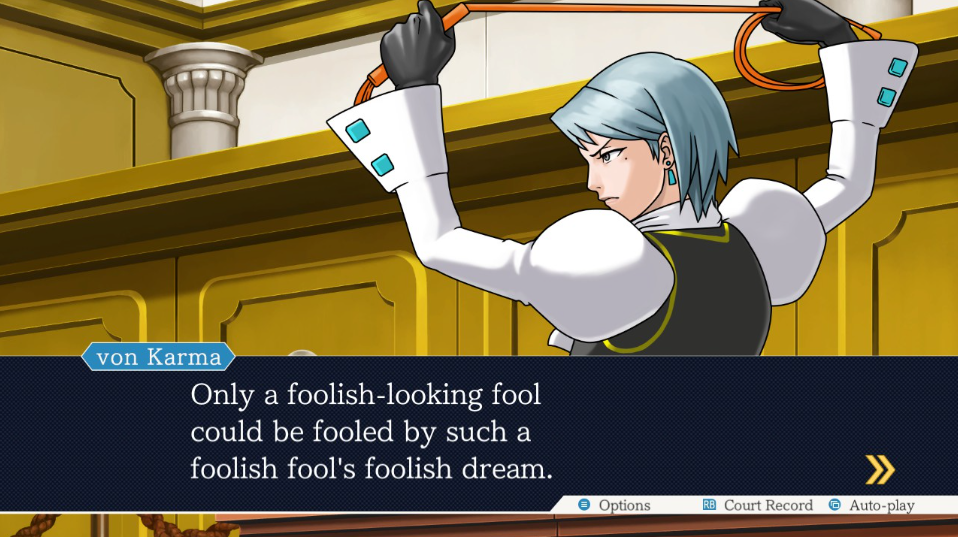
Sorry Franziska, but you are the worst prosecutor in the trilogy. Edgeworth has a personal connection to Phoenix, and so does Godot in Trials and Tribulations – although Phoenix doesn’t know it – but Franziska is just Miles’ kind of little sister (daughter of the man who adopted Edgeworth and SPOILERS he was a bad guy) and she’s mad at Phoenix for besmirching the Von Karma name, but the closest thing we get to a plot twist is that she’s protective of the Von Karma legacy – i.e. being a really good prosecutor – more than she’s upset about the actual arrest of her father, who she acknowledges was a dick. But… so? That’s no reason for her to hate Phoenix, until she suddenly helps to deliver a vital piece of evidence in Case 4 and… respects him now or something. It’s not a bad story, but it’s not a very compelling one compared to other prosecutors in the series. At least her verbal tic of trying to work the word ‘fool’ into sentences as frequently as possible is entertaining.
And while I feel this is rather petty, it would be dishonest for me to omit this, even if it’s a very minor complaint; the ‘Cornered’ music in Justice For All is by far the worst one of the trilogy. The triumphant music that plays when you finally nail down the tricky bastard on the stand who has been dodging your accusations and threatening to get away with it is finally going down, and this is the music that plays in Phoenix Wright: Ace Attorney. It’s so great that I would not find it hard to believe that the entire game was designed solely around this one piece of music, designated for that moment of triumph.
Trials and Tribulations is a little bit of a step down, but still decent. And to be fair, in the final Objection! of Case 5 – Bridge to the Turnabout – then the original tune begins to play again, and it’s more effective than ever. 10/10, fantastic culmination to the trilogy using the most iconic tune from the original game.
And Justice For All is… fine?
I don’t like it. I don’t get it. It doesn’t fit the mood for me at all, honestly. It doesn’t sound like a victory, it sounds like something that plays when you walk into a dungeon filled with enemies in an RPG and the challenge is just beginning. It doesn’t sound like the culmination of… anything, really. Not a good musical choice, I would say.
I understand that these are fairly basic complaints – no overarching narrative to get invested in, uninteresting prosecutor… bad Cornered music – but remember, Justice For All is still a very good game. These faults don’t seriously ruin anything, they just make the entry ever so slightly more noticeably… not as good in comparison with other entries in the series. And I think that might be the final reason Turnabout Big Top is not very well-respected; it’s not just the worst case, but the worst case from the worst game.
Verdict: Guilty of Being the Worst Case.
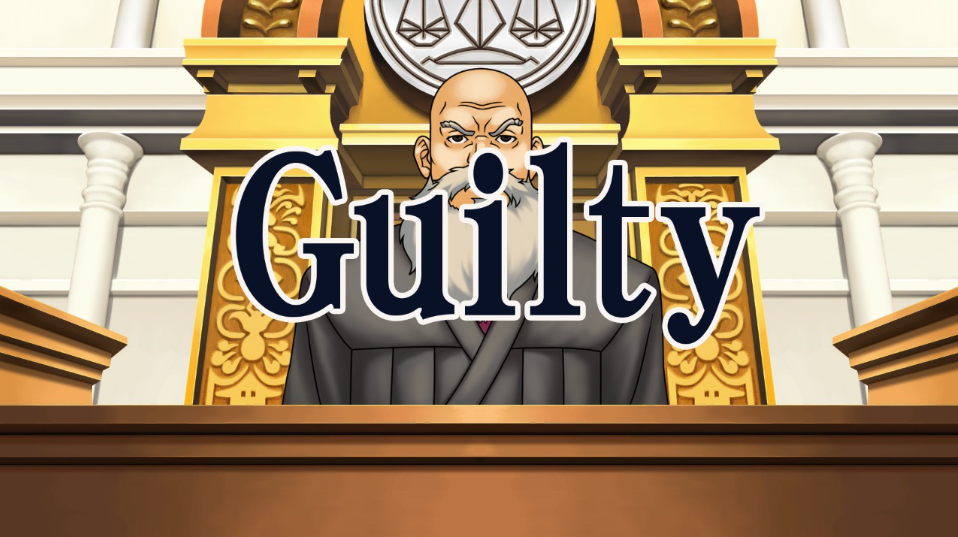
Turnabout Big Top is not a very interesting case. None of the characters are likeable or memorable. The gameplay is made slightly more annoying than usual because you are punished for trying to cross-examine a witness. The killer is invisible on Day One, and obvious on Day Two. Franziska adds nothing to the experience. It provides no contribution towards the overarching story, which also – for the most part – doesn’t even exist. It’s forgettable and bland and if you had to remove one case from the original Ace Attorney trilogy without having a serious effect on the rest of the plot, you could safely delete this one and almost nothing of value would be lost. It’s the worst Ace Attorney case in the worst Ace Attorney game.
Verdict: Not Guilty of Being Bad
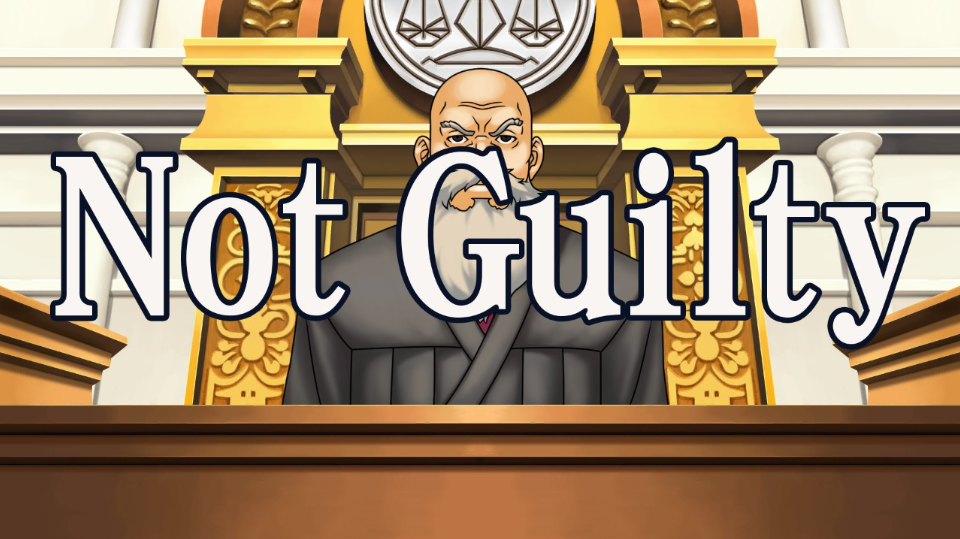
… But the worst Ace Attorney game is still pretty good. And the worst case in it is still… fine. Cue the confetti!
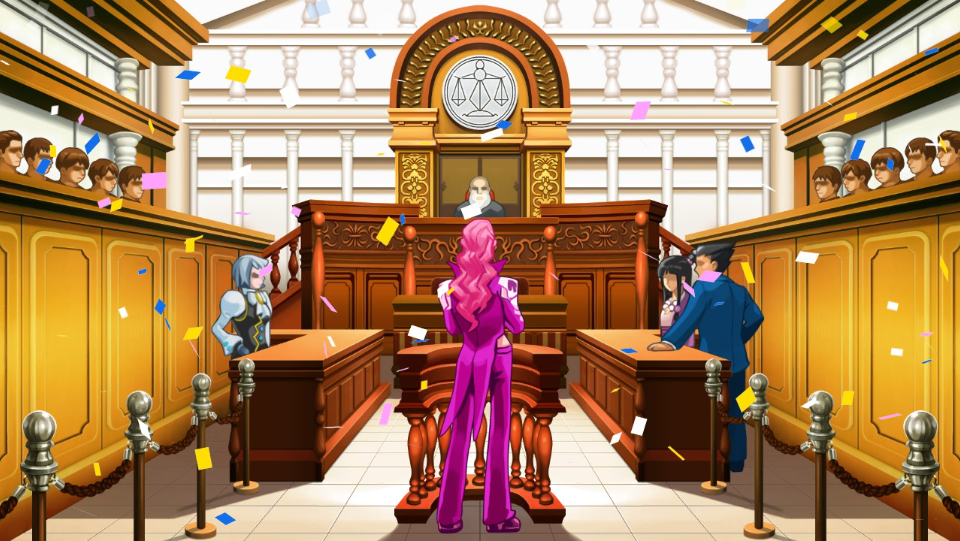
Turnabout Big Top isn’t just mid or forgettable, but also a testament to how good the series is that this is their low point. A case that is still entirely… passable. That doesn’t sound like a compliment, but it genuinely is; if you look at the low points of any other video game series, any TV show, any film franchise, you are bound to find at least one stinker. Not just a slight misstep, but something outright crap. The Water Temple. The Sand Snakes. Kratos VS Asura. So many series have an entry that just fucking sucks, and… THIS is the worst that Ace Attorney could do?
It’s still good!
Even though the cast are annoying, the mystery isn’t much of a mystery, and the game isn’t the best, it doesn’t change the fact that interrogating suspects, uncovering the truth, and pointing out contradictions on the stand is still fun! Even when you’re being unfairly penalized because the witness is a clown specializing in awful, awful jokes. (I can sympathise with that… to an extent.) I mentioned before that if Justice For All was the only Ace Attorney game, I would be clamouring for more, but that’s underselling it; if Turnabout Big Top was the only Ace Attorney case ever released – as a demo of some kind, presumably – then I would also be begging for more. Because the concept works, and it works so well in fact, that even the absolute worst, lowest-quality, bottom of the barrel, scraping the barrel – it’s kind of weird that there are two metaphors concerning low quality involving barrels, do you think a poet had a grudge against a barrel-maker a long time ago or something? – lowest low point of the series… is good. It’s still good.
None of this is to walk back anything that I said earlier – it’s the least-good, that’s for damn sure, and there are a lot of easy ways that it could have been made better (introduce Acro from the start, don’t get penalized for Moe’s crappy puns, age up Regina for Christ’s sake) – and I hope Capcom learned from the mistakes that they made with this one… but I have to hope that they’re at least a little bit proud on some level (they have a lot to be proud of… and on the other hand, they also have Resident Evil 6) that this was the worst of the worst when it came to Ace Attorney… and it was still decent.
I also hope that my desperate pandering in some way contributes to the next Ace Attorney game being announced/released quicker, because The Great Ace Attorney Chronicles was 2021 – itself a compilation of two games released in 2015 and 2017 – so… we’re coming up to a decade with no new Ace Attorney content; please! Please, Capcom! I’ll take anything! I’ll take a whole compilation rerelease of nothing but variants of Turnabout Big Top! I’d really rather you didn’t, because it’s the worst of the best, but the worst of your best is a hell of a lot better than some people’s best of worst.
…
Seriously, who made Ben 31 though? Who decided to- never mind, goodnight everybody!
Thanks for reading!
-Dopefish


